A Ngorongoro Crater safari is a guided game drive across the floor of a collapsed volcano in northern Tanzania, where black rhino, lion, elephant, buffalo and flamingos share a grassland bowl of about 260 square kilometres. Most visitors arrive by road from Arusha on a northern circuit safari and get one descent of about six hours per vehicle. The crater lies inside the Ngorongoro Conservation Area, a UNESCO World Heritage Site shared with Maasai herders.

If this is your first Tanzania safari, the crater is where the wildlife feels close and almost certain, and it rarely needs more than a morning. This guide covers the crater itself, what lives on the floor, the fees and the six hour rule, the choice between a day trip and a night on the rim, the best months, lodges, the rest of the conservation area, and how the crater fits into a longer trip. To test dates and a route as you go, our Plan Your Tanzania Safari page has a trip builder and a migration month planner.
Ngorongoro Crater Safari at a Glance
The crater has its own authority, its own tariff and its own rules, which is why so many first time visitors find the planning confusing. The basics fit in one table.
| Item | Ngorongoro Crater |
|---|---|
| Location | Northern Tanzania |
| From Arusha | About 180 km |
| Managed by | NCAA |
| Crater floor | About 260 sq km |
| Wall height | About 600 m |
| Rim altitude | About 2,300 m |
| Conservation area | About 8,292 sq km |
| Time on floor | About 6 hours |
| Gate hours | About 6am to 6pm |
| Adult entry | US$70.80 per 24 hrs |
| Crater fee | US$295 per vehicle |
| World Heritage | Since 1979 |
A word of honesty before the detail. The crater is busy. It is small and spectacular, and every northern circuit itinerary wants a piece of it, so at a lion sighting in August you may count fifteen or twenty vehicles. People who know this in advance tend to love it anyway, and the sections below explain how to get the quiet hours.
Ngorongoro Crater Facts: How the Caldera Formed and Why the Animals Stay
Ngorongoro is the largest intact, unflooded volcanic caldera on earth. It formed between two and three million years ago, when a large volcano collapsed in on itself; geologists think the original mountain may have stood close to the height of Kilimanjaro. What remained was a sealed bowl about 19 kilometres across, with walls rising roughly 600 metres from the floor to a rim at around 2,300 metres.
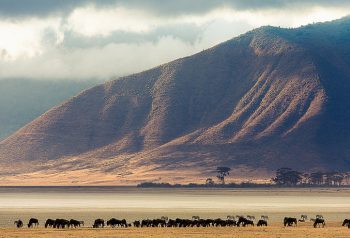
That shape explains a Ngorongoro safari. The bowl holds permanent springs, swamps and a soda lake, so the grazers have water and grass all year and do not migrate. The figure most often quoted is around 25,000 large animals on the floor, mostly wildebeest, zebra, buffalo and gazelle. Treat it as an estimate that rises and falls with rain and grazing, not a census. In practice it means you rarely drive more than a few minutes without something to stop for.
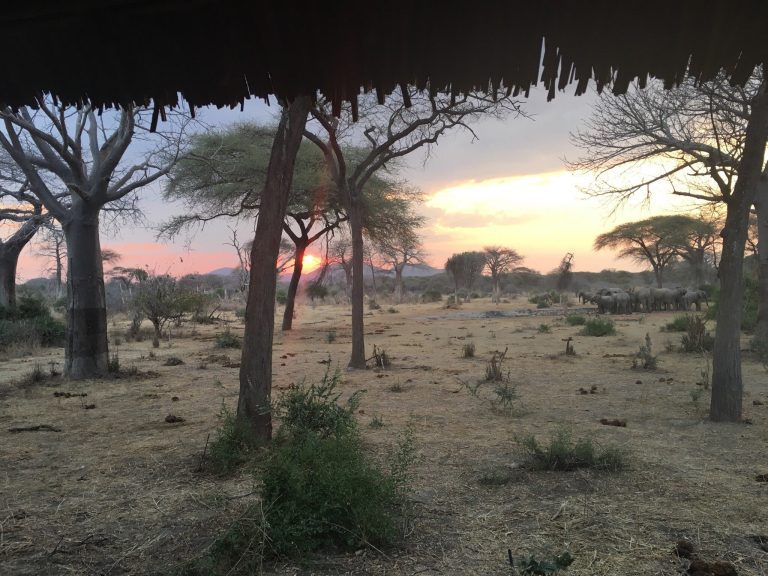
The rim has its own weather. At around 2,300 metres it catches cloud from the east, so mornings up top are often misty, damp and cold while the floor below sits in sunshine. The rim forest is wild too: buffalo and elephant walk the lodge driveways after dark, which is why rim lodges escort guests to their rooms at night, and leopards are seen on the forested rim road more often than on the open floor.
The Crater Floor Game Drive Safari: What You See
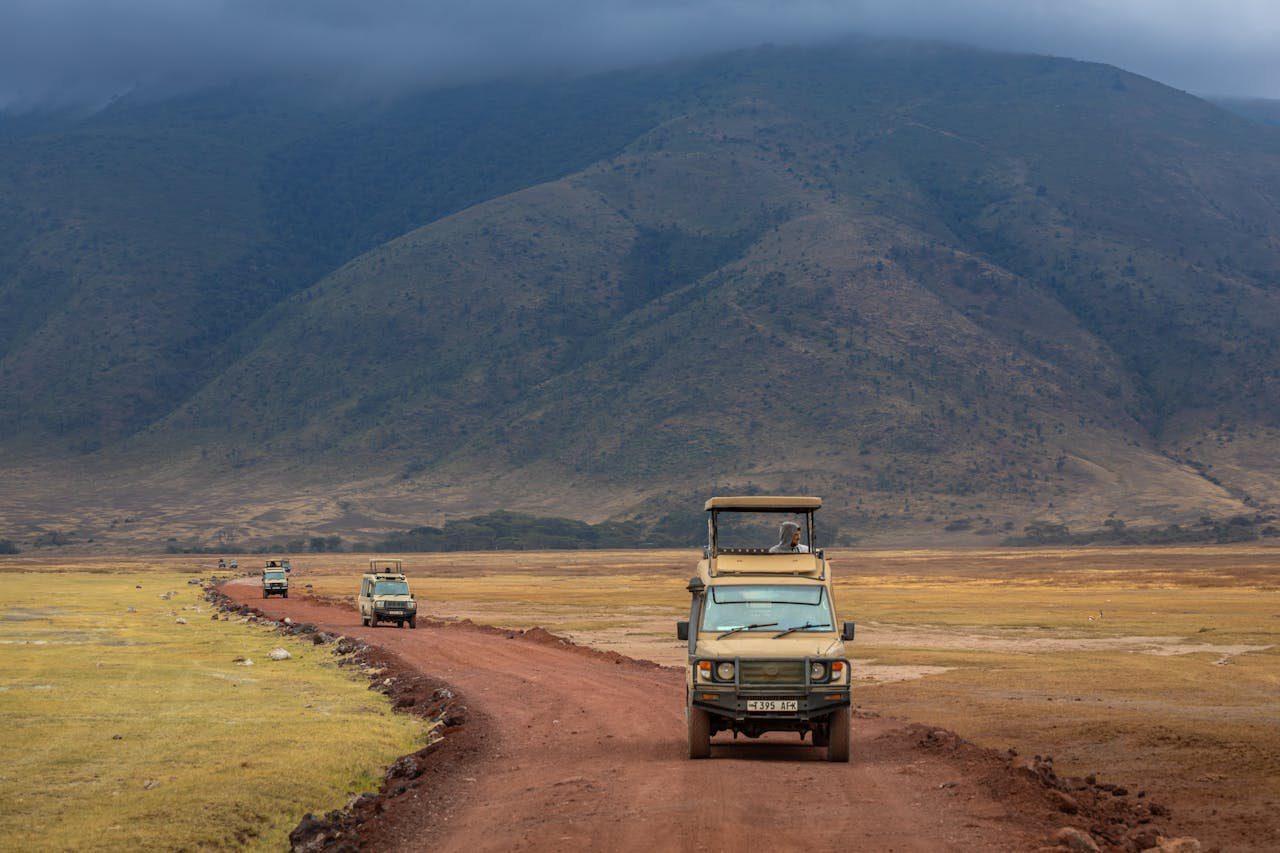
The crater floor game drive is the reason anyone books a Ngorongoro safari, and it follows a fairly set rhythm. Your guide takes the vehicle down one of the steep descent roads from the rim, through cloud forest on the upper slopes, then out onto open grass where wildebeest and zebra are often grazing within a few minutes of the bottom. Our page on Ngorongoro safari tours compares the day trip and short package formats.

Seen from the rim, the floor looks uniform. It is not. Guides work it as a series of distinct habitats, each with its own residents.
The resident grazers are the backbone of the drive: wildebeest, plains zebra, buffalo, eland, Grant’s and Thomson’s gazelle, kongoni, warthog and waterbuck. Spotted hyena are everywhere and very bold, and golden jackals trot along the tracks in broad daylight. Serval cats turn up in the long grass more often here than in most parks.

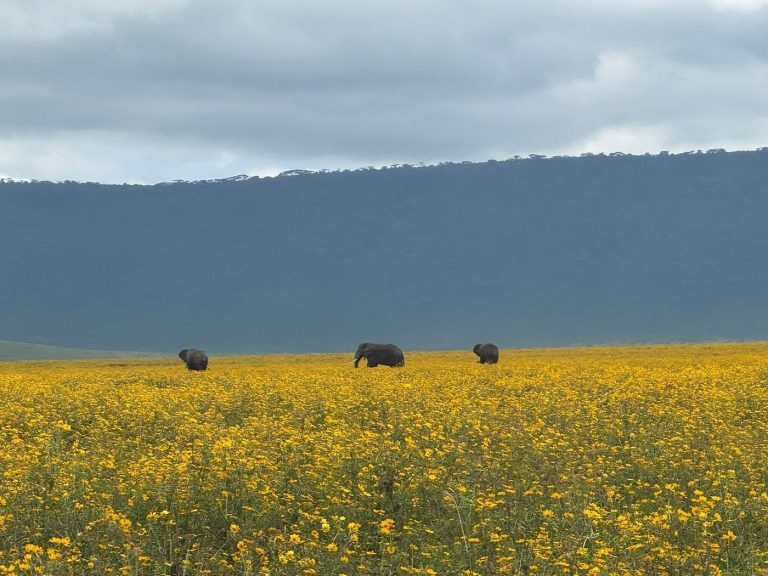
Two absences surprise people. There are no giraffe on the crater floor, since the steep walls and the lack of browse keep them out, though you will see them on the rim road and further into the conservation area. Impala and topi are missing too. Elephants on the floor are mostly mature bulls, some with very large tusks, while breeding herds keep to the highland forest on the rim. You can drive a loop of the whole floor in about two hours, which trip reports note makes the six hour limit feel generous on a quiet day.
Birding is better than most visitors expect. The bird list for the wider conservation area runs to several hundred species. On the floor, kori bustards stride across the grass, crowned cranes feed in the wet areas, and ostrich, secretary birds and several vultures are routine. The rim forest adds a different set again, and if you are heading on to Uganda, the contrast with birding in Bwindi makes the trip pair nicely.
Black Rhino, Lion Prides and Flamingo Watching in the Crater
The black rhino safari angle is what sets Ngorongoro apart from the rest of northern Tanzania. Poaching cut the crater’s population to a handful in the 1970s and 1980s. Protection and a few reintroductions have brought it back to a few dozen animals, which is small, yet it is one of the most reliable places in East Africa to see a wild black rhino from a vehicle.

Sightings are likely, not guaranteed. Rhinos here often rest far out on the open grass, so you may get a clear view at a few hundred metres rather than a close one, and binoculars make a real difference. Trip reports agree on this: even visitors who have been twice sometimes see them only as grey shapes at distance. Guides tend to look between the Lerai Forest and the eastern side of the floor, and they share sightings by radio.
Lions are the other big draw of a crater game drive. Several prides hold territory on the floor, and the males have long been known for dark, heavy manes. Because the bowl is enclosed, the prides cannot range as widely as Serengeti lions, so they are easier to find, and a crater morning without a lion is unusual. Hyena clans compete with them directly and often steal kills.
Leopard and cheetah are present but scarce on the floor. Count either as a bonus.
Then there are the flamingos. Lake Magadi can turn pink at the edges when conditions suit, though the numbers rise and fall with rainfall and water level. In a very dry spell the lake shrinks and the birds move to other soda lakes such as Empakaai, Natron or Manyara, so ask your guide on the morning. Taken together, the crater is one of the most practical places in Africa to see the Big Five in a single day: lion, elephant, buffalo and rhino are all regular, and only leopard needs luck.
Ngorongoro Crater Fees for Your Safari
Ngorongoro Crater fees come from the Ngorongoro Conservation Area Authority’s own tariff, not the national parks one, and three lines matter for almost every visitor: entry per person, the crater service fee per vehicle, and a concession fee per night if you sleep inside the conservation area. The amounts below are the NCAA’s published figures for non East African visitors, and the odd cents show that VAT is already included.
| NCAA fee | Basis | Amount |
|---|---|---|
| Entry, adult 16+ | Per 24 hours | US$70.80 |
| Entry, child 5 to 15 | Per 24 hours | US$23.60 |
| Crater service fee | Per vehicle, per descent | US$295 |
| Concession, adult | Per night at a lodge | US$59 |
| Public campsite, adult | Per night | US$35.40 |
| Olduvai, Shifting Sands | Per adult | US$35.40 |
| Laetoli footprints | Per adult | US$23.60 |
| Ranger walk, short | Per adult | US$23.60 |
| Ranger walk, long | Per adult | US$29.50 |
| Cultural boma | Per vehicle | US$20 |
Children under five enter free. Tanzanian and East African citizens pay in shillings at much lower rates, and expatriate residents pay US$35.40 entry. The tariff also lists smaller lines most visitors never see because operators fold them into the price: a permit for serving a hot bush lunch in the crater at US$23.60 per vehicle, the Endoro Nature Trail and Elephant Caves walk at US$17.70, and vehicle permits for foreign registered cars.
The crater service fee is why group size matters on the crater day. Two people in a private vehicle split US$295 into US$147.50 each, while six sharing pay under US$50 each. Entry is charged per 24 hours, so a well timed rim night and an early descent can fit inside one entry period, while a Karatu night outside the gate means paying entry again the next day.
Whole trips are priced per day with these fees inside. Published day trips from Arusha commonly run from about US$250 to US$600 per person, with a private vehicle, lunch and fees, lowest when five or six share. Multi day northern circuit tours run at about US$220 to US$460 per person per day camping, US$340 to US$515 on a private mid range lodge safari with two sharing, and rarely below about US$900 a day once you move into luxury rim camps with a private vehicle. Group lodge departures of three days to the Serengeti and the crater start from about US$1,220 per person. Most operators ask a deposit of 20 to 30 percent to confirm, some up to 40 percent. Our Serengeti safari cost page builds a full total for the combined trip, the Tanzania safari cost guide covers the whole country, and rim lodge rates are priced in our Tanzania luxury safari cost guide.
Crater Safari Rules: The Six Hour Limit, Gate Times, Roads and Picnic Sites
The NCAA runs the crater with a stricter set of rules than most parks, and knowing them helps you plan your Ngorongoro game drive day.
The roads deserve a sentence on their own. All three are steep, narrow and unpaved, with tight bends and long drops, and they can get muddy in the rains. Nervous passengers usually find the descent slower and calmer than they feared, and the climb out on the Lerai road is the easier of the two.
Lunch is a picnic. There are no restaurants on the floor, so your lodge packs a box lunch and you eat at Ngoitokitok Spring, the main picnic site, or at one of the smaller designated stops near the hippo pools and the Lerai area. Ngoitokitok has toilets and shade and gets crowded around midday. Watch out for black kites, which are very good at taking a sandwich from your hand in flight; eat inside the vehicle if they are circling.

To beat the crowds, timing matters more than anything else. Being among the first vehicles down at 6am gives you an hour or two of quiet floor in soft light, and that usually means staying on the rim. The other option is a late descent around midday or early afternoon. Many vehicles climb out by about 1pm to drive on to the Serengeti or back to Arusha, so the floor thins noticeably after lunch, though you lose the cool early hours when the cats are most active.
Ngorongoro Crater Day Trip or Overnight Safari
A Ngorongoro Crater day trip from Arusha is possible, and plenty of operators sell one. You leave Arusha before dawn, drive about three to four hours to the Lodoare gate and up through the forest, spend roughly six hours on the floor, then drive back after dark. That is six or seven hours on the road around one game drive, and you reach the floor after the early vehicles have taken the best light. It suits travellers who are already based in Arusha, short of time and happy with a long day.
An overnight changes the shape of the day. Sleep on the rim or in Karatu and you can be at the descent road for the 6am opening, spend the morning on a quiet floor, and still have the afternoon for Olduvai, a coffee farm walk or the drive on to the Serengeti. Most forum advice lands in the same place: six hours is plenty for the crater itself, so the night is about getting down early rather than staying longer.
Best Time for a Ngorongoro Crater Safari, Month by Month
The best time for a Ngorongoro Crater safari is June to October for dry weather, short grass and easy viewing, or January and February for green grass and the calving herds at Ndutu next door. It works in every month, because the animals do not leave. What changes is the weather on the rim, the condition of the roads, the colour of the grass and, most of all, how many vehicles share the floor with you.
| Month | Rain | Crowds | Floor |
|---|---|---|---|
| January | Light | Moderate | Green |
| February | Light | Moderate | Green |
| March | Rising | Low | Green |
| April | Heavy | Very low | Wet |
| May | Heavy | Low | Wet |
| June | Dry | Rising | Drying |
| July | Dry | High | Dry |
| August | Dry | Very high | Dry |
| September | Dry | High | Dusty |
| October | Dry | Moderate | Dusty |
| November | Short rains | Low | Greening |
| December | Short rains | High late | Green |
January and February are the sweet spot for many guides. The short rains have passed, the floor is green, and the calving herds are on the Ndutu plains next door, so a crater morning and a migration afternoon fit in the same trip. Crowds are moderate.
March to May is the long rainy season, with April usually the wettest month. The crater roads get slippery and some rim lodges close for maintenance, yet this is when you have the floor most to yourself, and rates drop. Afternoon storms are typical, so mornings are often still good for game viewing. If you do not mind mud, it can be the best value time to go.
June to October is the long dry season and the classic safari window. The grass is short, visibility is excellent and the weather is settled. It is also peak season, so expect the most vehicles, especially in July and August, and book rim lodges well ahead. Nights on the rim are cold, often close to freezing in June and July, and the floor gets dusty by September and October.
November and December bring the short rains, usually as afternoon showers. The floor turns green again, birding improves with the arrival of migrant species, and crowds stay fairly low until the Christmas holiday weeks. Our guide to the best time to visit Tanzania covers how the crater fits with the other northern parks month by month.

Where to Stay on a Ngorongoro Safari: Crater Rim Lodges or Karatu
Choosing a base is the biggest planning decision on a Ngorongoro safari, and it comes down to two areas. Stay on the crater rim and you wake ten to forty minutes from the descent road, with a view straight down into the bowl, but you pay the nightly concession fee on top of higher room rates and you sleep somewhere cold and often misty. Stay in Karatu, a farming town outside the Lodoare gate, and you get warmer nights, gardens, coffee farms and lower prices, at the cost of roughly an hour more driving each crater morning and an extra entry period.

The best known rim property, Ngorongoro Crater Lodge on the southwestern rim, was closed for a complete rebuild, so check with your operator whether it is taking guests again before planning round it. It sits at the very top of the market, priced in the thousands of dollars a night, while other rim camps such as LABA Ngorongoro and Lemala Osonjoi publish rates from several hundred dollars per person per night.

The Ngorongoro Serena Safari Lodge is built from local stone into the western rim, with rooms stepped down the slope so that most look into the crater, and fires lit in the bar and dining room in the evenings. It is a short drive to the Seneto descent road.

On the quieter eastern side, the Ngorongoro Sopa Lodge is a large lodge with spacious rooms, a glass fronted lounge and a swimming pool that only the hardy use in the highland chill. It sits close to the Lemala road and is often one of the better value rim stays.
Whichever side you choose, pack for cold nights: rim lodges lean on log fires, hot water bottles and heavy blankets for a reason. If you only get one rim night on your whole trip, make it the night before the crater drive. For lodge tiers across the region, see our guide to safari lodges.
Safari Trips Beyond the Crater in the Ngorongoro Conservation Area
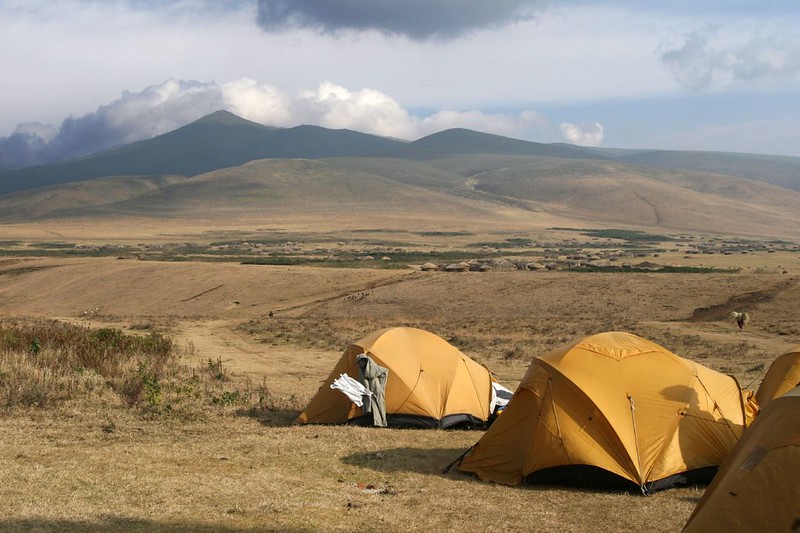
Most people see the crater and leave. That misses most of the conservation area, which is roughly thirty times larger than the crater floor and holds some of the best walking safaris, hiking trips and cultural tours in northern Tanzania.

Olduvai Gorge tour. On the road between the crater and the Serengeti, Olduvai is one of the most important early human sites in the world. Mary and Louis Leakey’s team found the skull known as Zinjanthropus here in 1959, and digging in the gorge has turned up hominin fossils and stone tools reaching back nearly two million years. A museum on the rim of the gorge tells the story, and a guide can walk you to the dig sites. The fossil footprints at Laetoli, further south, are around 3.6 million years old; a visit there carries its own fee.
Shifting Sands trip. North of Olduvai, a crescent dune of black volcanic ash creeps across the plain, pushed by the prevailing wind. It moves several metres a year, and marker posts show how far. It is a short detour that pairs with the gorge.
Ndutu safari. The southwestern corner of the conservation area runs into the southern Serengeti plains round Lake Ndutu and Lake Masek. From roughly December to March the great wildebeest migration spreads across these short grass plains to calve, mostly in February, and the predators follow. Unlike the crater, off road driving is allowed on parts of the Ndutu plains, which makes for very different game viewing.

Empakaai Crater hike. About two and a half hours’ drive north of the main crater, Empakaai is a smaller, steep walled caldera with a deep soda lake that often holds flamingos. An armed ranger walks you down a forest trail from the rim to the lake shore and back, which takes most of a day with the drive. On clear mornings you can see Ol Doinyo Lengai, the active volcano, and sometimes Kilimanjaro. The forest holds blue monkeys, bushbuck and very good birding, with sunbirds, crowned eagles and the occasional trogon.
Olmoti Crater walk. Closer to the main crater, Olmoti is a shallow, grassy caldera reached by a short climb from the village of Nainokanoka. A ranger leads the walk to a viewpoint over the Munge waterfall, which feeds the stream on the crater floor. It is quiet, and few people bother.

Crater rim walking safari. Walking is not allowed on the crater floor, but ranger led walks on the rim and the highlands are. A short walk along the western rim crosses grassland, forest edge and acacia woodland, often passes Maasai herders with their cattle, and is good for highland birds such as Schalow’s wheatear, the montane white eye, golden winged sunbird and mountain buzzard. The Endoro Nature Trail on the southern slopes leads to caves dug out by elephants mining salt. Longer guided treks across the highlands to Empakaai and down toward Lake Natron are possible with a specialist operator.
Lake Eyasi and Hadzabe tour. Just outside the conservation area to the southwest, Lake Eyasi is home to the Hadzabe, one of the last hunter gatherer communities in East Africa, and to Datoga blacksmiths. An early morning walk out with a Hadzabe hunting party is the usual visit.

Maasai Cultural Tours in the Ngorongoro Conservation Area
More than 100,000 people live in the conservation area, most of them Maasai, and meeting them is part of any Ngorongoro cultural tour. Several communities run cultural bomas near the main road, where you visit homesteads, see dances, watch beadwork and talk with residents about herding life. The NCAA charges a fee per vehicle to enter a boma, and the community charges its own fee on top, so ask your guide how that money is shared before you go.

Visits are short and fairly staged, and some travellers find them uncomfortable. Others value the chance to ask direct questions about schooling, grazing and life alongside lions. Both reactions are fair. The NCAA has also been moving some residents out of the area to other districts, a live and contested issue that rights groups and the government describe very differently, and it is worth reading about before you visit. Walks with a Maasai guide on the rim, where herders take cattle to water at the same springs as the buffalo, often feel more natural than a boma visit.
Ngorongoro or Serengeti Safari: Which Suits Your Trip
People ask whether Ngorongoro or the Serengeti is better, and the fair answer is that they do different jobs. The crater is a short, dense safari: a few hours, a small floor, black rhino and a strong chance of all the big animals before lunch. The Serengeti is space. At 14,763 square kilometres it is more than fifty times the size of the crater floor, and it gives you the migration herds, long cat hunts and drives where you may not see another vehicle for an hour.
Most travellers do not have to choose, because the road from Arusha to the Serengeti runs over the crater rim. A typical first Tanzania safari of six to eight days gives the crater one morning and the Serengeti three nights. If you truly have only two or three days, the crater with Tarangire or Manyara is the efficient choice. Our Serengeti safari guide covers which area suits which month.
Getting to Ngorongoro from Arusha for Your Safari
Arusha is the starting point for almost every Ngorongoro safari tour. International flights land at Kilimanjaro International Airport, about 46 kilometres east of Arusha and roughly an hour’s drive from town, and some regional flights use the smaller Arusha airport just west of the city. Your safari company normally collects you from either. Our guide to Tanzania safari packages explains how to compare what is included.

By road, the route runs west on tarmac past Makuyuni and Mto wa Mbu, then climbs the Rift Valley escarpment to Karatu and the Lodoare gate. Allow around three to four hours from Arusha to the gate without stops, then another thirty to forty five minutes up through the forest to the rim. Karatu is about twenty to thirty minutes from the gate. Tarangire and Lake Manyara both sit just off this road, which is why so many itineraries stop at one or both on the way.

To save the drive, light aircraft fly from Arusha and Kilimanjaro to the Lake Manyara airstrip, and from there it is roughly an hour and a half by road to the rim. If you are coming from Uganda or Rwanda, regional flights link Entebbe and Kigali with Kilimanjaro, which matters for the combination trips below. Our getting there guide covers the Uganda side. Most visitors need a Tanzanian tourist visa: US$50 for most nationalities, and a US$100 multiple entry visa for United States citizens.
Ngorongoro Crater Safari Itineraries with the Serengeti, Tarangire and Manyara
The crater sits on the main road between Arusha and the Serengeti, so it almost always comes as part of a longer northern circuit safari. The most common order runs Tarangire for elephants and baobabs, Lake Manyara for the forest and the lake, then Ngorongoro, and finally the Serengeti for big plains and the migration. Coming back, many travellers fly out from a Serengeti airstrip rather than drive back past the crater.
Our Serengeti safari guide explains which part of that park to choose for the month you travel, and the sample trips show how the crater fits at different lengths. A 3 day Tanzania safari or 4 day safari tour covers Tarangire or Manyara plus the crater. The 5 day tour and the 6 day wildlife safari add the Serengeti, while the 7 day adventure, 10 day wildlife tour and 14 day safari leave room for Empakaai, Lake Eyasi or a second Serengeti area. For beach time afterwards, the 15 day Tanzania safari and Zanzibar holiday is the usual shape, and some travellers add a Kilimanjaro trek at the start. Kenya’s Masai Mara is the other common add on for a full migration loop.
Booking a Ngorongoro Crater Tour: Operators and What a Quote Should Include
Almost every visitor books a Ngorongoro Crater tour through a licensed Tanzanian operator, because a licensed guide must be in the vehicle on the crater floor and the operator pays the NCAA fees on your behalf. Compare two or three quotes from our list of Tanzania safari companies and check that each lists the entry fee per person, the US$295 crater service fee, the concession for any rim night, and whether lunch on the floor, drinking water and Olduvai are included.
A good quote also names the lodge for the crater night, says whether the vehicle is private or shared and how many people will be in it, and gives the descent time. Ask for a 6am descent if you are staying on the rim. Most operators take a deposit of 20 to 30 percent, a few up to 40 percent, with the balance due weeks before travel. For rim lodges in July and August, book several months ahead.
Ngorongoro Crater Safari Safety, Health and Altitude
A guided Ngorongoro Crater safari is a low risk day. You stay in the vehicle on the floor, the guide drives the steep roads slowly, and the main hazards are the cold at dawn and the odd muddy bend in the rains. On the rim the risks change after dark: buffalo, elephant and the occasional leopard move through the lodge grounds, so let staff walk you to your room and keep to lit paths.
The rim sits at about 2,300 metres. Few people feel the altitude beyond a little breathlessness on stairs, but the sun burns fast and nights can drop close to freezing from June to August. Malaria is a risk in the lower parks on the same route, so take advice from a travel clinic, and carry a yellow fever certificate if you arrive from a country with yellow fever risk, including Kenya and Uganda. Read your own government’s current travel advice for Tanzania before you book, since advisory levels change.
What to Pack for a Ngorongoro Crater Safari
Packing for a Ngorongoro Crater safari is different from packing for the lower parks, because the rim is high and cold. Mornings in June, July and August can feel close to freezing in an open vehicle at 6am, then warm up to t shirt weather on the floor by late morning. Layers solve it: a base layer, a packable fleece jacket, and a light windproof shell, plus a warm hat for the descent. A pair of 8×42 binoculars matters more here than in most parks, since rhinos are often far out on the grass.
Dust is the other issue in the dry months. The pop top roof is open all morning, so a camera dust cover or a simple dry bag protects lenses, and a buff or scarf helps for your face. Sunscreen and sunglasses are needed even when it feels cool, as the equatorial sun at altitude burns fast. Bring a small day bag for the vehicle with water, snacks and the layers you shed as the day warms.
Our African safari packing list covers the full kit for a northern circuit trip, what to wear on safari covers colours and fabrics, and the camera and binoculars guide explains which lenses and optics suit crater distances. You can browse every gear guide in our safari gear and clothing section, and if you are adding Bwindi, the gorilla trekking packing list covers the forest half.
Pairing a Ngorongoro Safari with Gorilla Trekking in Bwindi
The crater pairs well with gorilla trekking in Uganda. Tanzania has no mountain gorillas, so a growing number of people fly from Kilimanjaro to Entebbe or Kigali after the northern circuit and spend two or three days in Bwindi Impenetrable National Park. The two halves suit each other: open plains and big herds first, then a forest walk to sit with a gorilla family for an hour. Our guide to a Tanzania safari and gorilla trekking trip covers the flights and the order, and you can read about Rwanda gorilla trekking if Kigali suits your route better. Uganda permits are booked through a licensed tour operator and sell out in peak months, so check how Uganda gorilla permits are booked before you fix the Tanzania dates.
Ngorongoro Crater Safari FAQ
How much are the Ngorongoro Crater fees?
The NCAA tariff for non East African visitors is US$70.80 per adult (16 and over) and US$23.60 per child aged 5 to 15 for entry per 24 hours, with under fives free. Going down into the crater adds a crater service fee of US$295 per vehicle per descent, shared by everyone in the vehicle, and a night at a lodge inside the conservation area adds a US$59 concession per adult. Confirm current figures with your operator when you book.
How much does a Ngorongoro Crater safari cost in total?
Published day trips from Arusha run from about US$250 to US$600 per person with fees, lunch and a private vehicle, lowest when five or six share. A 3 day group lodge trip to the crater and the Serengeti starts from about US$1,220 per person, and longer private trips follow daily bands of about US$340 to US$515 mid range. A gorilla permit, if you add Uganda, is US$800, or US$600 in April, May and November.
What is special about the Ngorongoro Crater?
It is the world’s largest intact, unflooded volcanic caldera, with permanent water that keeps an estimated 25,000 large animals on the floor all year. That density, the black rhino and the chance of four of the Big Five in one morning make it different from any other park in Tanzania.
What is the best time to visit the Ngorongoro Crater?
June to October for dry weather and short grass, or January and February for green grass and the calving herds at Ndutu next door. April and May are wettest, quietest and cheapest, and the crater works in every month because the animals stay.
Is Ngorongoro or Serengeti better?
Neither; they suit different parts of a trip. Ngorongoro is best for a short, dense game drive and black rhino, the Serengeti for space, big cat hunting and the migration. Since the Serengeti road crosses the crater rim, most first safaris include both.
Is half a day enough for the Ngorongoro Crater?
For most people, yes. The floor is small, the rules allow about six hours, and you can drive a full loop in around two. A full morning from the 6am opening is the classic plan, and the floor gets quieter after about 1pm when many vehicles leave.
Can I visit the Ngorongoro Crater as a day trip from Arusha?
Yes, leaving before dawn and returning after dark, but you spend about as long driving as you do in the crater. One night in Karatu or on the rim makes the day far more relaxed and lets you go down early.
Will I see a black rhino in the crater?
There is a good chance, but it is never guaranteed. Rhinos often stay far out on open grass, so binoculars or a long lens help a great deal, and guides share sightings by radio.
Is the Ngorongoro Crater a national park?
No. It sits inside the Ngorongoro Conservation Area, managed by the Ngorongoro Conservation Area Authority rather than Tanzania National Parks. That is why it has its own fees, its own six hour crater rule and Maasai communities living inside it.
Can you stay overnight inside the Ngorongoro Crater?
No. There is no accommodation or camping on the crater floor, and all vehicles must be out by about 6pm. You sleep on the rim, at Simba A campsite, elsewhere in the conservation area, or in Karatu.
Is it safe for Americans to go to Tanzania right now?
Large numbers of American visitors travel the northern circuit without trouble, and the parks are far from the cities where protests have flared. Read the current US State Department advisory before you book and again before you fly. On the ground, the usual risks are petty theft in towns, road accidents and malaria; inside the crater, staying in the vehicle with your guide handles the rest.
Can I do a self drive safari into the Ngorongoro Crater?
Self drive is allowed in the conservation area with a suitable four wheel drive vehicle and the right permits, but to go down into the crater you need a licensed guide on board. Most independent travellers book a guided vehicle for the crater day.
Is a Ngorongoro safari suitable for children and older travellers?
Yes. The game drive is done entirely from the vehicle, and the roads, though steep, are driven slowly. Children under five enter free and some rim lodges have age rules. The main thing for every age is the cold early start, so pack warm layers.
Is the Ngorongoro Crater worth it?
For most people, yes. The density of animals and the chance of black rhino are hard to match anywhere. The crowds are real, especially from June to October, so stay on the rim, go down at the 6am opening or visit in the green season. If crowds bother you badly, give more of your trip to remote Serengeti areas.
Can you see the Big Five in the Ngorongoro Crater?
Often four of them in one morning: lion, elephant, buffalo and black rhino are all regular on the floor. Leopard is scarce down there and more often seen in the rim forest, so a full set in one day needs some luck.
Why are there no giraffes in the Ngorongoro Crater?
The floor is open grassland with very few of the trees giraffe browse on, and the steep walls make the way down hard for them. You see giraffe on the rim road and elsewhere in the conservation area instead.
Can you see Kilimanjaro from the Ngorongoro Crater?
Rarely. The mountain lies far to the east and is usually hidden by haze or cloud. On a very clear morning it can sometimes be picked out from the rim of Empakaai Crater, along with Ol Doinyo Lengai.
What colours should I not wear on a Ngorongoro safari?
Skip white, which the dust stains within hours, and dark blue or black, which attract tsetse flies in wooded parts of northern Tanzania. Khaki, olive, tan and grey work best, with warm layers for the rim.
Which is the best safari in Tanzania?
For a first trip, most people choose the northern circuit: Tarangire, Lake Manyara or both, the Ngorongoro Crater and the Serengeti, over six to ten days from Arusha. Repeat visitors and people who dislike crowds often look south to Ruaha and Nyerere instead. Our guide to Tanzania safari packages compares the common routes.