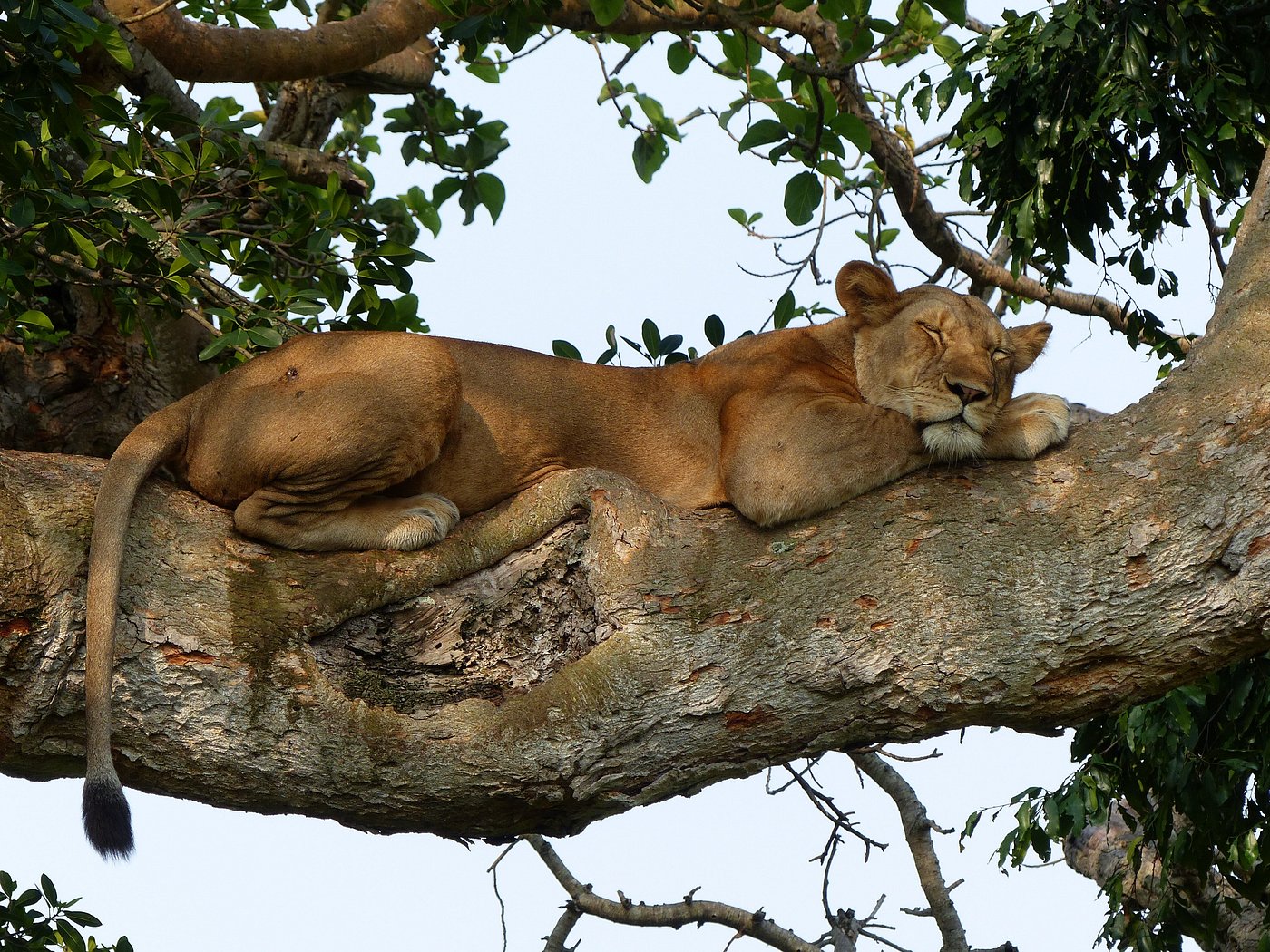
Tree climbing lions in Uganda are found in the Ishasha sector, the remote southern plains of Queen Elizabeth National Park, where lions rest in the wide branches of fig and acacia trees. Most travellers see Ishasha on a game drive between the park’s northern circuit and Bwindi gorilla trekking in the Buhoma sector. The lion population here has fallen sharply, so sightings are now a matter of patience and luck rather than a sure thing.
Lions are heavy, ground hunting cats, and most of them never bother with trees. That is what makes the Ishasha prides worth the detour. A lioness stretched along a fig branch with her legs hanging either side is a sight people talk about for years, and photographs of it have sold Uganda safaris for decades. Cubs test the lower limbs while adults sleep off a meal well above the grass.
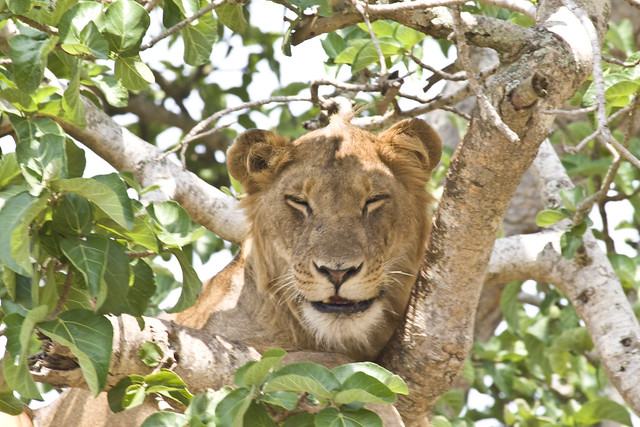
This guide covers why the lions climb, how many are left and what happened to them, when and how to look for them, how the Ishasha sector works on the ground, and how to fold the detour into a gorilla trekking safari. It also compares Ishasha with Tanzania’s Lake Manyara, the other place famous for the same habit.
Where to See Tree Climbing Lions in Uganda on Safari
Your best chance of a tree climbing lions safari in Uganda is the Ishasha sector of Queen Elizabeth National Park. The park covers about 1,978 square kilometres of savanna, crater lakes and wetland in the western Rift Valley, and Ishasha is its quiet southern end, about 500 square kilometres of open grassland broken by scattered fig and acacia trees. The Ishasha River marks the western edge, and the Democratic Republic of Congo lies on the far bank.
Lions elsewhere in Queen Elizabeth do climb now and then, particularly around the Kasenyi plains in the north, and occasional reports come from Murchison Falls and, more rarely, Kidepo Valley. None of those places has the same reputation. Ishasha became famous because its prides climbed often, in the same trees, in full view of the tracks.
Why there? The southern plains offered everything a lion pride needed: herds of Uganda kob and topi, buffalo along the river, water all year and big trees with low, near horizontal limbs. Compared with the busier north, Ishasha sees few vehicles. On many afternoons you can sit at a fig tree with no other car in sight.
Why the Ishasha Lions Climb Fig and Acacia Trees
Nobody has proved why these lions climb, so treat every explanation on a lion tracking safari as a theory. Researchers and guides tend to point to five reasons, and the truth is probably a mix of them.
Heat. Ground temperatures on the Ishasha plains climb steeply by late morning, with air temperatures often passing 28C. A branch a few metres up catches the breeze and sits in shade, so a resting lion loses heat more easily than it would on bare earth.
Biting insects. Tsetse flies and other biters are thick in the grass and thicket, especially after rain. Lifting the body off the ground seems to reduce the bites, which would explain why climbing often increases in the wetter months.
A view of prey. From a fig tree a lioness can watch kob and topi grazing across the plain without being seen as easily. Whether lions actively hunt from the trees is doubtful; they still make their kills on the ground. The height simply gives them a lookout while they rest.
Rest after feeding. Lions sleep up to twenty hours a day. Broad fig limbs make a comfortable bed above the damp grass, and well fed lions often climb after a meal.
Learned behaviour. Cubs follow their mothers up the trunks, and the habit passes through the pride. This is the strongest argument that climbing is a cultural trait rather than something Ishasha lions are built for. Their bodies are no different from other lions, and they belong to the same species found across East Africa.
The trees matter. Sycamore figs are the favourites: thick, spreading, with low forks a lion can reach in one jump. Large acacias come second, and guides occasionally find a lion in a candelabra euphorbia, the spiky, cactus like tree that dots the drier ground. A tree that suits lions tends to get used again and again, which is why guides know exactly which ones to check.

How Many Lions Are in Queen Elizabeth National Park Today
The short answer is very few. Uganda Wildlife Authority figures put the lion count for the whole of Queen Elizabeth National Park at 39 in 2022, down from about 400 in the late 1970s. Most of the survivors live in the north, on the Kasenyi plains and around the Mweya peninsula, where the kob herds are densest.
Ishasha has suffered worst. Older safari pages still quote fifty lions in four prides, or a range of twenty to thirty five, and in early 2022 IFAW described the sector as holding no more than about 35. A 2024 assessment by the Uganda Carnivore Program put the southern population at no more than twenty, while warning that the southern count was less certain than the northern one. More recently, the Uganda country director of the Wildlife Conservation Society told the environmental news site Mongabay that fewer than five lions remain in Ishasha.
Pride life explains part of the churn. Young males are pushed out of their birth pride at around three or four years old, and in Ishasha many of them cross the river into Congo’s Virunga National Park, while lionesses from the Congo side sometimes move the other way. The Maramagambo Forest, on the eastern edge of the park, is thought to serve as a corridor between the south and the north. When a new coalition of males takes over a pride, it often kills the cubs of the previous males, and fights over pride leadership cost adult lives too. In a healthy population those losses are absorbed. In a population of a handful, each one matters.
Guides like to point out that Ishasha males tend to carry dark manes, a trait often mentioned as a feature of the southern prides. Up north, a three legged male known as Jacob, who lost a leg to a poacher’s trap, has become something of a local celebrity among guides and visitors, and is a reminder of how much damage snares do even to the lions that survive them.
Ishasha Lion Population Today: Poisonings, Snares and Recovery Plans
This is the part most safari pages skip. Anyone planning a tree climbing lions tour deserves the current picture, and the picture is a hard one. African lions are listed as Vulnerable by the IUCN, and Ishasha shows why in miniature.
The older version of this page linked the 2018 poisoning to Ishasha. It actually happened in the north of the park. Ishasha’s own heaviest blow came in 2021, when that single incident removed six lions from a population that was already small.
Poisoning is the headline threat, yet snares do steady damage too. Wire traps set for antelope catch lions by the leg or neck, and poachers often set them in clusters of four or five along a game path. Ranger patrols, some supported by IFAW, spend whole mornings walking the plains to lift them. Cattle grazing inside and on the edges of the park brings herders and lions into conflict, and a pride that kills a cow is at risk of retaliation. Trafficking in lion parts, the motive behind the 2021 killings, adds another pressure, and the open border with Congo makes enforcement harder, which is why UWA works with Congo’s park authority, ICCN, on cross border cases.
There is a recovery plan. The Uganda Wildlife Authority and the Wildlife Conservation Society have signed a ten year agreement to jointly manage Ishasha. WCS takes on biodiversity management, community work and tourism development, while UWA keeps law enforcement. The plan includes recruiting lion guardians and scouts from nearby villages and funding predator proof livestock enclosures and boreholes so cattle stay out of the park. WCS has said the population probably cannot recover on its own and may need lions brought in from elsewhere once the causes of decline are under control. Lodges have joined in too: a group of former poachers near the southern gate has been helped into other work, from shoemaking to pig rearing.
What does that mean for your trip? Ishasha is still worth driving through, and every paying visitor helps make the case for protecting it. Go in expecting a scenic game drive with a chance of lions, not a guaranteed sighting.
Best Time for a Tree Climbing Lions Safari in Ishasha
Ishasha can be visited all year, but the best time for a tree climbing lions safari is during the drier spells, roughly December to February and June to September. The tracks hold up, the grass is shorter, and lions resting in trees stand out against the canopy. Those months also line up with the most popular period for gorilla trekking in Bwindi, which suits the classic combined route.
The wetter months, March to May and October to November, are harder going. Black cotton soil on the plains turns slick, some loops close, and the road south to Buhoma can be cut by washouts. Some guides argue that climbing is actually more frequent after rain, when biting insects peak and the ground is wet. Fewer vehicles and green scenery are the trade off, provided your driver has a sound 4×4 and time to spare.
Time of day matters more than month. Lions tend to be on the ground or on the move around dawn, and they climb as the heat builds. Most sightings in trees happen from mid morning to mid afternoon, roughly from half past ten until about two or three o’clock, before they come down again in the cooler evening.
How to Search for Lions on an Ishasha Game Drive
An Ishasha game drive is a slow, methodical search rather than a quick loop. The tracks run between the big fig trees, and guides work through them one by one, scanning the main forks and the longest limbs. A tawny shape on a pale branch is surprisingly easy to miss, so a good pair of binoculars for every passenger pays for itself here; our guide to the best binoculars for safari explains what to look for.
The sector has a few distinct areas. The northern circuit and the southern circuit are the two main loops through the fig tree country, and between them they cover most of the trees the lions have used over the years. Farther north, the Lake Edward flats open onto the lake shore, good for kob, topi and waterbirds. The Ishasha River campsite, under tall riverine trees, is where hippos and colobus monkeys are easiest to see.
Start early. Leaving the lodge at first light gives you the best chance of finding lions on the ground near a kill or walking between trees, and then you can watch where they settle as the morning warms. If the first sweep draws a blank, return to the fig trees around midday. Lions that were invisible in the grass at seven are sometimes sprawled on a branch by eleven.
Trip reports from people who missed the lions share a theme. They drove through Ishasha in an hour or two on the way to Bwindi, with no time to wait. Visitors who stayed a night, or allowed a full morning, report better luck. Recent grass burning can push lions to another part of the sector for a few days, and a cool, overcast day may keep them on the ground. Several travellers mention guides phoning each other once a tree is occupied, so a driver who knows the other Ishasha guides is worth having.
Stay in the vehicle, keep voices low and do not ask the driver to park directly under an occupied tree. A lion that feels crowded will simply climb down and walk off into long grass, and that ends the sighting for everyone. A long lens, or at least a zoom of 200mm or more, gives you frame filling shots from a respectful distance, and many visitors shoot short video clips too, since a lion shifting along a branch tells the story better than a still. Our gorilla trekking packing list covers optics and clothing that work for both the forest and the plains. Wear khaki or olive rather than dark blue or black, which draws tsetse flies.
An empty tree is part of the experience. Even on a day without lions, the Ishasha plains are among the most attractive game drive country in Uganda.
Other Wildlife on an Ishasha Safari
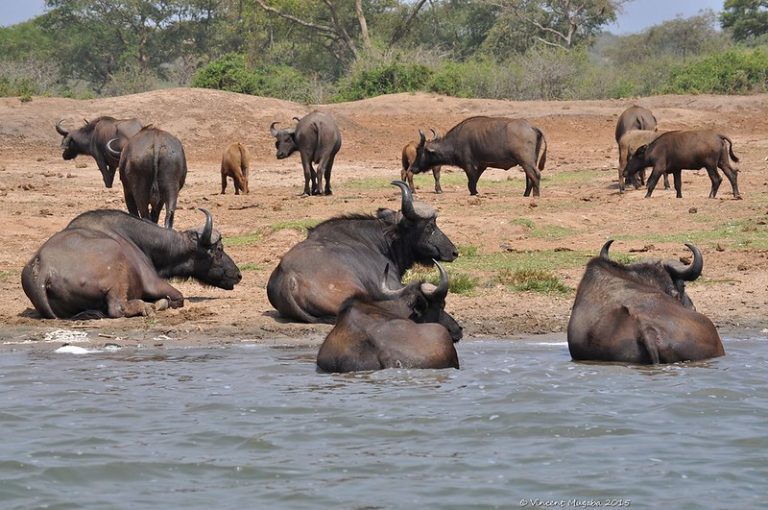
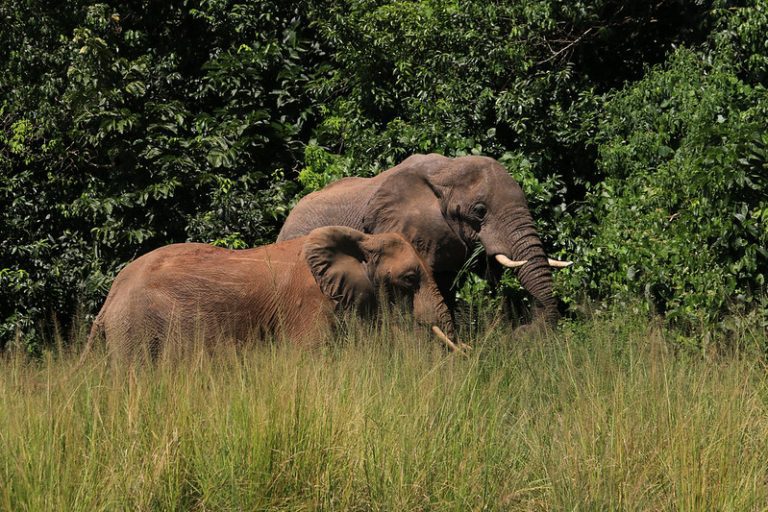
The plains support large herds of Uganda kob, the main prey of the lions, and Ishasha is the only part of Queen Elizabeth where topi are seen in good numbers. Buffalo gather along the river and in the open grassland, and elephants move between Uganda and Congo across the Ishasha River. Warthog, waterbuck and bushbuck are common. Some websites list zebra for Ishasha; there are none in Queen Elizabeth, and travellers who want zebra find them at Lake Mburo National Park.
The riverine forest along the Ishasha River holds black and white colobus, vervet monkeys and baboons, while hippos crowd the deeper pools. Leopard and spotted hyena are present but shy, and lodges near the gate often hear hyenas calling after dark. Birders do well too: the river woodland, the open grassland and the edges of the Lake Edward flats each hold different species, with raptors over the plains in the morning and woodland birds most active late in the afternoon. That mix complements a birding trip in Bwindi.
Ishasha Sector Safari Logistics: Roads, Gates and Flights
Getting to Ishasha is part of planning any Ishasha safari, because the sector sits well away from the park’s main hub at Mweya. From Kampala, the drive runs through Mbarara or Fort Portal and takes roughly seven to eight hours with stops. From Mweya and the Kazinga Channel, the road south through Katunguru reaches Ishasha in around two to three hours of game viewing.
Most visitors go with a driver guide arranged through a safari company, which takes care of route knowledge and vehicle trouble on remote tracks. Self drivers manage fine in the dry season with a capable vehicle, a full tank and an early start. Our guide to getting to Bwindi covers road and air routes into the southwest in more detail.
Ishasha Lions and Buhoma Gorilla Trekking: The Classic Safari Route
The most popular way to see the tree climbing lions is as part of a gorilla trekking safari. Ishasha lies directly on the road between Queen Elizabeth’s northern circuit and Bwindi Impenetrable National Park, so the game drive replaces what would otherwise be a long transfer.
The classic route runs north to south. Travellers spend a night or two near Mweya for the Kazinga Channel boat trip and game drives on the Kasenyi plains, sometimes adding chimpanzee trekking in Kibale beforehand. On the transfer day they drive south through Ishasha, search the fig trees through the middle of the day, and continue about 65 kilometres via Kihihi to Buhoma. That last stretch takes about two to three hours on unsealed road, so leave Ishasha by mid afternoon to arrive before dark.
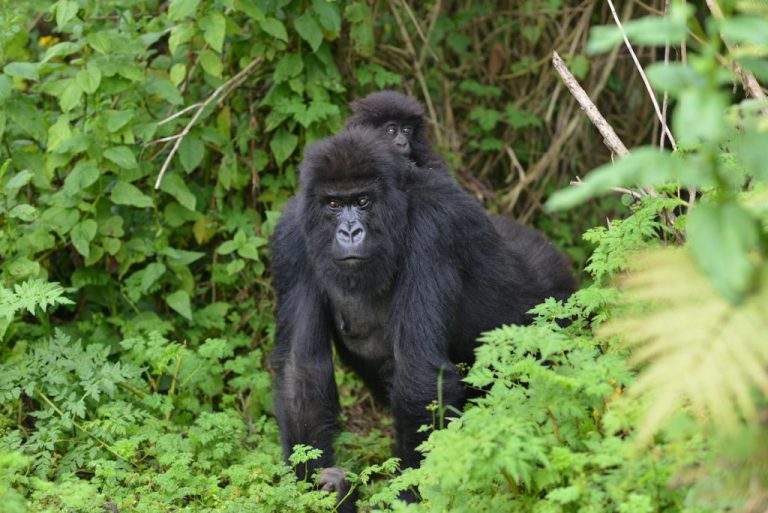
Buhoma is the northern trailhead for Buhoma gorilla trekking, home to the oldest habituated families in Uganda and the park headquarters. Arriving the evening before your trek date gives you time for the morning briefing. Secure your gorilla permits first, because permits sell out long before lodges do and the whole route is built around the trek date. If you want longer with the gorillas, the gorilla habituation experience runs in the south of the park and can be added after Buhoma.
Travelling south to north works equally well. After trekking in Buhoma, you can drive up through Ishasha and spend a night there before heading on to Mweya. A night at Ishasha, either way round, is the single best change you can make to improve your odds of seeing lions in a tree.
Where to Stay on an Ishasha Safari
Ishasha has a small range of lodges and camps, mostly on the river or close to the southern gate, from simple bandas to tented camps. Staying here rather than driving through gives you both early morning and midday searches. See our safari lodges guide for options near Bwindi to pair with an Ishasha night.
Book well ahead in the dry months. With so few beds in the area, a lodge can fill up from a single group tour.
Lake Manyara Tree Climbing Lions: How the Tanzania Safari Compares
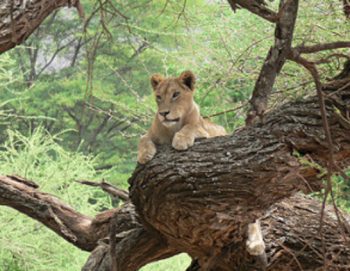
The other famous home of climbing lions is Lake Manyara National Park in northern Tanzania, on the floor of the Rift Valley below the escarpment. The soda lake covers most of the park, and the lions use acacias and other large trees in the woodland between the escarpment and the shore. Like Ishasha, the reasons are debated, and sightings are never guaranteed.
| Feature | Ishasha, Uganda | Lake Manyara |
|---|---|---|
| Main trees | Sycamore fig | Acacia |
| Habitat | Open plains | Lakeshore woods |
| Crowds | Very few cars | Busier |
| Access | Remote, 4×4 | Near Arusha |
| Pairs with | Bwindi gorillas | Ngorongoro |
Manyara is far easier to reach, sitting on the main road from Arusha to Ngorongoro and the Serengeti, so most northern Tanzania circuits pass by it. That convenience means more vehicles at each sighting. Ishasha is wilder and quieter, but its tiny lion population now makes it the longer shot of the two. If climbing lions are a priority, some travellers build a two country trip: gorillas in Bwindi plus the northern circuit in Tanzania. Our Tanzania safari and gorilla trekking guide and the Serengeti safari page show how the two link up, with a flight connecting Entebbe or Kigali to Kilimanjaro.
Why does Tanzania have so many more lions overall? Size and space. The country holds the largest lion population in Africa, spread across huge protected areas such as the Serengeti, Ruaha and Nyerere, with migrating herds of wildebeest and zebra to feed them and far fewer people and cattle pressing on the boundaries than in western Uganda. In Kenya, the Masai Mara and its neighbouring conservancies hold the country’s densest lion population, which is why a Mara game drive is the surest place in East Africa to watch prides on the ground.
Lions in other parks, including the Serengeti, Tarangire, Kruger and Botswana’s Okavango Delta, also climb from time to time. Those are individual habits, though. Ishasha and Manyara are the two places where whole prides made it routine.
Tree Climbing Lions Uganda FAQ
Are there still tree climbing lions in Uganda?
Yes, but very few. The Wildlife Conservation Society says fewer than five lions remain in the Ishasha sector, down from estimates of about fifty a decade or so ago. Sightings still happen, especially for visitors who stay a night and search patiently, but they are no longer something to count on.
How many lions are in Queen Elizabeth National Park?
Uganda Wildlife Authority figures gave 39 lions for the whole park in 2022, compared with about 400 in the late 1970s. Most live in the north around Kasenyi, while Ishasha in the south is down to a handful. Further losses since then, including three lions poisoned at Nyamugasani in December 2025, mean the current figure is probably no higher.
Why do lions in Uganda climb trees?
No single reason has been proved. The usual explanations are escaping ground heat and biting tsetse flies, catching a breeze, resting after a meal and keeping watch over kob on the plains. Cubs copy their mothers, so the habit passes down through the pride.
How much does it cost to see the tree climbing lions in Ishasha?
There is no separate lion permit. You pay Queen Elizabeth National Park entry, which on the most recent UWA conservation tariff we could confirm was US$40 per 24 hours for foreign nonresident adults, US$30 for foreign residents, US$25 for other African residents and UGX 20,000 for East African citizens. Children aged 5 to 15 paid US$20 as foreign nonresidents, and under fives enter free. Confirm the current schedule with UWA before travel. If you continue to Bwindi, a gorilla permit costs US$800 for foreign nonresidents, US$700 for foreign residents and UGX 300,000 for East Africans, with a US$600 low season rate announced for April, May and November. Vehicle hire, driver guide and lodge costs come on top and vary widely by operator.
What time of day are the Ishasha lions in the trees?
Mostly from mid morning to mid afternoon, when the ground heats up. An early start lets you find lions on the ground first, then watch which trees they climb.
What is special about Queen Elizabeth National Park?
It is Uganda’s most visited savanna park, with more than 95 mammal species and over 600 birds, the longest bird list of any park in the country. Beyond the Ishasha lions it offers the Kazinga Channel boat trip past hippos and crocodiles, Kasenyi game drives, explosion craters, chimpanzees in Kyambura Gorge and a direct road link to the Bwindi gorillas. Our Queen Elizabeth National Park safari guide covers each sector.
Can I see the tree climbing lions on the way to Bwindi?
Yes. Ishasha lies on the road between Queen Elizabeth’s northern sector and Buhoma, so a game drive through it is the standard transfer day on a gorilla trekking safari. Allow at least half a day in the sector, or better, spend a night.
Is a tree climbing lions safari safe?
Yes, provided you stay inside the vehicle and follow your guide. Lions in trees are usually resting and ignore vehicles at a sensible distance. Do not get out on the plains and do not ask the driver to park under an occupied tree.
Which is better for climbing lions, Ishasha or Lake Manyara?
Lake Manyara is easier to reach and currently has more lions, so the odds there are better. Ishasha is quieter and fits neatly into a Uganda gorilla trip. Your choice usually comes down to which country the rest of your safari is in.
Which national park has the most lions in Kenya?
The Masai Mara National Reserve, together with the conservancies on its northern edge, holds Kenya’s largest and densest lion population. Its lions rarely climb, but prides are seen on most game drives, which makes the Mara a good partner for a Uganda gorilla trip if lions are high on your list.
Why are there so many lions in Tanzania?
Tanzania has more land under protection than almost any African country, including the Serengeti, Ruaha and Nyerere ecosystems, and those areas carry huge herds of prey. Lower human and cattle pressure along many boundaries means fewer revenge killings, so Tanzania holds the largest lion population on the continent.
Can children join an Ishasha game drive?
Yes. Game drives have no minimum age, unlike gorilla trekking, which is limited to visitors aged 15 and over. Long road days are the main thing to plan around with young children.
How can visitors help the Ishasha lions?
Visit, and choose operators and lodges that support local communities, since tourism revenue sharing and compensation for livestock losses reduce retaliation. Report any snares or suspicious activity you see to your guide or the rangers.