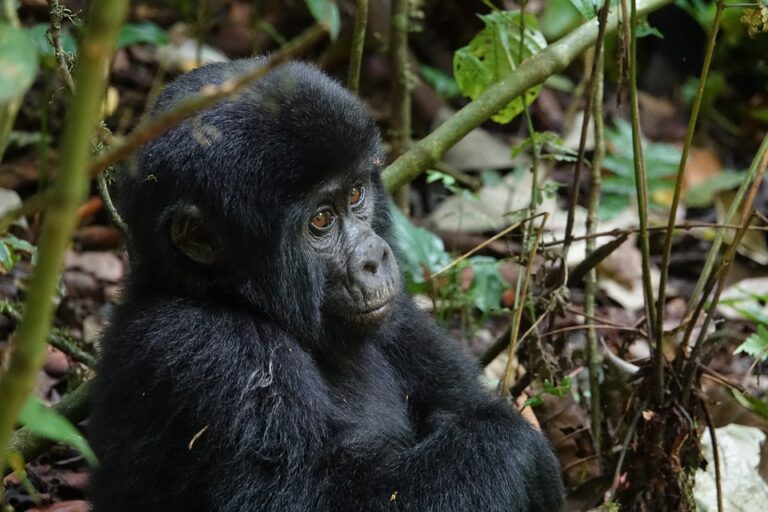
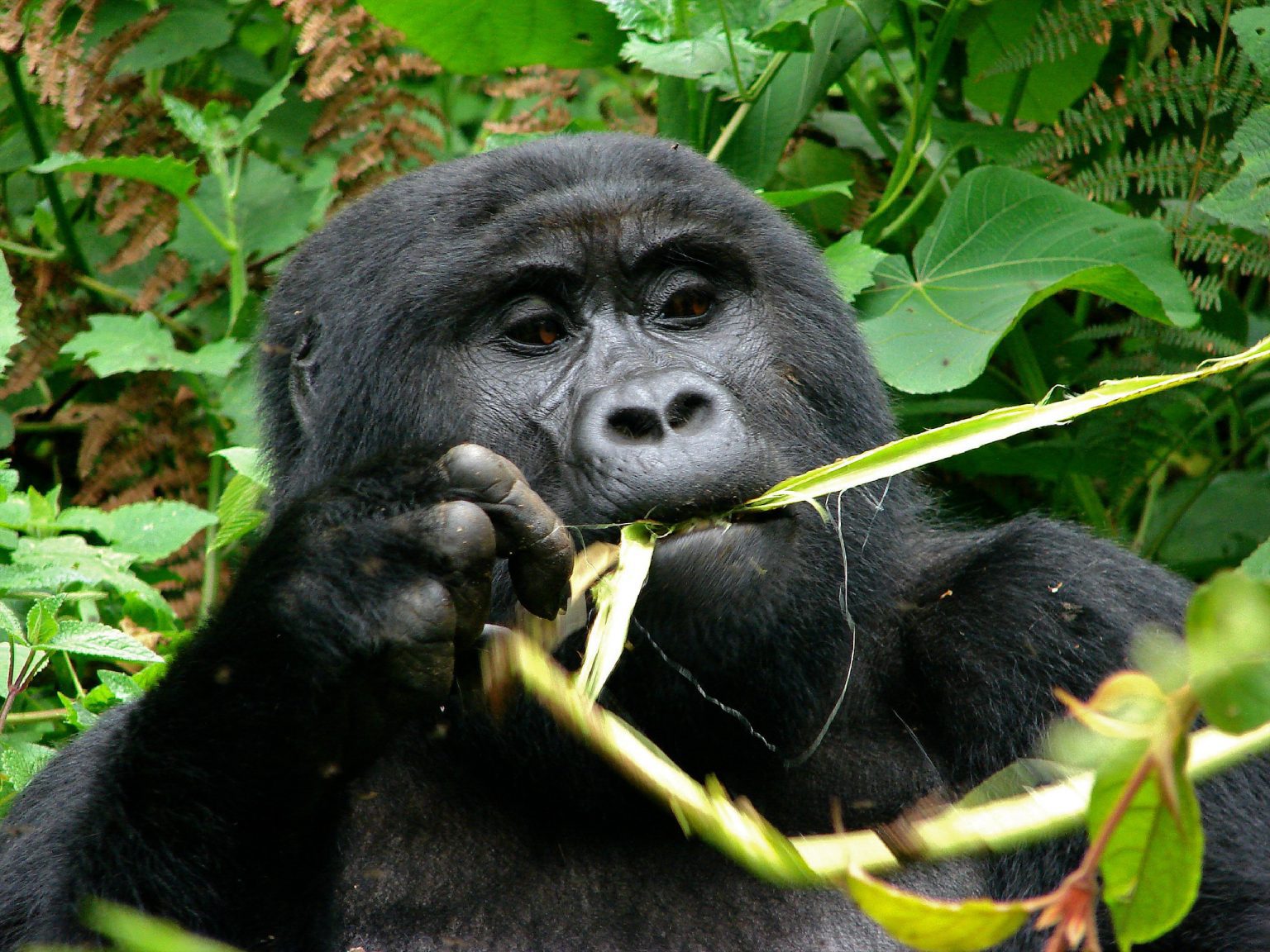
Gorillas mate on the ground, usually with the female crouched forward and the male behind her, in a brief act that lasts around a minute and can happen in any month. The female usually starts it, the silverback fathers most infants, and visitors gorilla trekking in Uganda, Rwanda or Congo occasionally see it. These great apes of Central and East Africa live in family groups, and their breeding habits explain much of what a trek shows.
Gorilla Family Life You See on a Trek: Who Breeds in the Group
Every gorilla trek ends at a family, and that family is a breeding unit before it is anything else. A typical group holds one dominant silverback, several adult females, their infants and juveniles, and sometimes one or two younger males. Ten or so members is common. Some groups top thirty.
Families keep to themselves. Two groups meet now and then at the edge of their ranges, and those meetings matter for breeding because they are when females can switch families and when rival males test each other. Most days, though, a family moves, feeds and nests apart from its neighbours, which is why a permit is always for one family and never for the whole forest.
The silverback does most of the fathering. That is the deal at the centre of gorilla society: he protects the females and their young from rival males and leopards, and in return they stay with him and breed with him. A silverback with three adult females is ordinary; a strong one may hold six or more.
He is not always the only father, though. Mountain gorillas live in groups with more than one adult male far more often than western gorillas do, and genetic testing of Virunga groups found that the second ranking male sired roughly 15 percent of infants. The leader guards fertile females closely, yet a subordinate male or blackback sometimes gets a chance while the boss is busy feeding or dozing. Rivalry between the two can flare into chest beating and short charges, though most days pass without trouble. If that kind of display worries you, the guide on whether gorillas are aggressive covers how habituated families react to visitors, and the silverback gorilla facts page explains what the leader does all day.
Gorillas belong to two species, each with two subspecies: mountain and eastern lowland gorillas in the east, western lowland and Cross River gorillas in the west. Breeding works much the same way across all four, with differences in timing that come up below. For the full split, see types of gorillas in the world.

When Gorillas Reach Breeding Age
Females grow up faster than males. A young female starts ovulating at around six to eight years old, then passes through a stretch of adolescent infertility, so her first baby usually arrives near the age of ten. Long term field records put the average first birth at about 10.1 years in the Virunga mountain gorillas and 10.5 years in Bwindi. Western gorillas start later, at around 12.
Males take longer. Between roughly 8 and 12 years a male is a blackback: sexually mature, still lean, without the grey saddle. Silver hair starts to spread across his back at around 12 or 13, and he seldom fathers infants until he is a full silverback with the size and confidence to hold females.
What happens next splits the young males in two. Some stay in the group they were born into, rise through the ranks and may inherit leadership when the old silverback weakens. Others leave and wander alone or join loose bachelor bands for years, trying to win females away from established groups when two families meet in the forest. Neither route is safe. Lone males take a lot of injuries.
Females can breed into their late thirties. Wild gorillas commonly live 35 to 40 years, and in zoos some pass 60: Fatou at Berlin Zoo, born around 1957, is the oldest gorilla on record.
Gorilla Courtship Signals Guides Point Out on Tracking Trips
Courtship is quiet and easy to miss on a gorilla tracking trip unless a ranger tells you what to watch. Female gorillas show no large pink swelling the way chimpanzee females do. A slight swelling is there, but it is hard to spot, so ovulation is close to hidden. The signal is behaviour.
A female ready to mate walks slowly toward the silverback, purses her lips and holds his gaze for a long time. If he ignores her she gets more direct. She slaps the ground as she closes in, sometimes slaps the male himself, and may back up against him. Some trip reports describe rangers quietly telling a group to stay still because a female has started this routine near the end of the visit.
Her fertile window is short. Classic field work in the Virungas by Harcourt, Fossey, Stewart and Watts found the estrous cycle runs about 30 days, with the receptive period lasting around two days. During those days a pair may mate roughly once every three hours.
So how many times a day do gorillas mate? It swings hugely. On a fertile day, a pair can mate several times between waking and nesting. Across the other four weeks of the cycle a female may not mate at all, unless she is soliciting for social reasons or is already pregnant. Averaged over a month, mating is a small slice of a gorilla’s day, far behind feeding and resting.
The male can start things too. He walks over, touches her or puts on a strutting display with a grunt. When a female holds back, a silverback may charge or slap her. Researchers have recorded this pressure in several populations, and a study from the early 1980s found that a female on the receiving end of repeated aggression sometimes solicited mating outside her fertile days, apparently to calm him.
When the silverback is distracted or not interested, a soliciting female may turn to a subordinate male in the same group instead.
How Gorillas Mate: Position, Length and Sounds
So how do gorillas mate, physically? Both animals stay on the ground. The female, about half the silverback’s weight, crouches forward on her hands and knees and the male mounts from behind. Field researchers call this the dorsal position, and it is the one used most of the time.
Gorillas also mate face to face. For a long time this was thought to be limited to humans and bonobos, and then it turned up in gorillas. The first photographs of it in the wild were taken in 2005 at Mbeli Bai in the Republic of Congo, showing a western lowland gorilla pair, and they were published in 2008. Mountain gorillas use it as well, less often. So gorillas mating face to face is real, though rear entry stays the normal position in every population studied.
The act is short. The Virunga study timed copulation at about a minute and a half on average, and most accounts put the usual range at one to two minutes, with rare bouts running far longer. That is much quicker than a typical human couple, and a lot less private. Long sessions are unusual enough that a minute or two covers nearly everything a trekker will see.
It is not silent. Both partners make soft, rhythmic panting grunts and hoots during mating, and field researchers have long recorded these copulation calls in mountain gorillas. Other group members rarely react. Juveniles sometimes wander over and stare, or try to climb on the pair, and get brushed away.
The difference between the mountain gorilla and the lowland gorilla shows up in how often each population uses the face to face position, not in the basic routine.
Mating Beyond Reproduction: Social Sex Seen During Gorilla Watching
Most gorilla mating is tied to the fertile window, yet a fair share of it cannot produce a baby. People watching gorillas are sometimes surprised to learn that pregnant females mate, and often. A study of 71 female mountain gorillas found they copulated most often, and with the most partners, while pregnant.
Why would they? Researchers suggest a few reasons. Mating keeps a female in favour with the silverback. It may also take up his attention so that he mates less with other females who could conceive, which reduces the number of rival infants competing with hers. Mating with several males in a multi male group could also give each of them a reason not to harm her future baby, since none can be sure it is not his.
The silverback’s interest in one ovulating female often stirs up the others. Females squabble, push between the pair or solicit him themselves, and his preference for experienced adult mothers over young females adds to the friction.
Some western silverbacks have been seen mating with females whether or not they are fertile. Female mountain gorillas have also been recorded in sexual contact with each other, complete with courtship gestures and calls. Researchers who studied it found sexual arousal explained it better than dominance or making up after a fight.
Do male gorillas mate with other males? Not in the sense of breeding, but sexual contact between males has been recorded, mostly in all male groups. Field work on a bachelor band in the Virungas described mounting, embracing and courtship type behaviour between its members, and later accounts from other all male groups describe the same thing. In mixed families with females present it is rarely seen. These bands are also where young males practise the displays they will need later, so play, rivalry and sexual behaviour overlap.
Female Transfers and Mate Choice: Why Trekking Groups Change Size
Ask a ranger why the family on your gorilla trekking permit has fewer adult females than last year and the answer is often a transfer. Unlike most mammals, gorilla females are the sex that moves. Almost every female leaves the group she was born into once she is mature, and many move again later in life.
Moves happen when two groups meet. A female watches the meeting, sizes up the other family and walks across if she likes what she sees. A study drawing on more than twenty years of Dian Fossey Gorilla Fund monitoring in Rwanda found that group size and the number of males mattered surprisingly little. Females preferred groups holding other females they already knew, and they avoided groups led by males they had grown up with.
That second preference is how gorillas avoid inbreeding. A female cannot know for certain which male is her father, so steering clear of the males she was raised among does the job. Females who stay in their birth group tend to mate with a subordinate male rather than the silverback who may have fathered them.
The system works only when there are other groups to move to. Cross River gorillas on the Nigeria and Cameroon border survive in small, scattered pockets of forest, and genetic studies point to low diversity there, so close relatives breeding together is a real worry for the rarest gorilla of all. It is one of the quieter reasons conservationists push to keep forest corridors open between populations.
Females also leave ageing silverbacks. As the leader slows down, fewer females stay with him, and when he dies the rest scatter to other groups unless a son takes over. Protecting their infants is the main driver. A female with a baby is far safer in a family led by a strong male, for reasons covered under infant survival below.
Gorilla Pregnancy and Birth in the Wild
Gorilla pregnancy lasts about 8.5 months, close to 255 days and only a little shorter than a human one. Outward signs are slight. The female’s belly rounds a little and her breasts grow slightly larger, but in a big, pot bellied plant eater neither is obvious, and even rangers who see a group daily are sometimes caught out by a new arrival.
Births tend to happen in the early hours, often in the night nest. Beforehand, a mother may seem restless, stretch often and go off her food. She gives birth alone, without help from other females.
A newborn weighs about 2 kg, roughly 4 to 5 pounds. Twins are rare, and a mother carrying and nursing two infants at once has a hard time keeping both alive, so twin births have often ended with one baby lost. The baby is pink grey and helpless, with a grip strong enough to cling to its mother’s chest hair from the first day.
Births are spaced widely. Nursing suppresses ovulation, so a mother does not cycle again until her infant is close to weaning. Long term records give an average gap of about 4.2 years between births in the Virungas and about 5 years in Bwindi, where mothers nurse for longer. Over her life a female may raise somewhere between two and six offspring to maturity, which is a very small number for an animal that size.
The silverback does no carrying or feeding. His job is acceptance and protection. He lets infants play and rest beside him, stops older juveniles from bullying them and keeps rival males away, and a new mother stays close to him for the first months.
Baby Gorilla Growth: The Infants on Every Gorilla Trekking Safari
Infants are the highlight most people mention after a gorilla trekking safari, and the stage a baby has reached decides what you see it doing. Some visitors have watched a family with a newborn only a couple of weeks old; others get a two year old somersaulting off the silverback’s back.

| Age | Stage | What you see |
|---|---|---|
| 0 to 4 months | Newborn | Clings to chest |
| 5 months | Rider | On mum’s back |
| 6 months | Taster | Chews leaves |
| 12 months | Explorer | Strays 5 m |
| 2 years | Player | Wrestles, climbs |
| 3 to 5 years | Weaned | Builds own nest |
For the first four months the baby rides on its mother’s chest and suckles often, sometimes every hour or two. Around the fifth month it moves to riding on her back and starts spending short spells on the ground beside her. Leaves and stems go into its mouth from about six months, more as practice than food.
By its first birthday an infant may venture about five metres from its mother before hurrying back. By two it plays hard with other youngsters, wrestling, climbing and drumming its little chest, while still nursing and sleeping in her nest at night. This is the phase that fills most memory cards.
Weaning is slow, and it is a gradual taper rather than a single date, which is why sources disagree. Solid food takes over from about two and a half years, yet many youngsters still suckle now and then for a year or more after that. Most Virunga mountain gorillas are fully weaned at three to four years, while the Bwindi average is later, close to five years, or about 57 months. Once weaned, a youngster builds its own night nest and its mother starts cycling again, which restarts the whole breeding cycle.

Infant Survival, Infanticide and the Role of Gorilla Trekking Permits
Slow breeding only works if most infants survive, and many do not. Records from the Karisoke Research Center in Rwanda show that roughly one in five infants dies in its first year, and more are lost before adulthood. Older accounts often say close to half of all young gorillas never reach maturity; in the closely watched Virunga and Bwindi families the share is lower today, partly because vets now treat snared and sick animals in the field.
Infanticide is the hardest part of gorilla breeding to read about. When a silverback dies or loses his group, an incoming male may kill unweaned infants he did not father. With her baby gone, the mother starts cycling again within months rather than years, and the new male can breed with her sooner. This is the main reason females cling to strong silverbacks and leave old ones, and why a group that loses its leader with no son ready to step up can fall apart quickly.
Disease is the other worry, and people are part of it. Gorillas catch human respiratory infections, which is why visitors with a cold are asked to stay behind and why every group keeps its distance. Bwindi alone held 459 mountain gorillas at the 2018 census, out of a world total of 1,063, and the results of the newer count are still awaited. Permit fees from each trek pay for the rangers, vets and monitoring that keep those numbers climbing, which makes visiting a direct part of how this slow breeding species recovers.
Watching Gorilla Family Life on a Bwindi Trekking Safari
A standard gorilla trekking safari in Bwindi gives you one hour with a habituated family, viewed from at least 10 metres in Uganda under Uganda Wildlife Authority rules and 7 metres in Rwanda. You will almost certainly see feeding, grooming and infants playing. Courtship or mating is possible but uncommon, and nothing on a trek is guaranteed. Reports of it tend to come from groups found resting in thick cover, where rangers have to cut vines just to give the party a view.
If you care most about mothers and babies, ask your operator which families have young infants before your permit is assigned; group composition changes, so this is a question for the week you travel, not for an old forum thread. Each sector has its own families. Buhoma, Rushaga and Nkuringo all host groups that have recorded births in recent years, and the Bwindi gorilla groups page lists them.
For a slower look at the social behaviour on this page, the gorilla habituation experience allows up to four hours with a family still getting used to people. Permits for both sell out in busy months, so read the guide to booking Uganda gorilla permits early and check the best time for gorilla trekking in Uganda. Pack long sleeves and gloves for the nettles; the gorilla trekking packing list has the rest.
Plenty of East Africa safari companies run gorilla tours to see these families in the wild. Mountain gorillas live only in Uganda, Rwanda and the Democratic Republic of Congo, while lowland gorillas can be seen in Congo, the Central African Republic and on gorilla trekking in Gabon. Many travellers fold the trek into a longer trip, pairing Bwindi with chimpanzee trekking in Kibale, gorilla trekking in Rwanda or a Tanzania safari with gorilla trekking for the Serengeti plains. Nights near the park are covered on the Bwindi safari lodges page.
Gorilla Mating and Breeding FAQs for Trekking Visitors
How do gorillas mate?
On the ground, usually with the female crouched forward and the male mounting from behind, though face to face mating happens in both mountain and western lowland gorillas. The female normally starts it with pursed lips, a long stare and slaps on the ground, and the act lasts about a minute and a half.
What do gorillas do when they mate?
The female signals with pursed lips, a long stare and ground slaps, then backs up against the male. He mounts from behind, both make soft panting grunts, and after a minute or two they separate and carry on feeding or resting. The rest of the group mostly ignores it.
How many times a day do gorillas mate?
On a female’s fertile days a pair can mate several times a day, roughly every few hours. On most other days she may not mate at all, so the monthly total is low.
How often do gorillas mate?
A female is receptive for about two days in a cycle of roughly 30 days, and during that window a pair may mate around once every three hours. Pregnant females also mate often. Because mothers nurse for years and do not cycle while nursing, births come only every four to five years.
How fast do gorillas mate compared with humans?
Much faster. A typical bout lasts about a minute and a half, usually one to two minutes. Like humans, gorillas sometimes mate face to face, but the usual position is the female crouching with the male behind her.
Do male gorillas mate with other male gorillas?
Sexual behaviour between males has been recorded, mostly in all male bachelor groups in the Virungas, where mounting and courtship gestures pass between members. It does not happen often in mixed families, and it plays no part in breeding.
Do gorillas have a mating season?
No. Mating and births happen in every month of the year, so infants of any age can turn up in any family.
How long is a gorilla pregnant?
About 8.5 months, roughly 255 days. Almost every birth is a single baby weighing around 2 kg.
Can eastern and western gorillas mate with each other?
They are separate species living about 1,000 km apart, so they never meet in the wild and no wild hybrids are known. The two subspecies within each species are also kept apart by distance.
Can gorillas breed with humans?
No. Gorillas carry 48 chromosomes and people carry 46, and the two are different species that cannot produce offspring together.
Can gorillas mate with other animals or apes?
No. Gorillas breed only with gorillas. Chimpanzees share some forests with them, in Bwindi and in parts of Gabon and Congo, but the two keep apart and no gorilla and chimpanzee hybrid has ever been recorded.
Will I see gorillas mating on a gorilla trek?
It is possible but rare, and no sighting is guaranteed. A standard trek gives you one hour with a habituated family at a distance of at least 10 metres in Uganda or 7 metres in Rwanda, and you are far more likely to watch feeding, grooming and infants playing.
What does a gorilla trekking permit cost if I want to see a gorilla family?
In Uganda a trekking permit costs US$800 for foreign non residents, US$700 for foreign residents and UGX 300,000 for East African citizens, and a lower US$600 rate has been announced for April, May and November. The four hour habituation experience is sold at US$1,500, with a rise to US$1,800 announced, so confirm the rate with your operator. A Rwanda permit costs US$1,500.