
The best waterfalls in Uganda are Murchison Falls, where the Nile forces through a rock gap about seven metres wide, the three Sipi Falls on Mount Elgon, the Nile rapids at Itanda near Jinja, the sacred Ssezibwa Falls near Kampala and Kisiizi Falls in the southwest. Most sit on or near a standard safari route, so they slot into a Uganda gorilla trekking trip with little extra driving. Aruu and Nkusi reward travellers who go further off the circuit.
Uganda gets its waterfalls from two things: a lot of rain and a lot of broken ground. The Nile leaves Lake Victoria at Jinja and drops through rapids on its way north. Mount Elgon in the east and the Rwenzori range in the west wring water out of the clouds and send it down cliff faces. Between them, rivers cutting across the Rift Valley escarpment throw up smaller falls that only locals and a few curious travellers ever see.
What follows covers each of the falls worth your time, what you can actually do there, how hard each is to reach, and which ones fit around a Bwindi gorilla trekking safari. Some of the older lists you will find online still send people to falls that no longer exist. This one tells you which those are.
Murchison Falls Safari: The Nile Through a Seven Metre Gorge
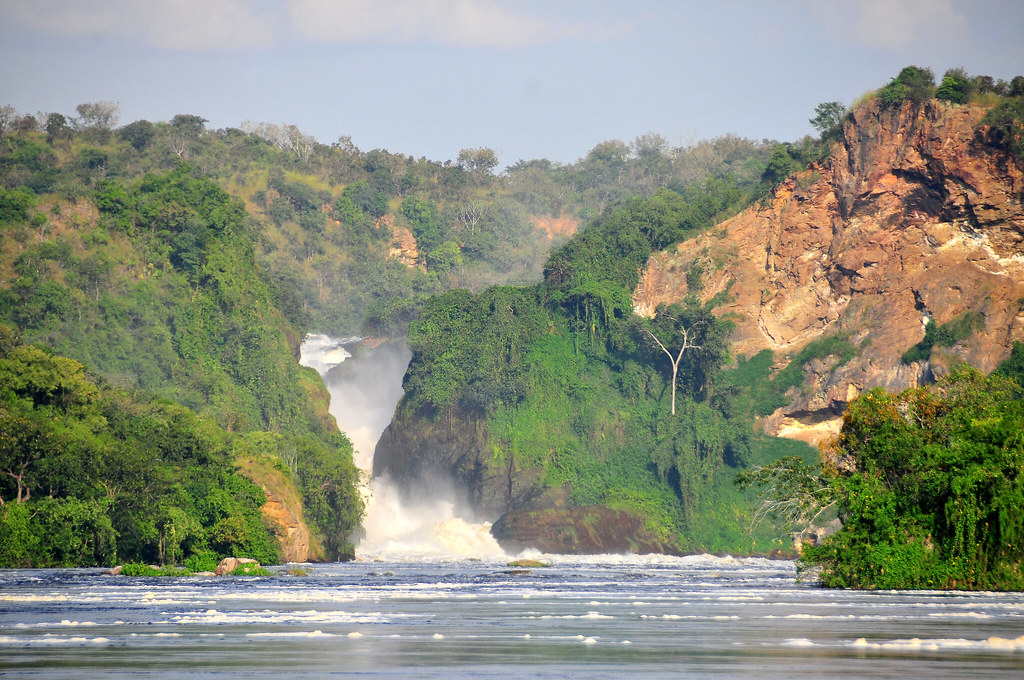
Murchison Falls is the headline stop on any Uganda waterfall trip, and a Murchison Falls safari is how most visitors see it. Here the Victoria Nile, which has been running wide and calm for miles, is forced into a cleft roughly seven metres across and drops about 43 metres into a pool locals call the Devil’s Cauldron. The falls are also known as Kabalega Falls, after the Bunyoro king. They give their name to Uganda’s largest national park, which sits between Lake Albert and Lake Kyoga.
Why is Murchison Falls famous? Mostly for that squeeze. Lake Victoria releases roughly 300 cubic metres of water a second into the Nile, and almost all of it reaches this gap, which is why you will often read that this is the most powerful waterfall in the world. That label is about force through a narrow channel rather than total volume: Victoria Falls on the Zambezi and the big Congo cataracts carry far more water across a much wider front. In Uganda, though, nothing else comes close, which makes Murchison the answer to “what is the biggest waterfall in Uganda” by any measure except height.
The name has its own history. Samuel and Florence Baker were the first Europeans to record the falls, in 1864, and Samuel named them after Sir Roderick Murchison, then President of the Royal Geographical Society. In the 1970s Idi Amin’s government renamed them Kabalega Falls, after the Omukama of Bunyoro who resisted British rule. The change was never formally made law, the old name came back after Amin fell, and today both names are in use. Ernest Hemingway crash landed a light aircraft just downriver in 1954, and a few historians argue that a Roman party sent up the Nile by Nero may have reached this area around 61 AD, though most doubt it. More recently, the government turned down a proposal for a hydro scheme at the falls in 2019 to protect the site’s value to tourism, which is good news for anyone booking a safari here.
Height is not the point here. Volume is. Standing at the top, you feel the rock shake and the spray soaks you within a minute, and the noise makes conversation hard. Rainbows form over the gorge on sunny mornings.
There are two ways to see the falls, and the best plan uses both. The launch cruise runs upstream from Paraa toward the base of the falls, passing hippos, crocodiles, elephants at the water’s edge and, with luck, a shoebill in the papyrus. Boats stop short of the turbulent water below the falls. From there you can be dropped at Baker’s Point and do the top of the falls hike with a ranger, a steep climb of roughly forty five minutes to an hour with steps and handrails on the worst sections. On the way up you get a view of Uhuru Falls, a second channel just north of the main gorge, which you cannot see properly from the boat or from the top car park.
Arrange your pickup before you start walking. If no afternoon boat is running, you need a vehicle waiting at the top. And go early: the slope faces the afternoon sun and the heat builds fast.
One blogger who ranked Uganda’s falls made a fair point: most people come to Murchison for the game drives and the river, and the falls are the bonus. That is the right way to frame it. Plan a full Murchison Falls safari itinerary of at least two nights, with a morning game drive on the northern bank, the cruise and the hike, and perhaps an afternoon of fishing for Nile perch below the falls with a licensed operator.

Sipi Falls Hiking Tour on the Slopes of Mount Elgon
For many travellers, a Sipi Falls hiking tour is the most beautiful waterfall day in the country. Three separate falls drop off the edge of the Mount Elgon massif near Kapchorwa in eastern Uganda. The main fall is usually given as 95 to 100 metres, with the other two, known as Simba and Ngasire, somewhere between 65 and 90 metres depending on whose measurements you trust; the World Waterfall Database puts the middle fall at about 75 metres. The village sits at around 1,775 metres, so mornings are cool. The name comes from the sep, a wild banana that grows along the river and is used in local medicine. Behind them the plains of eastern Uganda stretch toward Lake Kyoga, and on a clear morning you can see a very long way.

The full loop to all three falls is around seven kilometres and takes most people three to five hours, longer if you linger at each pool. If time is short, a path of about twenty minutes from the trading centre reaches the base of one fall, and on the main fall a ledge lets you walk behind the curtain of water, which is cold and loud and worth the soaking. Hire a local guide for the full loop. The paths weave through farms and village tracks, and without someone who knows them it is easy to end up in someone’s coffee garden. Guides are organised by the community and by the lodges around Sipi trading centre.
Trip reports agree on one thing: after rain, the steep descent to the base of the main fall turns into a slick mud chute. Some walkers give up on the final section. Porters wait at the trailhead in the wet months, and a walking pole helps more than you would expect. Boots with real grip matter more here than at almost any other Uganda waterfall.
Beyond the hike, Sipi offers abseiling beside the main fall with certified local operators, rock climbing on the cliffs, and Arabica coffee tours where farmers walk you through picking, roasting and brewing Bugisu coffee. Many travellers combine the falls with a trek on Mount Elgon itself. Our Sipi Falls tour guide covers the area in more depth.
Itanda and Kalagala Falls: Rafting Adventures on the Nile near Jinja
Itanda Falls is not a single drop but a set of heavy rapids on the Nile, around 27 kilometres downstream of Jinja town. It is one of the strongest stretches of white water in Africa, and a Nile rafting adventure is why most people come. The main rapid is so violent that rafting crews usually carry around it on foot. Upstream, Kalagala Falls pours over a rock shelf into a wide pool and is easier to enjoy from the bank.
Around both sites you will find rafting and kayaking companies, river surfing on standing waves, fishing, quad bike trails, horse riding and birding along the riverbank. Local people treat the area as sacred, and you may see offerings left near the water.
Be aware that the river here has changed. The Isimba dam further downstream flooded part of the old rafting run, and several named rapids are now under its reservoir. Rafting continues on the remaining stretch, but routes and grades differ from what older guides describe. Ask the operator exactly which section they run before you book.
Bujagali, Owen and Ripon Falls: Touring the Jinja Falls Lost to Dams
Many Uganda waterfall lists still recommend three falls near Jinja that you can no longer see. A Jinja tour will take you to where they were, which is interesting in its own right, but go in with the right expectations.
Ripon Falls marked the point where the Nile flows out of Lake Victoria. John Hanning Speke reached them in 1862 and named them as the source of the Nile. They were drowned when the Owen Falls Dam was completed in 1954. Today you visit the Source of the Nile on the west bank, take a short boat ride to the spot where the river leaves the lake, and look at the monument to Speke.
Owen Falls, known locally as Nalubaale, now lies under the dam of the same name, which still carries the main road from Kampala to Jinja across the river. There is nothing left of the falls to see.
Bujagali Falls were a series of big rapids a few kilometres north of Jinja and, for years, the centre of the town’s rafting and bungee scene. The rising reservoir of the Bujagali dam covered them in November 2011. The riverbank lodges and bungee platform still operate above the calm water, and Jinja remains a good base for Itanda, Kalagala and the Nile rafting companies.
Ssezibwa Falls Day Trip from Kampala
A Ssezibwa Falls day trip is the easiest waterfall outing from the capital, about 35 kilometres east of Kampala in Mukono District, just off the Jinja highway. The river drops through a narrow rock gorge, splits around the quartzite and falls into a dark pool. It is not large, and heights quoted for it range widely, but it has a story few falls can match.
According to Baganda tradition, a woman of the Kibe clan named Nakangu gave birth to twins, and one was not a child but a river. That river was Ssezibwa. Shrines sit around the falls, and people still come to pray, give thanks and ask for blessings, wealth, children or luck in love. Walk quietly near the shrines and ask your guide before taking photographs of anyone praying.
A trail climbs to the top of the falls for a view over the gorge and the forest. Birders log a good number of species in a short walk, and there are picnic spots by the water.
Manage your expectations on facilities. Visitors have described the attached resort as run down, and the site works best as a short stop on the drive to Jinja rather than a full day out. Pair it with the Source of the Nile and a rafting trip the next morning.
Karuma Falls on the Road to a Murchison Safari
Most travellers reach Karuma Falls on the way to or from a Murchison safari from the east, since the Kampala to Gulu highway crosses the Victoria Nile on the Karuma Bridge right beside them. These are not a single drop but a long run of white water over a rocky bed, turning the river into foam for several hundred metres. Speke crossed the Nile near here, and the local Luo name for the falls is often said to mean “great spirit”.
The Karuma hydro station, Uganda’s largest at 600 megawatts, is now running here, and because it diverts part of the river through underground tunnels, the rapids can look thinner than in older photographs. The view from the bridge area is still worth a stop. Baboons often sit along the roadside here, so keep food out of sight. For travellers coming from Kidepo or Gulu, Karuma also marks the eastern gateway into Murchison Falls National Park.
Kisiizi Falls Tour in Rukungiri
Deep in the hills of Rukungiri District, in the southwest, a Kisiizi Falls tour makes a good half day for travellers moving between Queen Elizabeth National Park, Lake Bunyonyi and Bwindi. The Kyabamba River drops into a forested gorge right next to Kisiizi Hospital, a fall quoted at anywhere from 27 to 36 metres depending on the source, and the falls drive a small hydro plant that supplies the hospital and nearby homes.
The site carries a dark history. For generations, the story goes, unmarried girls who became pregnant were thrown from the top of the falls as a punishment and a warning. Local accounts tell of one girl who held on to the relatives pushing her and pulled them over with her. The practice ended long ago, and a hospital now stands on the same ground.
Tourism revenue at Kisiizi supports the hospital. The Skytrail zip line runs in three stages across the gorge, a suspension bridge gives a view straight into the spray, a short path leads into a cave beside the falls for a face on view, and you can feel the mist from a hundred metres off on a full day. Short forest and birding trails lead around the site. Plan on about two hours. The roads into Kisiizi are rural murram, so ask your driver or your Kabale or Bunyonyi lodge about conditions before you set off, particularly in the rains.
Munyaga River Waterfall Hike in Bwindi
Bwindi has its own waterfalls, and most visitors to the park never hear about them. The Munyaga River waterfall hike starts at the park offices in Buhoma and follows the river upstream through old forest to a series of three falls, the tallest dropping roughly 30 metres over a wall of ferns and moss. It is one of the guided Bwindi nature walks, led by a ranger, and it takes around three to four hours there and back.

Expect primates and birds rather than gorillas. Black and white colobus, L’Hoest’s monkeys and red tailed monkeys are common along the river, with duikers sometimes crossing the trail and butterflies everywhere in the clearings. Birders can pick up several Albertine Rift endemics on the way, and the walk pairs well with birding in Bwindi on a separate morning.
The trail is steep in places and slick after rain. Wear the same boots and gaiters you pack for gorilla trekking, which our gorilla trekking packing list covers. Families with young children usually choose the shorter Buhoma community walk instead. The ideal slot is the afternoon after your Buhoma gorilla trek, or the spare day many travellers keep in case a trek runs long.
Rwenzori Mountains Waterfall Trekking
The Rwenzori Mountains on the Congo border are some of the wettest high ground in Africa, and their valleys are threaded with waterfalls. Serious hikers see them on the main summit routes, but you do not need to climb toward the glaciers to see them. A Rwenzori waterfall trek on the southern Kilembe side runs as a circuit of roughly four days, staying below the high peaks and passing a string of falls on the Nyamwamba River and its tributaries. Enock Falls, a short walk from Sine Camp on the first day, is the one most hikers remember.

Shorter day hikes from the trailheads near Kasese and Fort Portal reach smaller falls in the foothills, and the newer Mahoma trail climbs toward Lake Mahoma on the eastern slopes. Expect mud in the bamboo zone whatever the season, and very cold nights higher up. See our guide to Rwenzori Mountains National Park before planning anything longer than a day.
Aruu Falls Trip in Northern Uganda
An Aruu Falls trip takes you into Acholi country in Pader District, roughly 47 kilometres from Gulu off the road toward Kitgum. The Aruu River spreads over a wide, tilted rock face and splits into dozens of channels, so the falls look different from every angle. Pools between the rock steps are popular for swimming and the slabs make good picnic spots, but they are smooth and very slippery when wet.
The last stretch from the main road is a bumpy murram track, and a 4×4 is the sensible choice in the rains. Aruu fits neatly as a stopover on the long drive between Murchison Falls and Kidepo Valley National Park. Rock climbing, birding and short community walks round out a visit. Come with a local guide or arrange a visit through a Gulu hotel, since there is little in the way of formal facilities.
Mpanga, Nkusi, Mahoma, Sisiyi and Wanale: Off the Beaten Track Waterfall Adventures
Uganda has more falls than any one trip could cover. These five draw few visitors, which is much of their appeal.
A note on accuracy. Older lists online describe some of these falls with heights, distances and access routes that vary wildly from one source to the next. Treat any single figure with caution, and ask a local guide for current road and trail conditions before you commit a day.
Waterfalls on the River Nile in Uganda: A Source to Lake Albert Tour
A good share of the country’s falls sit on one river. Follow the Victoria Nile from Lake Victoria to Lake Albert and you pass most of the waterfalls in Uganda that people search for, some still roaring, some now under reservoirs. Read in order from the source, the river runs like this.
Between Itanda and Karuma the river crosses Lake Kyoga, which is why there are no big falls in the middle section. A Nile waterfall tour splits neatly into two halves: Jinja on a short trip east of Kampala, and Karuma and Murchison together on the drive north. Rafting operators in Jinja and launch operators at Paraa run the river activities, and the Murchison Falls safari planner covers how many days the northern half needs.
How Many Waterfalls Are in Uganda? Lesser Known Falls for Waterfall Trips
Nobody keeps an official count. The World Waterfall Database, a hobbyist catalogue that most waterfall lists draw on, holds 46 entries for Uganda, but that figure includes the drowned Jinja falls, rapids it does not class as true waterfalls such as Karuma and Busowa, and a dozen unnamed drops logged from maps. The real number of falls worth a visit is closer to twenty, and the sections above cover the ones with trails, guides and some kind of access.
The rest are for waterfall trips with plenty of time and a driver who likes a challenge. The same database records Iborogya Falls in the west, Kyansore Falls near Mbarara, Oliva Falls near Arua in the West Nile region, and names such as Kamdini, Ngite, Mungilo and Munyana with little or no visitor information attached. It also lists Nkusi on Lake Albert at about 100 metres, level with Sipi as one of the tallest in the country. Treat these as leads to ask about at your lodge or with a district tourism office rather than as planned stops; access, fees and even exact locations can be hard to confirm in advance.
For a broader list of what to see beyond the falls, our Uganda tours and things to do guide ranks the main attractions across the country, from gorillas and chimpanzees to the Rwenzori and the Nile.
Best Time to Visit Uganda’s Waterfalls on Safari
Uganda’s waterfalls flow all year, but how they look and how easy they are to reach changes with the seasons. The long rains run roughly from March to May and the short rains from October to November. December to February and June to September are drier.
| Month | Rain | Falls flow | Trails |
|---|---|---|---|
| Jan to Feb | Low | Moderate | Firm, dry |
| Mar to May | Heavy | Fullest | Muddy |
| Jun to Aug | Low | Good | Firm |
| Sep | Rising | Good | Mostly firm |
| Oct to Nov | Moderate | Strong | Slippery |
| Dec | Easing | Strong | Drying out |
For photographs of the falls at full force, the weeks during and just after the rains are best. Sipi, Wanale, Kisiizi and the Munyaga River falls look their strongest in April, May and November. The catch is the trails: the Sipi descent, the Rwenzori bamboo zone and the forest path in Bwindi all turn to mud, and a three hour walk can stretch to five. Pack a rain jacket, quick drying trousers and a dry bag for your camera, plus boots you do not mind ruining.
For easy walking and game drives, June to September and December to February work best. Murchison is the exception to the seasonal rule: the Nile is fed by Lake Victoria, so its flow stays heavy all year, and the dry months simply give better wildlife viewing on the way there. These months also line up with the best time to go gorilla trekking, so most combined trips land in them. If you are planning by season, low season months bring quieter trails at every waterfall and fewer vehicles at the gorilla trailheads.
Combining Uganda’s Waterfalls with a Bwindi Gorilla Trekking Safari
The waterfalls fall into three natural circuits, and each links to the gorillas in a different way.
Distances in Uganda are long and the roads slow, so do not try to tick off every waterfall in one trip. Murchison and Bwindi sit at opposite ends of the country, around a full day’s drive apart, and adding Sipi means another long day east. Domestic flights from Entebbe to airstrips near Murchison and Bwindi save time on tighter schedules, and our getting to Bwindi guide lays out the options. For somewhere to sleep near the park, see our pick of Bwindi safari lodges.
Book your Uganda gorilla permit first and build the waterfalls around it, since permit dates are the hardest thing to change. If you also want to compare Uganda’s falls with the rest of Africa, the region’s best known cascade is Victoria Falls on the Zambia and Zimbabwe border, which some travellers join to a gorilla trip by flying south. Rwanda’s Nyungwe Forest, an easy add on to Rwanda gorilla trekking, has a waterfall trail of its own, and a gorilla trip also pairs naturally with a Masai Mara safari in Kenya.
Uganda Waterfalls FAQ
Which is the most famous waterfall in Uganda?
Murchison Falls, in Murchison Falls National Park. The whole Victoria Nile is forced through a gap about seven metres wide before dropping roughly 43 metres, which makes it the most forceful waterfall on the river. Sipi Falls is the most popular for hiking.
What is the biggest waterfall in Uganda?
By force and volume, Murchison Falls, where roughly 300 cubic metres of Nile water a second pass through the gorge. By height, the tallest are the main Sipi Fall and Nkusi Falls on Lake Albert, each listed at around 100 metres, more than twice the 43 metre drop at Murchison.
Why is Murchison Falls famous?
Because the entire Victoria Nile is forced through a cleft about seven metres wide before it drops, which gives it more force than any other waterfall in the region and has earned it the popular title of the world’s most powerful waterfall. It also sits inside Uganda’s largest national park, so a visit comes with game drives, a Nile launch cruise past hippos and crocodiles, and a good chance of a shoebill.
What is the most famous waterfall in Africa?
Victoria Falls on the Zambezi, on the border of Zambia and Zimbabwe, is the best known and among the largest curtains of falling water anywhere. Murchison is the most famous in East Africa. Both can be joined to a gorilla trek; see our Victoria Falls safari guide.
How many waterfalls are in Uganda?
There is no official count. The World Waterfall Database lists 46 entries, including drowned falls, rapids and unnamed drops, while around twenty have trails, guides or regular visitors. Murchison, Sipi, Itanda, Ssezibwa, Kisiizi and Aruu are the ones most travellers see.
What are the top 10 tourist attractions in Uganda?
Most lists include gorilla trekking in Bwindi Impenetrable National Park, chimpanzee tracking in Kibale, Murchison Falls National Park, Queen Elizabeth National Park and its Kazinga Channel, the Source of the Nile at Jinja, Sipi Falls and Mount Elgon, Lake Bunyonyi, the Rwenzori Mountains, Kidepo Valley National Park and the Uganda Martyrs Shrine at Namugongo. Our things to do in Uganda guide goes through each.
How much does it cost to visit Murchison Falls?
You pay Murchison Falls National Park entry per 24 hours. On the latest Uganda Wildlife Authority tariff we could confirm, that was US$45 for foreign nonresident adults, US$35 for foreign residents and UGX 25,000 for East African citizens. The ranger guided top of the falls hike carries a small extra UWA fee, reported at around US$15 for foreign visitors, and the launch cruise is paid separately to the boat operator. Check the current UWA schedule before you travel, since tariffs are reviewed periodically.
What do the smaller falls such as Sipi and Ssezibwa charge?
Fees at falls outside the national parks are set by communities or site managers and change often. Ssezibwa has been reported at around UGX 10,000 to 18,000 for foreign visitors, with extra for a guided walk. At Sipi you pay a small community fee plus your guide, and operator led hikes typically start from about US$15 to 20 per person. Kisiizi charges separately for entry and for the Skytrail zip line. Carry Ugandan shillings in cash and confirm at the gate.
Can I see a waterfall on a Bwindi gorilla trekking safari?
Yes. The Munyaga River waterfall trail starts at Buhoma and reaches three falls inside the forest in three to four hours return, led by a UWA ranger. Kisiizi Falls is also within reach of Bwindi’s southern sectors and Lake Bunyonyi as a half day trip. The walk is booked as a Bwindi nature walk alongside your park entry. If you are trekking, a gorilla permit costs US$800 for foreign nonresidents, US$700 for foreign residents and UGX 300,000 for East Africans, with a US$600 low season rate announced for April, May and November.
Can you swim at waterfalls in Uganda?
At some. Aruu Falls has pools that people swim in, and Sipi’s main plunge pool is used by hikers on hot days. Never swim anywhere near Murchison, Karuma or the Nile rapids, where the currents are lethal and crocodiles live in the river. Ask your guide before getting in anywhere, and avoid swimming after heavy rain.
How fit do you need to be for the Sipi Falls hike?
Moderately fit. The full loop to all three falls is around seven kilometres with steep descents and climbs, and it takes three to five hours. If you can manage a day of hill walking you will be fine. Anyone with knee trouble can visit just the main fall from the top viewpoints.
Are Bujagali Falls and Owen Falls still worth visiting?
Not for the falls themselves. Owen Falls disappeared under the Owen Falls Dam in 1954 and Bujagali Falls were flooded by the Bujagali dam in 2011. Jinja is still worth a stop for the Source of the Nile, rafting from the remaining rapids and the riverside lodges where the falls once were.
What is the closest waterfall to Kampala?
Ssezibwa Falls in Mukono District, around 35 kilometres east on the Jinja road. Allow about an hour each way in normal traffic, more at peak times, and combine it with Jinja if you have a full day.
What should I pack for a waterfall tour in Uganda?
Boots with a good grip, a rain jacket, quick drying clothes, a dry bag or waterproof cover for your camera and phone, insect repellent, sunscreen and water. Gardening gloves help on slippery rock and nettled forest paths. The same kit works for gorilla trekking.
Is it safe to visit waterfalls in northern Uganda?
Yes. Northern Uganda, including the Aruu and Karuma areas, has been peaceful for many years and receives regular visitors. The main risks at any waterfall are slippery rock and fast water, so stay back from edges and go with a local guide.