Birding in Bwindi means walking forest trails with a bird guide to find some of Africa’s rarest montane species, led by the African green broadbill at Mubwindi Swamp. Most birders base a birding safari at Ruhija for two nights, then add Buhoma and the Neck, often alongside gorilla trekking. Bwindi Impenetrable National Park, in southwest Uganda, holds over 350 bird species, including 23 Albertine Rift endemics.
Gorillas put Bwindi on the map. Birds are why a certain kind of traveller stays a week. This guide covers the species worth targeting, the trails that produce them, the months that suit each kind of birder, how to find a good bird guide, what to pack, and how to fit a Bwindi birding tour around a gorilla permit without wrecking either day.
Bwindi Birds on a Birding Safari: Species and Endemics
A Bwindi birding safari works because of altitude. The park climbs from about 1,160 metres in the north near Buhoma to 2,607 metres on Rwamunyonyi Peak above Ruhija, so a single morning can move from lowland forest birds with Congo basin affinities to cool montane specialists that only live along the Albertine Rift. UNESCO lists more than 347 forest bird species for the park, and the Uganda Wildlife Authority uses a figure of about 350.
The number that matters to birders is the endemic count. Bwindi holds 23 Albertine Rift endemics, birds found only in the chain of mountains and forests running along the borders of Uganda, Rwanda, Burundi and eastern Congo. Published counts range from 22 to 24 depending on how a checklist treats a couple of borderline species, yet every version puts Bwindi at or near the top of any single site in East Africa. Several of these birds are also globally threatened. On the latest BirdLife assessments, Grauer’s broadbill and Grauer’s swamp warbler are listed as Vulnerable and Shelley’s crimsonwing as Endangered.
Not everything is hard. On a first walk you will probably log red headed bluebill, African emerald cuckoo, white tailed blue flycatcher, common bulbul, several greenbuls and a scatter of sunbirds without trying. A strong birder with a good guide can pass 100 species in a full day here, mostly by ear.
That last point surprises people. In closed forest, perhaps three birds in four are heard first, and some are never seen at all. Your guide’s ear does half the work.
Why does one forest hold so much? Bwindi is old. Its lower slopes are thought to have stayed forested through the dry spells of the last ice age, when much of the surrounding country turned to grassland, so it acted as a refuge where forest birds held on. It was protected as a forest reserve from 1932, became a national park in 1991 and was inscribed as a UNESCO World Heritage Site in 1994, which is why the habitat is still continuous from the lowland valleys to the bamboo.
Three Bwindi birds are evolutionary oddities that serious birders travel for in their own right. The African green broadbill, Grauer’s warbler and the short tailed warbler (also called Neumann’s warbler) each sit in a tiny genus with no close living relatives in Africa, and the broadbill’s nearest kin are thought to be the broadbills of tropical Asia. Seven Bwindi birds are listed among the trigger species that make the park a Key Biodiversity Area: the green broadbill, Grauer’s swamp warbler, Grauer’s warbler, handsome francolin, Rwenzori turaco, Shelley’s crimsonwing and Chapin’s flycatcher.
The older Important Bird Area inventory for Uganda, which this page has quoted for years, frames the park’s weight in national terms. It credits Bwindi with about 347 species, 24 of the 25 Albertine Rift endemics recorded in Uganda, 76 of the country’s 144 Guinea Congo forest biome species, 68 of its 86 Afrotropical highland biome species and 4 of the 12 Lake Victoria biome species, plus several globally threatened birds. Some 14 species recorded in the park are known from nowhere else in Uganda. Taxonomy has moved on since those tallies were made, so read them as the scale of the thing rather than an exact checklist.
Visitors from the north arrive too. Between about November and April, Palearctic migrants such as the barn swallow, common cuckoo and black kite pass through or winter in and around the park, adding a handful of familiar European birds to a forest list that is otherwise strange to most visitors.
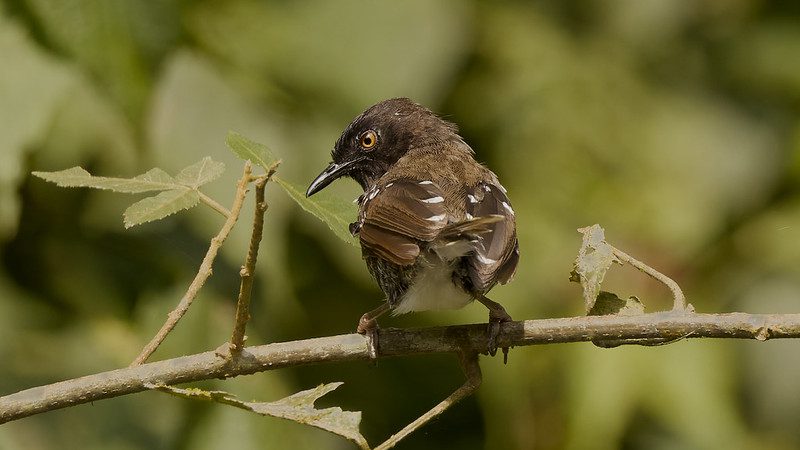
Albertine Rift Endemics to Target on a Bwindi Birding Tour
Every serious Bwindi birding tour builds its days around a short list of range restricted species. These are the birds most visiting birders put at the top of their lists, with where each one tends to turn up. Sightings depend on weather, season and luck, so treat this as a guide to effort, not a promise.
Beyond the endemics, wish lists often include black bee eater, bar tailed trogon, black billed turaco, great blue turaco, montane oriole and African wood owl. The black bee eater, a glossy black bird with a red throat, is a favourite at the Neck and around Buhoma. Lagden’s bushshrike, a big grey headed, green backed shrike with a flame orange throat, is a prize along the Ruhija road. Other names on a good Bwindi list include Jameson’s antpecker, white bellied robin chat, fine banded woodpecker, grey cuckooshrike, western green tinkerbird, cinnamon chested bee eater, white tailed crested flycatcher, many coloured bushshrike, Mackinnon’s shrike, dusky twinspot and black faced rufous warbler. Fraser’s eagle owl and the red chested flufftail are heard more than seen, and raptors overhead include the mountain buzzard, Ayres’s hawk eagle and Cassin’s hawk eagle. The African pitta is recorded but rarely found.
Outside the forest boundary, the farmland and swamps near Buhoma and on the road to Ruhija are good for the grey crowned crane, Uganda’s national bird, and for Ross’s turaco on the forest edge.
Mubwindi Swamp Birding Trail in Ruhija
The Mubwindi Swamp birding trail is the single most important walk for birders in Bwindi, and the reason Ruhija fills with telescopes rather than gorilla trekkers some weeks. The trail drops about 300 metres from the ridge through montane forest to a high altitude swamp, then climbs all the way back. Expect four to five hours return on a normal day, longer if a flock or a broadbill holds the group up, which is the hope.
The downhill feels easy. Most trip reports agree that the climb out is what people underestimate, especially after rain, when the clay turns slick and every root becomes a step. Walking poles help. So does an early start: the walk usually leaves Ruhija soon after first light, which gives the best chance of the broadbill calling and the francolin on the track.
Targets here include the African green broadbill, Grauer’s swamp warbler in the swamp itself, Carruthers’s cisticola, dusky crimsonwing, regal sunbird and Rwenzori batis. Access is controlled, so it has to be booked in advance through the Ruhija office or arranged by your lodge or operator, and you go with a ranger and usually a specialist bird guide. Carry a packed lunch and plenty of water.
Skip this walk and you skip several endemics. Groups that drop Mubwindi to save time often say so in their trip reports, and rarely without regret.
Ruhija is also the base for gorilla trekking in the east of the park, which is why so many birders combine the two. The Ruhija gorilla trekking guide covers the habituated families, lodges and the drive in.
Ruhija Bamboo Zone and Ridge Birding Walks
The bamboo zone birding walk climbs the other way from Ruhija, toward Rwamunyonyi Peak, the highest point in Bwindi. It passes one of the park’s few stands of mountain bamboo and runs through the coldest, mossiest forest you will see here. The full hike to the peak takes six to seven hours return and suits fit walkers; birders often turn around partway once the flocks have been worked.
Up here the birds change. Mountain masked apalis, white starred robin, Rwenzori turaco, Kivu ground thrush and montane sooty boubou are all possible, and sunbirds move between flowering plants along the forest edge. Mist sits in the trees on many mornings until about nine, so do not be surprised if the first hour is mostly listening.
Plenty of good birding also happens without a formal trail. The Ruhija ridge road and the edges around the village and lodges are productive at dawn and in late afternoon, when mixed flocks follow the forest edge and handsome francolins walk the verges. Two nights in Ruhija is the usual minimum for a serious birder: one full day for Mubwindi, and mornings and evenings on the ridge and the bamboo trail. Our Bwindi nature walks page lists the other Ruhija trails and their lengths. For everything else that fills the days around a trek, see our guide to things to do in Bwindi.
The Neck and the Buhoma Waterfall Trail Birding Tour
Between Ruhija and Buhoma the forest pinches into a narrow corridor locals call the Neck. The road runs through it beside a river, and because the road cuts an open strip through the trees, it is one of the easiest places in the park to see canopy birds without craning straight up. Most birding trips stop here for two or three hours on the transfer between the two sectors.
Birding the Neck is relaxed: you walk the road with your guide while the vehicle follows. Black bee eaters perch on exposed snags, bar tailed trogons call from the midstorey, and the river adds mountain wagtail and sometimes African black duck. Cassin’s hawk eagle, Chapin’s flycatcher and several greenbuls are also recorded along this stretch. It is a good place for anyone who finds dense forest birding frustrating, because the light is better and the birds sit in view.
At the other end, the Buhoma Waterfall Trail birding tour follows the Munyaga River into the forest from the main park gate. It is the oldest and busiest birding trail in the north of the park, lower and warmer than Ruhija, with a different set of birds. Expect turacos, greenbuls, sunbirds, the Kivu ground thrush near the start in the early morning, and with luck the bar tailed trogon. The full walk to the waterfalls takes about three hours return, and many birders do a shorter version along the lower river section.
Buhoma also has the widest choice of lodges and the most forest edge right outside the rooms. Lodge gardens here are worth an hour with binoculars before breakfast. The Buhoma sector guide has more on the area.
Two longer Buhoma walks suit birders with a spare day. The Habinyanja trail crosses the Munyaga River and climbs a steep ridge before easing down to the Habinyanja swamp, four to six hours in all, with black bee eaters and African black duck among the birds reported along it; a rock outcrop that looks like the map of Africa, known locally as the African Corner, sits on the way. The Rushura Hill walk gives fewer forest birds but wide views and raptors over the ridge. Village paths and tea gardens on the edge of Buhoma are worth a slow afternoon too, since weavers, mannikins, seedeaters and sunbirds feed in the gardens.

Birding Trips in Rushaga and Nkuringo
The southern sectors are gorilla country first, and dedicated birding trips here are less common. Still, the forest edge around Rushaga and Nkuringo is birdy, and the community walks and the long Ivi River trail between Nkuringo and Buhoma pass habitat where sunbirds, turacos, greenbuls and forest edge seedeaters are easy. Nkuringo sits high on a ridge, so montane birds overlap with the Ruhija list.
Lodges in Nkuringo point birders to two forest routes. The Ivi River trail drops from the ridge to the river and on toward Buhoma, and the Kashasha River trail follows another valley through the southern forest; both are long, quiet walks where bar tailed trogons, turacos and mixed flocks reward anyone willing to stop often. Around Rushaga, birders report Archer’s ground robin and the yellow eyed black flycatcher, and the quieter trails mean fewer people flushing birds ahead of you. Ask the sector office which routes are open, because some are booked as through hikes rather than birding loops.
For endemics, the southern side has one big advantage: it is close to Echuya Forest Reserve on the road to Kisoro. Echuya’s bamboo and Muchuya swamp are a known site for Grauer’s swamp warbler, and many birding itineraries stop there on the way to or from Mgahinga, where the Rwenzori turaco is more reliable. If you are trekking from Rushaga or Nkuringo, a half day in Echuya is the easiest way to add serious birding to the trip.
Best Time for Birding Safaris in Bwindi
A Bwindi birding safari works in every month. The question is which trade you prefer: drier trails and easier walking, or more song, more breeding activity and visiting migrants with mud to match. Rain can fall on any day here, since this is a rainforest.
Bird guides tend to pick out two sweet spots. Late May and June bring the peak of nesting, with food plentiful from late May into September, and the green broadbill is most often found along the Mubwindi trail from about May to July. March and September are also named by local guides as strong months, when song is high and the trails are not yet at their worst. June and July are usually the driest.
Time of day matters more than month. The first three hours after dawn are the most productive almost everywhere, a second burst comes in late afternoon, and the middle of the day can go quiet in the forest interior. Mornings in Ruhija start cold and misty, so be in position before the mist lifts. For how the seasons also affect gorilla treks and road access, see the best time for gorilla trekking in Uganda.
Bird Guides and a Typical Birding Day in Bwindi
All walks inside the park go with a Uganda Wildlife Authority ranger guide. For birding, ask for a specialist bird guide as well, or travel with a birding operator who brings one. The difference is huge. A good Bwindi bird guide knows the calls of the endemics, knows which tree the broadbill was using last week, and can pick a flock’s composition by sound before anyone has raised binoculars.
Independent bird guides are based around Buhoma and Ruhija, and some lodges can arrange them. Book ahead in the busy months, because the best guides are often committed to birding groups. Ask what species they have seen recently, which trail they suggest for your targets, and whether they carry a scope.
A typical birding day runs something like this. Breakfast before dawn, on the trail by about 6.30, slow walking with long pauses until lunch, then a rest and a shorter session on the forest edge from about 3.30 until dark. Group size changes everything. Two or three birders with one guide will see far more than a group of eight, because forest birds will not wait for people at the back to get in position.
Guides use playback sparingly in Bwindi, and a responsible guide will stop if a bird is clearly disturbed or near a nest. Some guides use a green laser pointer to show a bird high in the canopy, which saves a lot of “which branch?” frustration. Follow their lead on both.
A few park rules shape the day. Birding inside Bwindi is booked through the Uganda Wildlife Authority and walked with a ranger, often an armed one, and you stay on the trail. Keep well back from any nest, and never flush a bird for a photograph. Dull greens, browns and greys help far more than people expect; a white shirt in dark forest is visible from fifty metres. Some trip reports note that birders who finished their targets early were glad they had booked the extra day anyway, because the weather can wipe out a morning.
Bird Photography on a Bwindi Birding Tour
Bird photography in Bwindi is harder than almost anywhere else on a Uganda birding tour, and it helps to know that before you pack. The forest birds here are easy to hear and hard to see, and harder still to photograph. Light under the canopy is dim even at midday, many birds stay high or deep in tangles, and the best views often last two or three seconds.
Work with the conditions rather than against them. A body that produces clean files at high ISO matters more than the longest lens, and an image stabilised zoom in the 100 to 400 mm or 150 to 600 mm range is light enough to carry down to Mubwindi and back. Shoot wide open and accept some noise. Flash is a poor idea in the forest, since it disturbs birds and flattens the image, and many guides will ask you not to use it near nests.
The best photographs usually come from the open places. The road through the Neck, the Ruhija ridge at dawn, lodge gardens and the forest edge in Buhoma all put birds against the sky or in side light. Sunbirds on flowering shrubs, turacos crossing a gap and bee eaters on a dead snag are realistic subjects. The broadbill, if you find it, may sit still for a while near a nest, but your guide will set the distance. Our guide to photography on a gorilla trek covers camera settings that also suit forest birding.
Combining Birding with Gorilla Trekking in Bwindi
Most visitors to Bwindi come for gorilla trekking, and a birding safari fits around it easily, as long as you treat them as separate activities. A gorilla trek group moves to reach its family, and the ranger will not stop for a sunbird. You will see birds on the way, but planning a trek as a birding walk only leads to disappointment.
The simplest plan is one extra night for each activity. Trek gorillas from Ruhija on one day, walk to Mubwindi Swamp the next, then bird the Neck on the transfer to Buhoma and spend a morning on the waterfall trail. That gives four nights in the park and covers the main birding sites alongside one gorilla trek. Permits are the fixed point, so secure them first through the Uganda gorilla permits guide and build the birding days around the date you get.
Birders who want a slower day with gorillas sometimes choose the gorilla habituation experience in Rushaga, which keeps you in the forest for most of the morning with a semi habituated family. And for a broader view of what else lives here, from L’Hoest’s monkeys to forest elephants, read our guide to Bwindi wildlife and primates.
Birding Gear for a Bwindi Forest Trip
Forest birding is tougher on gear than savannah birding. The light is low, the air is wet, and you will spend hours looking up into the canopy in drizzle. The right kit makes a bigger difference here than on almost any other safari.
Binoculars come first. In dark forest, aperture matters more than magnification. An 8×42 gathers plenty of light, gives a wide field of view for finding a bird that is moving through leaves, and focuses close enough for the warblers and ground birds by the trail. Look for a roof prism model that is fully waterproof and fogproof, which means nitrogen or argon filled, because cheap glass mists up inside after one wet morning in Ruhija. A waterproof 8×42 birding binocular from makers such as Vortex, Nikon or Celestron covers almost every birding situation in Bwindi. If you prefer more reach on open edges like the Neck, a 10×42 binocular with ED glass works too, though it is harder to hold steady after a steep climb.
Carry them on a binocular chest strap rather than a neck strap. Five hours with 700 grams hanging from your neck on the Mubwindi climb is not pleasant, and the chest strap keeps the glass from swinging into branches. A binocular rain guard and a few microfibre lens cloths stop the lenses streaking every time you lift them in drizzle. For the optics themselves, our camera and binoculars guide goes deeper on sizes, weights and what to bring for photography.
A field guide matters more than people expect. Your guide will name birds fast, and checking plumage in a book that evening is how the names stick. The standard reference for the region is the Stevenson and Fanshawe guide; look for a current field guide to the birds of East Africa. A phone app is lighter, but a book survives rain and dead batteries.
Rain protection is the third pillar. A rain cover for a camera and telephoto lens lets you keep shooting when the showers start, and a waterproof backpack rain cover keeps the field guide, spare batteries and lunch dry. Add a light rain jacket that does not rustle; the swish of a stiff shell is enough to flush a skulking warbler. Our rain jacket guide covers what works in Bwindi.
The rest overlaps with a gorilla trek. Waterproof boots with real grip for the Mubwindi descent, long trousers tucked into gaiters against safari ants, gardening gloves for grabbing vines, and a rechargeable waterproof headlamp for dawn starts and the nightjar walk at dusk. A small notebook and pencil also earn their place for logging calls. You will find the full kit in the gorilla trekking packing list and across the Safari Gear & Clothing section.

Planning Your Bwindi Birding Safari
Where you sleep shapes the birding. Ruhija is the base for Mubwindi Swamp and the bamboo trail, with a handful of lodges along the ridge; Buhoma has the most choice and the easiest forest edge birding. A typical birding route spends two nights in Ruhija and two in Buhoma, linked by the Neck. Our Bwindi safari lodges guide lists options by sector and budget.
Getting to Ruhija means either a long road transfer from Kampala or Entebbe, or a scheduled or charter flight to Kihihi or Kisoro followed by a drive on hill roads. The ridge road to Ruhija is rough in the rains, so a four wheel drive with an experienced driver is the norm. Details are in the getting to Bwindi guide.
Most birders travel with an operator who handles permits, Mubwindi bookings, the bird guide and the vehicle. Specialist companies run set departures and private trips, such as these Uganda Birding Tour Packages, while general safari companies can add birding days to a gorilla itinerary. Compare licensed options on our gorilla safari companies page and ask each one which bird guide they use.
Uganda Birdwatching Tours Beyond Bwindi
Uganda records over 1,000 bird species, more than half of all species found in Africa, in a country about the size of Britain. That density is why many birders call it the best birding destination in Africa, and why a Bwindi stay usually sits inside a longer birdwatching tour.
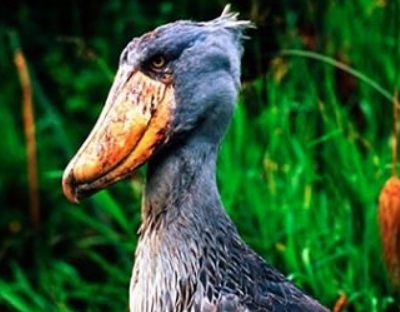
The usual extensions follow the road network. Mgahinga Gorilla National Park on the Virunga slopes is the place for the Rwenzori turaco and other high altitude species on the Gorge trail. To the north, the Bigodi wetland boardwalk beside Kibale Forest is a classic for great blue turaco and papyrus birds, and pairs with chimpanzee trekking in Kibale. Queen Elizabeth National Park, on the road between Bwindi and Kibale, adds water birds on the Kazinga Channel and raptors over the plains, while Murchison Falls and the Mabamba wetland near Entebbe are where most people look for the shoebill. Semuliki in the far west holds Congo basin species found nowhere else in East Africa. Our guide to Uganda safari tours links these parks into one route.
The wider circuit has more. Lake Mburo National Park, a natural overnight stop on the road between Kampala and Bwindi, is good for acacia birds, the red faced barbet and the African finfoot along the lake edge. The Rwenzori Mountains share many Albertine endemics, including the Rwenzori turaco and golden winged sunbird, on hikes into the montane forest. On the way north, the Royal Mile in Budongo Forest is a classic for forest kingfishers and hornbills, and Murchison Falls adds the shoebill, standard winged nightjar and a long list of savannah and river birds from the launch trip. Closer to Entebbe, Lutembe Bay on Lake Victoria hosts large numbers of migrant terns and waders, the Nile at Jinja gives easy river birding by boat, and Ziwa, the rhino reserve north of Kampala, combines rhino tracking on foot with shoebill chances in its swamps. Uganda has one bird found nowhere else in the world, Fox’s weaver, a bird of the seasonal swamps in the east of the country.

Across the border, Rwanda’s Nyungwe Forest shares many of the same Albertine endemics and fits a Rwanda gorilla trekking trip. Further afield, birders often pair Bwindi with the plains birds of the Masai Mara or the Serengeti, or with the endemic vangas and couas of Madagascar.
Bwindi Birding FAQ
How many bird species live in Bwindi?
About 350 species are recorded in Bwindi Impenetrable National Park; UNESCO gives a figure of more than 347. Of these, 23 are Albertine Rift endemics in the count most widely used, though checklists range from 22 to 24.
Where is the best place to see the African green broadbill?
The Mubwindi Swamp trail below Ruhija, in the east of the park. It is the best known site in the world for the species. Go with a specialist bird guide who knows recent nest or calling sites, start early, and allow a full morning. Sightings are never guaranteed.
How much does a birding walk in Bwindi cost?
On the latest UWA conservation tariff we could read, birding and day nature walks in Bwindi are listed at US$40 for foreign non residents, US$30 for foreign residents and UGX 30,000 for East African citizens, plus park entry of US$40, US$30 and UGX 20,000 per day. A specialist bird guide is paid separately and agreed in advance. Older pages still quote lower rates and UWA revises its tariff periodically, so confirm with UWA or your operator.
What does a gorilla permit cost if I add a trek to a birding trip?
A Uganda gorilla permit is US$800 for foreign non residents, US$700 for foreign residents and UGX 300,000 for East African citizens. UWA has announced a low season rate of US$600 for non residents and US$500 for foreign residents in April, May and November; those permits cannot be rescheduled. Permits are paid in full at booking.
Can I go birding during a gorilla trek?
You will see and hear birds, but the trek moves at the pace needed to reach the gorillas, and the ranger will not stop for birding. Book a separate birding walk on another day, ideally from the same lodge, so both activities get proper time.
How fit do I need to be for the Mubwindi Swamp trail?
Reasonably fit. The trail descends about 300 metres to the swamp and climbs back the same way at over 2,000 metres altitude, usually four to five hours in total. Most people manage with steady pacing, walking poles and plenty of water. The trekking difficulty guide explains how to prepare.
How many days do I need for birding in Bwindi?
Three to four nights covers the main sites: two in Ruhija for Mubwindi Swamp and the ridge, then the Neck on the transfer and one or two in Buhoma for the waterfall trail. Add a night if you also want a gorilla trek without cutting into the birding.
Which binoculars work best in Bwindi forest?
A waterproof, fogproof 8×42 is the best all round choice: bright enough for dark forest, wide enough to follow moving birds, and still light on long climbs. Pair it with a chest strap and a rain guard.
Where is the best birding in Bwindi?
Ruhija, in the east of the park, is the best birding base, because the Mubwindi Swamp trail, the bamboo zone and the ridge road all start there. Buhoma in the north is the easiest place for forest edge birding, and the Neck, the forest corridor on the road between the two, gives some of the clearest canopy views in the park. Rushaga and Nkuringo in the south are quieter and sit close to Echuya Forest.
What is the best time for birding in Bwindi?
Birding works all year. The peak nesting season runs from about May to June, the African green broadbill is most often found from May to July, and migrants from Europe and Asia are present from about November to April. June, July, December and January are the driest months for the steep trails.
Do I need my own bird guide, or is the park ranger enough?
A ranger goes on every walk inside the park, but rangers are trained for safety and general wildlife, not for finding skulking endemics. For the broadbill, the swamp warbler and the crimsonwings, a specialist bird guide who knows the calls and recent sites makes the difference between hearing a bird and seeing it.
Is Bwindi good for beginner birders?
Yes, with the right expectations. Forest birding is harder than savannah birding, because birds hide in leaves and are often only heard. Start with the forest edge at Buhoma and the Neck, where views are easier, and let a bird guide do the finding. Beginners usually enjoy the colourful sunbirds, turacos and bee eaters most.