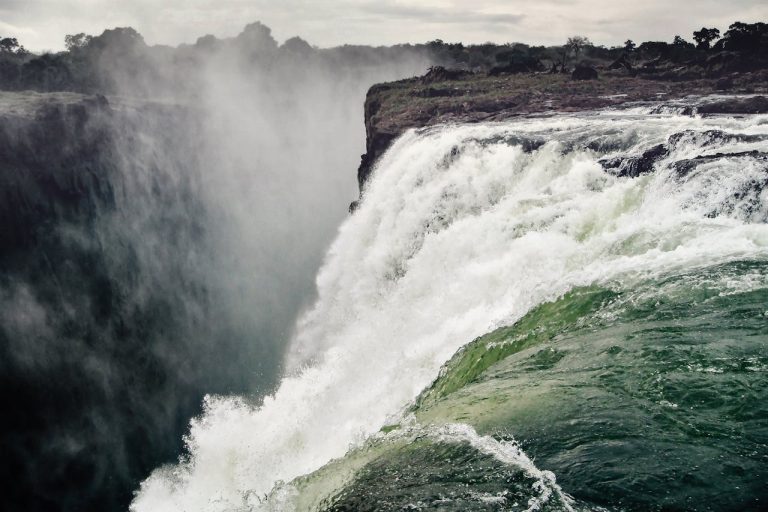
Victoria Falls sits on the Zambezi River on the border of Zambia and Zimbabwe, and the Victoria Falls Zambia side is the eastern end, reached from Livingstone through Mosi oa Tunya National Park about 10 kilometres south of town. It holds roughly a quarter of the curtain but the closest views: the Knife Edge Bridge, the Boiling Pot trail and, when the river drops from about mid August, Devil’s Pool on Livingstone Island. Fly into Livingstone or walk over the bridge from Zimbabwe.
Is Victoria Falls in Zambia or Zimbabwe? Choosing a Side for Your Trip
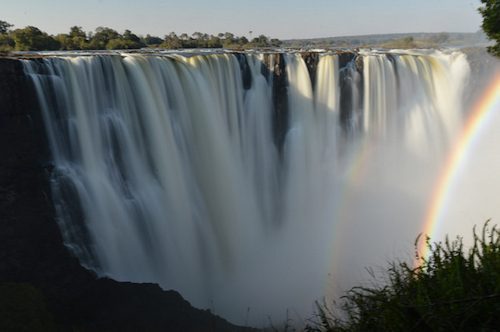
Both. The Zambezi forms the border, so the lip of the falls runs between the two countries and each side has its own national park, town, airport and gate. Zimbabwe holds roughly two thirds to three quarters of the frontage, with a long rainforest path and about sixteen viewpoints facing the Main Falls, Devil’s Cataract and Rainbow Falls. Our Zimbabwe safari guide covers that side, its rainforest walk and the parks beyond it in detail.
The Zambian side is shorter and closer to the water. You look straight across at the Eastern Cataract, stand on a footbridge wrapped in spray and can scramble down to the river at the Boiling Pot. Only Zambia offers Livingstone Island, Devil’s Pool and microlight flights. Livingstone also sits nearer the upper Zambezi, where most riverside lodges, canoe trips and sunset cruises are based, and meals, rooms and activities often cost a little less than across the river.
So is it better to see Victoria Falls from Zambia or Zimbabwe? For the classic wide panorama, Zimbabwe wins, and it keeps water falling all year. For getting close, getting wet and the island, Zambia wins. Timing tips the balance. From roughly October to early December the Zambian half of the curtain can shrink to a trickle or bare rock, while in the peak flood months spray on both sides can be so heavy that you see little more than white cloud.
Plenty of travellers do both in one day.
The bridge between the two border posts is a short walk or taxi ride. From each park gate it takes about ten minutes on foot to reach immigration, then about fifteen minutes to walk the bridge itself on a marked path beside the queue of trucks. The posts open from early morning, around 6am, until about 6pm, so finish any crossing in daylight. A common plan is two nights in Livingstone for the island, the rhino walk and the river, plus a morning on the Zimbabwe rainforest path. If one base suits you better, pick Livingstone for riverside lodges, a quieter town and the Zambian activities, or Victoria Falls town for a compact centre where you can walk to the park gate in minutes.
Walking Tour of the Zambian Falls: Eastern Cataract, Knife Edge Bridge and Boiling Pot
A self guided walking tour inside Mosi oa Tunya National Park takes two to four hours, depending on how long you linger and whether you tackle the steep trail down to the river. The gate opens at 6am and closes at 6pm, and your ticket covers one entry only, so plan to see everything in a single visit. Local guides wait near the entrance if you would like one, a curio market sits beside the entrance road, and raincoats can be hired there in the wet months.
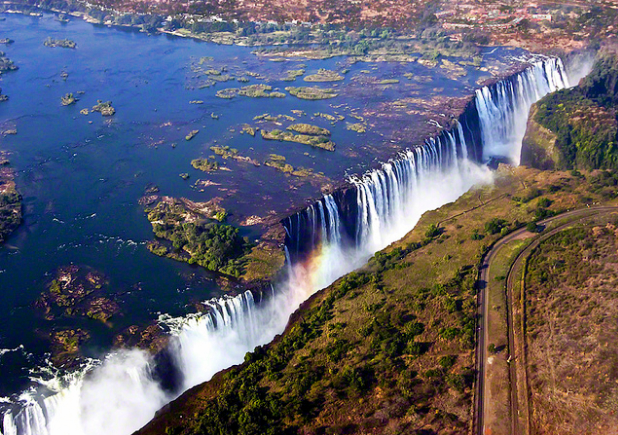
From the gate, the path follows the lip of the gorge to the Knife Edge Bridge, a narrow footbridge over a deep cleft that leads to a promontory facing the Eastern Cataract and the Boiling Pot below. In high water this is the wettest spot at the falls. Expect to be soaked within seconds, and wrap phones and passports in a dry bag. In low water the same walk shows the bare basalt of the lip and the zigzag gorges below, each one an old line of the waterfall.
The Boiling Pot trail drops through riverine forest to the edge of the Zambezi, where water from the whole falls swirls in a deep pool before running into the gorges. It is steep and slippery in places, with rocks and steps rather than a smooth path, so shoes with good grip matter more here than anywhere else in the park. Climbing back up takes longer than most people expect in October heat, and from the bottom you look up at the Victoria Falls Bridge from below.
A short path also runs upstream along the river, close to where the Zambezi slides over the lip. Signs mark the limits. Stay behind them: unlicensed “guides” sometimes offer walks across the rocks to the edge in low water, and accidents have happened on those trips.
Baboons and vervet monkeys work this park. They open bags, grab food and will bite if cornered, so keep snacks out of sight, never feed them, and hold on to anything you set down on the bridge railings. Drones are not permitted over the falls.
For photographs, mid morning and mid afternoon give the best rainbows on this side, while midday light flattens the spray. Guests at the two hotels inside the park, Avani Victoria Falls Resort and the Royal Livingstone, use a private gate, walk to the falls without the drive and, at the latest check, do not pay separate entry for the falls.
Livingstone Island and Devil’s Pool Tours: Seasons and Safety
The Livingstone Island tour is what most people mean when they talk about the Zambian side. A boat leaves the island launch site on the river near the Royal Livingstone and crosses the upper Zambezi to the island in the middle of the falls, the spot where Livingstone first looked over the edge and where a plaque now marks his visit. Hippos and crocodiles often rest along the way. From there a guide walks the group to the lip and, when the river is low enough, into Devil’s Pool, a rock basin on the very edge of the drop.
Only one licensed operator runs the trip, through Tongabezi, and visiting the island independently or with a private guide is not allowed. Groups are capped at around two dozen people. There are several departures a day: shorter morning trips with breakfast, a longer lunch trip and an afternoon high tea, with the island trip itself running for longer each year than the swimming season. Morning slots give the best chance of a rainbow below you while you sit in the pool.
The river sets the season, not the calendar. Devil’s Pool usually opens from about mid to late August and stays open until late December. For much of the rest of the year, when the water is too high for the main pool, guides take swimmers to Angel’s Pool, a shallower basin nearby. In the peak flood months, roughly from late February or March into the middle of the year, the island can close because the boat crossing is unsafe. The exact dates move each year with the rains upstream in Angola and western Zambia, so check river levels before you fix your dates around the pool.
Swimmers must be at least 12 years old, and children of 8 or over can visit the island without swimming. You will be asked to swim a few strokes across current to reach the pool, holding a rope or a guide’s hand, and guides can refuse anyone who seems nervous in the water or if the river looks too high on the day. Trip reports repeat the same few points: wear swimwear under your clothes, leave valuables at the hotel, and let the guide hold your camera rather than taking it into the water. Popular slots in September and October fill weeks ahead.

Victoria Falls Geology and Gorge Tour: What Makes the Falls Special
Victoria Falls is neither the tallest waterfall in the world nor the widest. What sets it apart is the combination: at about 1,708 metres across and 108 metres high, it forms the largest single curtain of falling water anywhere, roughly twice the height of Niagara and close to twice its width. The Zambezi does not speed up or narrow before the drop. It simply runs flat and wide to the edge, then falls the whole width of the river into a slot.
That slot is the key to a geology tour of the falls. The water drops into the First Gorge, a chasm only 25 to 75 metres wide facing a rock wall of the same height, which is why you can stand on the Zambian side and look straight into the falls from a few dozen metres away. The whole river then squeezes out through a narrow exit into the Boiling Pot and turns into the zigzag Batoka Gorge. The Second Gorge carries the Victoria Falls Bridge, and further down come the Third, Fourth and Fifth gorges and the Songwe Gorge, about 140 metres deep.
Each of those gorges was once the line of the waterfall. The falls sit on a sheet of basalt laid down as lava some 180 to 200 million years ago and cracked by joints as it cooled. The Zambezi finds a weak east to west crack, carves it out into a new gorge, then cuts back upstream along a north to south crack until it meets the next line of weakness. The zigzags below the bridge record eight earlier positions of the falls. Devil’s Cataract on the Zimbabwe side, lower than the rest of the lip, is already cutting back along the next weak line.
Flow swings hugely through the year. The mean is about 1,088 cubic metres a second, monthly averages range from around 300 in the dry months to about 3,000 at the flood peak, and the highest flow on record reached about 12,800. At peak flood the spray rises hundreds of metres and can be seen from many kilometres away, which is where the name “the smoke that thunders” comes from. In 2019 a drought across southern Africa pushed the falls to their lowest flow in about a century, and in dry years the Zambian side runs bare earlier than usual.
The spray also waters a strip of rainforest on the cliffs facing the falls, with ebony, mahogany, ivory palm and wild date palm growing in a region that is otherwise dry mopane woodland. Around 35 species of raptor use the gorges, including the rare Taita falcon, Verreaux’s eagle, the peregrine falcon and the augur buzzard. The falls also split the river’s fish: roughly 39 species live below the drop and about 84 above it, since nothing swims back up.
Livingstone History Tours: Names, Explorers, the Bridge and the Museums
Long before any explorer arrived, people living along the Zambezi had names for the falls. The Kololo and Lozi called them Mosi oa Tunya, the smoke that thunders. The Tonga name, Shungu Namutitima, means boiling water, and older names recorded by Livingstone, Seongo and Chongwe, are often translated as the place of the rainbow. Tonga families have lived in the valley for centuries and tell of Nyami Nyami, a river spirit with a serpent’s body said to live in the Zambezi, whose carved image you will see on walking sticks and pendants all over Livingstone’s craft markets.
David Livingstone first heard of the falls in 1851 and reached them in November 1855, paddled by local guides to the island on the lip that now carries his name. He came back in 1860 with the botanist John Kirk to study them. For the next half century, travellers crossed the river upstream at the Old Drift by canoe or barge, and early settlers lived there until fever drove them to higher ground, where Livingstone town grew from 1904. The Victoria Falls Bridge opened in 1905 to carry the railway north. It was placed across the Second Gorge so that spray would drift over passing trains, and steel for it was shipped from England and built out from both banks to meet in the middle. Livingstone served as the capital of Northern Rhodesia until 1935, and the falls and their parks became a UNESCO World Heritage Site in 1989.
A short town tour takes in colonial era buildings along Mosi oa Tunya Road, the Maramba market and the craft stalls, where bargaining is normal and both dollars and kwacha are taken. The Livingstone Museum, Zambia’s oldest and largest, holds a collection of David Livingstone’s letters and maps beside displays on the country’s history and wildlife, and the Railway Museum keeps old steam engines from the line that crossed the bridge. The bridge tour explains how it was built and lets you walk beneath the deck. Village visits to Mukuni and other communities around the town can be arranged through most lodges.
Mosi oa Tunya Game Drives and the White Rhino Walking Safari
Mosi oa Tunya National Park covers about 66 square kilometres in two parts: the falls section and, upstream along the river, a small game park of open woodland and grassland. A game drive here lasts two to three hours and works as a gentle first safari rather than a substitute for a big park. Plains zebra, giraffe, buffalo, impala, warthog and elephants crossing the river are the usual sightings. There are no resident lions, which is why walking here feels relaxed.
The main reason to go is the white rhino walking safari. A small population of southern white rhinos was reintroduced to the park, and armed wildlife scouts from Zambia’s Department of National Parks and Wildlife watch them around the clock. Licensed operators drive guests to the area the scouts are covering, then the group walks in quietly on foot, usually stopping some tens of metres from the animals. On most days the scouts know where the rhinos are, which makes sightings very likely, though no operator can promise one.
Wear muted greens and browns rather than white or bright colours, closed shoes and a hat. Operators set a minimum age for walks, often in the early teens, so families with younger children should book the drive instead. Morning walks run cooler and the light is softer for photographs.
The bird list around the falls is long, with African finfoot and Schalow’s turaco along the river and the Taita falcon nesting in the gorges. Birders get more from a slow boat on the upper Zambezi than from the drive.

Adventure Trips from Livingstone: Rafting, Bungee, Gorge Swing and Flights
Livingstone made its name as an adventure town, and most of the big activities run from the Zambian bank or can be booked from either side. Lodges book all of them, so there is little need to reserve before you arrive unless your dates fall in the September to November rush.
White water rafting on the Zambezi runs through the Batoka Gorge below the falls and carries grade five rapids. In low water, roughly August to January, the full run of about 23 rapids is open and trips start near the Boiling Pot. Half day trips cover the first stretch of about 14 rapids, which holds the biggest water, and full day trips carry on downstream. In high water, from around February to July, only the lower rapids are run, the hike in changes, and at peak flood rafting stops for spells. The real workout is the climb out of the gorge at the end, a steep climb of around 200 metres. Riverboarding and kayak trips use the same water, and at the lowest levels a calm float near the base of the falls is sometimes offered.
The bungee jump from the middle of the Victoria Falls Bridge drops about 111 metres toward the river. You do not need to stamp out of Zambia to jump; show your booking at the border post and walk out to the platform. A gorge swing, a bridge swing, ziplines and a bridge slide operate on the gorge edges nearby, and abseiling courses run on the Zambian rim.
For the view from above, microlight flights leave only from the Zambian side. They take one passenger behind a pilot, fly low over the falls and the game park for about 15 minutes, and do not allow personal cameras for safety, so photos come from a wing mounted camera you can buy afterwards. Early morning, around 7am, gives calm air and soft light. There is a passenger weight limit, and flights are often postponed in the rains. Helicopter flights, the “flight of angels”, also fly from Zambia and Zimbabwe and suit anyone who wants a closed cabin and room for a camera. In the high water months, when spray hides the falls from the paths, a flight is the only way to see the full width.
Some lodges still sell lion walks near Livingstone. These involve captive bred lions, and conservation groups question their release claims, so read up before you book.
Zambezi Sunset Cruises, Canoe Safaris, Dinner Trains and Lunar Rainbow Tours
Above the falls, the Zambezi spreads wide and slow around wooded islands, and this stretch is where the calmer trips happen. A sunset cruise lasts about two hours, on boats that range from large party decks with an open bar to small private launches, some with a barbecue on board. Hippos, crocodiles and elephants drinking on the islands are frequent sightings, and the sun drops over the water.
Canoe safaris on the upper Zambezi go further. Guides steer two person inflatable or fibreglass canoes down side channels between the islands, past hippo pods, with lunch on a sandbank. They suit anyone of average fitness and run in all but the highest water. Fishing trips for tigerfish leave from the same lodges, usually on a catch and release basis.
Evenings bring their own outings. The Royal Livingstone Express is a dinner train pulled by a restored steam engine that runs from Livingstone through the countryside and stops on the Victoria Falls Bridge at sunset, with several courses served in vintage carriages. It departs only on set days of the week and needs booking ahead. Closer to town, the Mukuni Boma evening at the Avani, held on set nights, serves Zambian food with drumming and dancing, and several riverside decks, among them the Victoria Falls Waterfront and the Royal Livingstone, are good spots for a sundowner without booking a cruise.
The lunar rainbow tour is a night visit to the falls for the few evenings around each full moon, when spray and moonlight produce a pale rainbow. It is strongest in the high water months, roughly March to July. Clouds and very heavy spray can hide it, so treat it as a bonus rather than the centre of your trip.
Victoria Falls Zambia Weather and Water Levels by Month
Water level decides almost everything on the Zambian side: how much falls you see, whether you get soaked, which rapids run and when Devil’s Pool opens. Rain falls on the Zambezi’s catchment from November to March, but the flood takes weeks to travel down the river, so the falls peak around March and April, well after the local rains begin. The lowest water comes in October and November.
| Month | Zambezi flow | Zambian falls | Island and pool |
|---|---|---|---|
| January | Rising | Filling out | Varies |
| February | Rising fast | Heavy spray | Often closing |
| March | Near peak | Soaking spray | Closed |
| April | Peak | Spray hides view | Closed |
| May | High | Heavy spray | Closed |
| June | High, easing | Full curtain | May reopen |
| July | Moderate | Clear view | Island open |
| August | Moderate | Clear, thinning | Pool opens |
| September | Low | Gaps showing | Pool open |
| October | Very low | Mostly rock | Pool open |
| November | Lowest | Dry or trickle | Pool open |
| December | Low, rising | Trickle | Pool to late Dec |
January and February bring hot, humid days, afternoon storms and a river rising fast. The Zambian curtain fills out again and rafting moves to the lower gorge as the weeks go on. Pack a light rain jacket and expect some lodge discounts.
March to May is the full flood. The falls are at their loudest and the spray column can be seen from many kilometres away, but on the Knife Edge Bridge you will be drenched and see mostly mist. This is the time for a helicopter or microlight flight, a raincoat and a waterproof phone case. Livingstone Island is usually shut.
June to August is the most balanced window. The weather is dry and cool, with chilly mornings that call for a fleece and daytime highs in the mid twenties Celsius. The curtain is still full, and the spray thins enough to see the drop. Livingstone Island reopens as the water falls, and Devil’s Pool usually opens in the second half of August. This is also the start of the dry season game viewing in Chobe and Hwange, so combination trips work well.
September to December belongs to Devil’s Pool, full day rafting and the clearest views of the gorge’s geology. Heat builds to its worst in October, when afternoons can pass 35C. By late October and November the Zambian half may show long stretches of dry rock. Travellers who arrive expecting a wall of water are sometimes disappointed; crossing to the Zimbabwe side, which keeps water falling, solves that. Late December rains start to lift the river again.
Malaria risk runs through the year and is highest in the wet months, so bring repellent and long sleeves for evenings, and speak to a travel clinic about tablets. Tsetse flies bite in the bush around the falls, mainly in the cooler parts of the day; they are drawn to dark blue and black, so wear khaki or olive on drives and walks.
Where to Stay and Eat in Livingstone on a Falls Safari
Many hotels are not in the town centre. They sit along the road to the falls or along the river upstream, so you will rely on lodge shuttles and taxis rather than walking, and taxis are easy to find. Electricity cuts have been frequent in Zambia in recent dry seasons, sometimes for most of the day; most lodges run generators or solar, but smaller guesthouses may not, so ask before booking.
Most of the riverside lodges serve all meals, but Livingstone has a handful of places worth a taxi ride. Olga’s Italian Corner in town is known for pizza and pasta, Cafe Zambezi serves local and international plates on a busy veranda, and the river deck at the Royal Livingstone is open to non guests for drinks and dinner beside the water, where hippos surface at dusk.
Two nights covers the falls, Livingstone Island and one big activity. Three or four lets you add the rhino walk, a Chobe day trip or a crossing to the Zimbabwe side without rushing. Our Zambia safari guide covers what lies beyond Livingstone, from the Lower Zambezi to South Luangwa.
Combining Victoria Falls with Chobe, Hwange and Bwindi Gorilla Trekking
Victoria Falls sits where four countries almost meet, which makes Livingstone one of the easiest starting points for a longer Southern Africa safari.
The gorilla pairing needs the most lead time. Uganda’s gorilla permits sell out months ahead for June to September, which is also the best time at the falls, so secure permits first through a licensed operator and build the southern half around them. Our pages on booking Uganda gorilla permits and the best time for gorilla trekking in Uganda explain how, and gorilla trekking in Rwanda is the shorter, pricier alternative. A typical sequence is three nights at the falls, three in Chobe, then four in Uganda for Bwindi. Gorilla trekkers can follow our gorilla trekking and Victoria Falls itineraries.
Getting to Livingstone for Your Safari: Flights, Road, Rail and Borders
Livingstone’s airport has regular flights from Johannesburg and Cape Town with Airlink, from Lusaka with Proflight Zambia, and some regional services from hubs such as Nairobi and Addis Ababa; Airlink has also linked Livingstone with Nelspruit, handy for a Kruger add on. The airport is about 15 minutes by taxi from most hotels. Victoria Falls Airport in Zimbabwe has more flights from South Africa and sits roughly 20 to 25 minutes from Victoria Falls town and 30 to 40 minutes from the Zambian border post. Fly into the side where you plan to stay, since landing on one side and sleeping on the other means two sets of border formalities and three taxis on arrival day.
By road, buses from Lusaka take about six to seven hours, long distance coaches run from Windhoek and Harare, and from Botswana a shared taxi or transfer from Kasane through Kazungula takes just over an hour. Trains are slower but memorable: the Bulawayo to Victoria Falls train on the Zimbabwe side takes about twelve hours when it runs, a slow train links Lusaka and Livingstone, and the luxury Rovos Rail runs from Pretoria to Victoria Falls over three days.
Visa rules have shifted in recent years. At the latest check, Zambia lets travellers from many countries, including the UK, the USA, Canada, Australia and most of the EU, enter as tourists without a visa, normally for up to 30 days, while others buy a visa online or on arrival. Zimbabwe still charges most nationalities for a visa. The KAZA UniVisa covers both Zambia and Zimbabwe for up to 30 days, with day trips into Botswana’s Chobe through Kazungula, and has been issued at Livingstone airport, the Victoria Falls bridge border and Kazungula. It cannot be extended, and staying overnight in Botswana ends it. Travellers have reported the stickers running out at small posts, so carry enough US dollar cash for a single entry visa as a fallback, and check the rules for your passport with the immigration departments before you fly. Fees are in the FAQ below. Our Botswana and Victoria Falls itinerary guide shows how to link the two.
US dollars are accepted at park gates and by activity operators, and Zambian kwacha are used in town, where you often get a better rate paying in kwacha. ATMs sit at the airport and the banks on the main street. Cards work at bigger hotels, but networks drop, so keep cash for tips, taxis and the park gate. Livingstone is relaxed and crime is low, though touts gather near the bridge and elephants cross the road between town and the falls, so do not walk the outskirts after dark. Drink bottled or filtered water. Safari insurance that covers adventure activities is worth arranging before you book the rafting or the island; see our African safari insurance guide, and use our African safari packing list for the dry bag, grippy shoes and rain shell this trip asks for.
Victoria Falls Zambia Trip FAQ
Is Victoria Falls in Zambia or Zimbabwe?
Both. The falls stretch across the Zambezi River, which forms the border, so Zambia holds the eastern end around Livingstone and Mosi oa Tunya National Park, and Zimbabwe holds the larger western part around Victoria Falls town and Victoria Falls National Park. The two sides are linked by the Victoria Falls Bridge.
Is it better to see Victoria Falls from Zambia or Zimbabwe?
Zimbabwe gives the wider, front on views of the Main Falls and keeps water flowing all year. Zambia gets you closer, with the Knife Edge Bridge, the Boiling Pot and the only access to Livingstone Island and Devil’s Pool. In the high water months Zimbabwe usually shows more; from September to December the Zambian side is the one with the pool. If you can, see both.
Is it worth going to the Zambia side of Victoria Falls?
Yes for most visitors. Even when the Zambian curtain is thin, the walk to the Knife Edge Bridge, the climb down to the Boiling Pot, Devil’s Pool, the rhino walk and the riverside lodges make it worth at least a day. From late October to early December, when parts of the Zambian lip run dry, add a morning on the Zimbabwe side to see a full curtain.
What is so special about Victoria Falls?
Its scale and shape. At about 1,708 metres wide and 108 metres high it forms the largest single sheet of falling water in the world, it drops into a narrow chasm you can stand right in front of, and at peak flood its spray rises high enough to be seen from far away, which gave it the name the smoke that thunders. The zigzag gorges below record earlier positions of the falls.
How much does it cost to visit Victoria Falls from Zambia, and what do the activities cost?
Falls entry at Mosi oa Tunya National Park has been around US$20 for international visitors, with reduced rates for children and Zambians, but the government tariff could not be confirmed at the latest check, so treat it as a guide and confirm at the gate. The Mosi oa Tunya game park section is listed at about US$10 a day for international visitors. On the Zimbabwe side, the rainforest gate charges US$58 for international visitors. Livingstone Island trips were listed at about US$149 for the breakfast trip (US$159 in peak months), US$199 to US$209 for lunch and US$189 to US$199 for high tea. Recent operator and traveller reports put white rhino walks at roughly US$80 to US$100 plus park fees, sunset cruises at about US$60 to US$80, half day rafting from about US$110 and full day trips to around US$175, the bridge bungee at about US$160 to US$200, and a 15 minute microlight flight from about US$180 to US$230. Prices change often; our Zambia safari cost and Zimbabwe safari cost guides carry fuller budgets.
Do I need a visa for the Zambian side, and how much is the KAZA UniVisa?
At the latest check, many nationalities, including UK, US, Canadian, Australian and most EU passport holders, could enter Zambia as tourists without a visa, but this was not confirmed against a current Zambian government source, so check the Department of Immigration before you fly. If you plan to cross into Zimbabwe as well, the KAZA UniVisa has cost US$50, covering both countries for up to 30 days and allowing day trips to Chobe; confirm the current fee and that it is being issued at your port of entry. Visa exempt travellers making a single crossing may find a Zimbabwe single entry visa, US$30 for most nationalities, cheaper than the UniVisa.
Is the Zambian side worth visiting in October and November?
Yes, if you know what to expect. The Zambian half of the curtain can be largely dry, but Devil’s Pool is open, full day rafting runs, and the bare gorge walls show how the falls formed. If seeing a full curtain of water matters most, add a morning on the Zimbabwe side.
Is Devil’s Pool safe?
On the official Livingstone Island trip, guides control who swims and when, check the river each day and hold swimmers at the edge. The serious accidents reported at the falls have involved people who went to the edge alone or with unlicensed guides. You need to be at least 12, comfortable in moving water, and willing to follow instructions.
How many days do I need at Victoria Falls in Zambia?
Two nights is the minimum to see the falls, do Livingstone Island and fit in one big activity. Three or four nights lets you add the rhino walk, a Chobe day trip or a visit to the Zimbabwe side.
Can I see both sides of Victoria Falls in one day?
Yes. Start early on one side, cross the bridge on foot or by taxi through both border posts, and finish on the other. Allow time for immigration queues, keep the right visa for a return crossing, cross back before the posts close in the evening, and note that each park ticket covers a single entry.
Is a Victoria Falls Zambia safari suitable for children?
Mostly. The park paths, sunset cruises and game drives suit families, and children from 8 can visit Livingstone Island. Devil’s Pool swimming starts at 12, rafting and the bungee have higher age limits, and rhino walks set their own minimum, so check each activity.
Is Livingstone safe for tourists?
Yes, by regional standards. Crime is low and the town is relaxed, but wildlife is the real hazard: elephants and buffalo cross the roads around town and the falls, so take taxis after dark rather than walking. Watch for touts near the bridge, keep bags closed around baboons, and follow guides’ instructions on the river.
What should I pack for the Zambian side of the falls?
A rain jacket or poncho for the high water months, a dry bag for phone and passport, shoes with good grip for the Boiling Pot trail, swimwear for Devil’s Pool, neutral clothing for the rhino walk, sun protection and insect repellent. Warm layers help on June and July mornings.
How much does it cost to add Bwindi gorilla trekking to a Victoria Falls trip?
A Uganda gorilla permit costs US$800 for foreign non residents, US$700 for foreign residents and UGX 300,000 for East African citizens, with a US$600 low season rate announced for April, May and November. Permits are paid in full at booking. In Rwanda the permit is US$1,500. Flights between Livingstone and Entebbe, usually via Johannesburg or Nairobi, are extra. For the trek itself, see our guide to gorilla trekking in Uganda.