Golden monkey trekking in Rwanda takes place only in Volcanoes National Park, where a ranger leads a small group from the Kinigi headquarters into the bamboo for one hour with a habituated troop of these endangered gold backed monkeys. Treks start with a 7am briefing and usually finish by late morning. Most travellers book through the Rwanda Development Board or a licensed safari company and pair the trek with gorilla trekking on another day.

Golden Monkey Species Facts for Your Volcanoes Trek
The primate at the end of a golden monkey trek is a mountain race of the blue monkey, listed as Cercopithecus mitis kandti and classed as Endangered by the IUCN. It belongs to the Albertine Rift. Its world is tiny: the bamboo and montane forest of the Virunga volcanoes shared by Rwanda, Uganda and Congo, plus a small population in Gishwati Mukura National Park in western Rwanda.
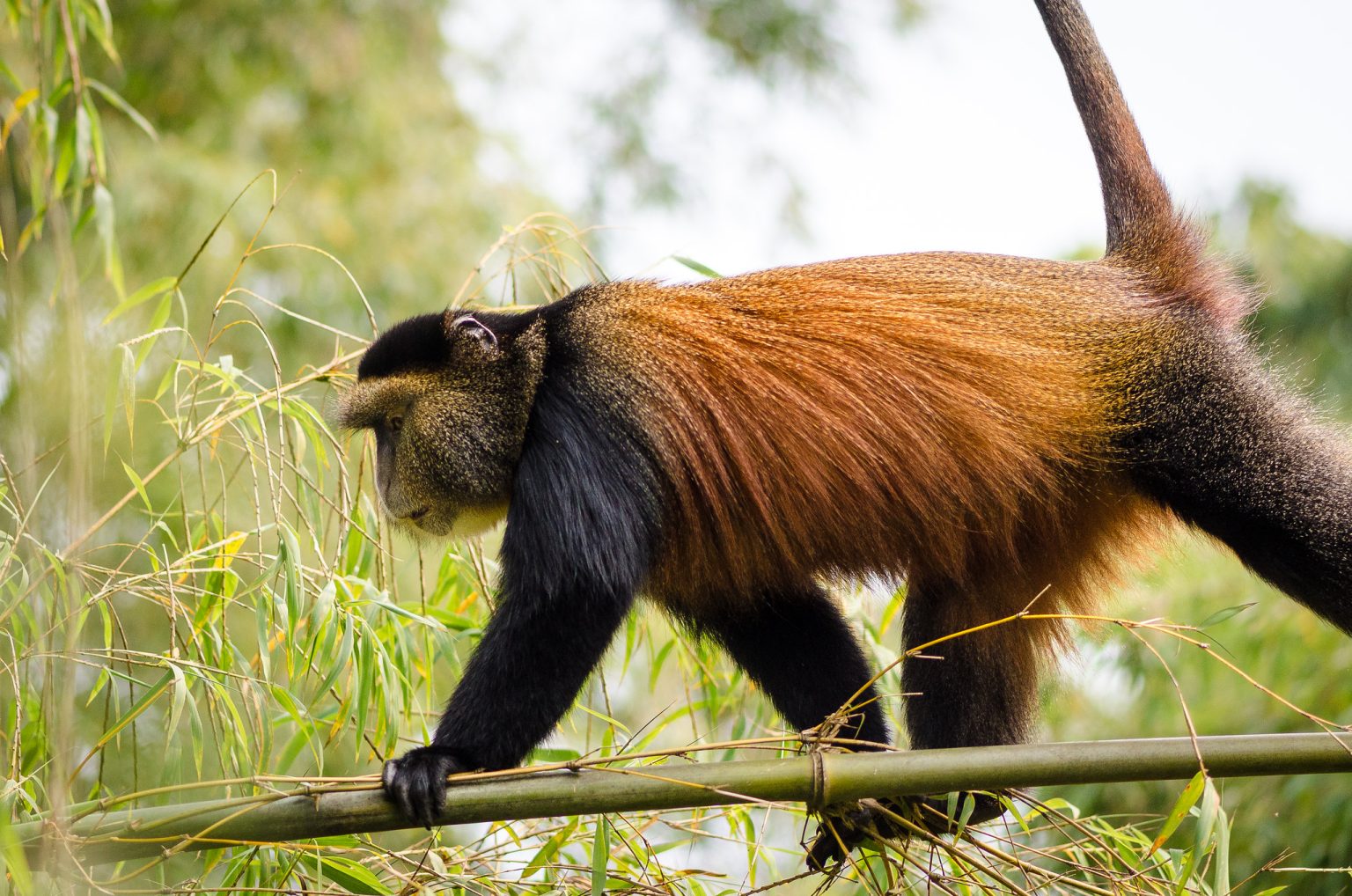
Colour gives it away. A bright orange gold patch runs over the back and flanks, set against dark limbs, a black cap and a long dark tail, with a grey, slightly whiskered face. In the dim green of a bamboo stand that gold shows from a long way off.
Most of the diet is bamboo. Young shoots and leaves carry the bulk of it, with fruit, flowers, lichen and the odd insect or grub picked from bark making up the rest. After rain, when new shoots push through, a troop can feed in one small patch for days. In drier spells the shoots toughen, troops range wider, and some drop to the eucalyptus woodlots and potato plots along the park wall.
Troops are large and loud. Group sizes run from a few dozen to well over a hundred, with a dominant adult male at the centre, females staying in the troop of their birth and young males leaving to find another. Males call to hold ground against neighbouring troops; females keep up softer contact calls, and juveniles chatter without pause. At night the monkeys sleep high in the bamboo or in forest trees, often in tight huddles, and unlike gorillas they build no fresh nests on the ground.
Breeding is slow. A female usually has one infant after about five months of gestation, with roughly two years between births, and an adult can live into its twenties. Farmland pressing against the park boundary is the main threat, so the bamboo inside the park holds most of the population. Survey figures for the wider Virunga population vary, and conservation groups such as the Dian Fossey Gorilla Fund monitor several troops, so treat any single headcount with care.
Kabatwa and Musongo Troops on the Golden Monkey Trek
Visits to the Golden monkeys in the Rwanda side of the Virungas centre on two habituated troops. The ranger assigns your group to one of them at the Kinigi briefing, and you normally cannot pick when you book.
The Kabatwa troop lives on the lower slopes of Mount Sabyinyo and is the group most golden monkey tracking safaris visit. It was the first troop studied in Rwanda and it is big: published counts range from about 80 to over 100 animals, and the Dian Fossey Gorilla Fund, which monitors it, has reported more than 200. Because it ranges near the park boundary, the walk in tends to be short.
The Musongo troop feeds higher, on the bamboo slopes toward Mount Karisimbi. Sources disagree widely on its size. They agree on the walk, which is usually longer and steeper, so it suits visitors who want a proper hike before their hour starts.
Have a knee problem or a reason to want the shorter walk? Tell your driver guide the evening before. He can raise it with the rangers at the briefing, and requests like this are often met when numbers allow.

Golden Monkey Trekking Day at Kinigi, Hour by Hour
A golden monkey trekking day runs on the same clock as a gorilla trek, only shorter and gentler. Knowing the order of things takes most of the uncertainty out of the morning.
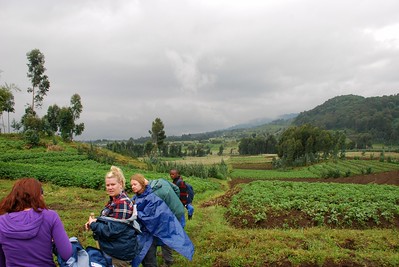
Many people rate the walk in as the surprise of the day. Paths cut through potato, pyrethrum and bean plots, children wave from doorways, and the volcanoes appear and vanish in the cloud. Past the wall the trail climbs on soft volcanic soil and bamboo litter, easy in places and greasy in others.
Then the troop arrives, usually overhead first. Golden monkeys rarely sit still, so a good part of the hour goes on following leaps between stems with your head tipped back, and the rest on crouching when a few drop to the ground to strip shoots a couple of metres away. Visitors expecting the calm of a gorilla family sometimes find the first twenty minutes frantic. Trip reports say the second half is often the best, once the monkeys forget the group and settle to feed.
One warning comes up again and again from people who have done it. Do not stand right under a monkey in the bamboo.
One Day Golden Monkey Tour from Kigali
A one day golden monkey tour from Kigali is possible and plenty of short stay visitors do it, but it makes for a long day. Kinigi is a little over 100 kilometres from the capital, about two and a half hours by road, and the 7am check in does not move for anyone.
The day trip works, yet a night near the park is kinder. Staying in Musanze or Kinigi turns that 4am alarm into a 6am one, lets you meet the altitude rested, and leaves room for a gorilla trek or a volcano hike on the next morning without another round trip on the same road.
Golden Monkey Tracking Rules, Age Limit and Group Size
Rules on golden monkey tracking in Rwanda come from the Rwanda Development Board and are enforced by your ranger guide. They mirror the gorilla rules, with a little more slack.
That age gap is why many families choose this trek. Children aged 12 to 14 cannot join a gorilla trek but can usually track golden monkeys, so a common plan is for one parent to trek gorillas while the other takes the children to the monkeys, then swap the next morning. Our family safari in Africa guide covers the other age rules across the region.
How Hard Is the Golden Monkey Trek: Fitness, Porters and Altitude
The golden monkey trek rates as easy to moderate, clearly gentler than gorilla trekking, and anyone who walks a few kilometres regularly at home should manage it. Altitude is the catch. Kinigi sits around 2,300 metres and the troops feed higher, so anyone who flew in from sea level a day or two earlier will breathe hard on the steeper pitches.
Start slower than feels necessary. The first half hour sets the tone, and rangers are used to stopping for breath breaks.
Porters wait at the trailhead to carry a daypack and give a hand on the slippery sections, and hiring one puts money straight into households around the park. Many are members of former poacher associations. Walking sticks are handed out free at the start. Mud is what turns an easy trek into a tiring one: after a wet night the farmland clay sticks to boots in thick clumps, and the Musongo route in particular can take twice as long as on a dry day.
Visitors with limited mobility should talk to their operator before booking. The Kabatwa troop, on its good days, is reached on fairly gentle ground, but there is no guarantee where the monkeys will be feeding that morning.
Packing and Photography for Golden Monkey Trekking
Pack for golden monkey trekking as you would for a short gorilla day. Waterproof hiking boots with real grip matter most, since volcanic soil is slick even in the dry months. Long trousers tucked into socks or gaiters keep out safari ants and stinging nettles, and gardening gloves make grabbing bamboo on a climb far more pleasant. Mornings at Kinigi run cold, often around 10 to 15 degrees Celsius before the sun gets through, with afternoons nearer 20, so bring a warm layer and a light rain jacket. One to two litres of water and a snack cover the outing. Binoculars, an 8×42 pair for example, help when the troop feeds high. Our Rwanda gorilla trekking packing list has the full kit.
Photography takes more thought than on a gorilla trek, because these subjects are small, quick and often perched against bright sky.
Best Time for Golden Monkey Trekking in Volcanoes National Park
Golden monkey trekking runs every day of the year, and trackers find the troops on almost every outing. Season changes the walking far more than the odds of a sighting.
| Months | Season | Trails |
|---|---|---|
| Dec to Feb | Short dry | Firmer |
| Mar to May | Long rains | Muddy |
| Jun to Sep | Long dry | Firmest |
| Oct to Nov | Short rains | Muddy |
June to September and December to February bring firmer paths and the clearest views of the volcanoes, which makes them the busiest months for permits and lodges. In March to May and October to November the farm tracks turn to clay and the walk lengthens. The rains also bring fresh bamboo shoots, and a troop feeding on new growth can stay low and close for long spells, which some photographers prefer to the dry season. Cloud and drizzle can arrive in any month on the Virungas, so the rain jacket goes in the bag whatever the calendar says.
Travelling in a wet month? Leave a spare morning in the plan so a slow trek does not squeeze the gorilla day.
Golden Monkey Trekking with Gorilla Trekking and Volcano Hikes
Few people drive to Kinigi for golden monkeys alone. Gorilla treks and golden monkey treks both report at 7am, so they always fall on separate mornings, and the standard plan is two or three nights near the park with one activity per day. Our Rwanda gorilla trekking guide covers the families and the trek itself, and the Volcanoes National Park guide sets out everything else the park offers. For trip lengths that fit both treks, compare our 1, 2 and 3 day Rwanda gorilla tours.
The order is up to you. Plenty of travellers track the monkeys first because it is easy and gets the legs used to the thin air before the bigger gorilla day. Others save the monkeys for the last morning as a lighter outing before a long drive, though a few trip reports say the monkeys felt flat straight after the gorillas, which argues for doing them first.
The Dian Fossey tomb hike fits around both. It climbs from farmland on the Bisoke side through bamboo and hagenia forest to Karisoke, the research camp Fossey founded in 1967, where she is buried beside Digit and other gorillas she studied. It takes most of a morning, and golden monkeys sometimes show up in the same bamboo on the way. Fit hikers can swap it for a full day on Mount Bisoke and its crater lake, or the two day climb of Mount Karisimbi, the highest of the Virunga mountains.
Primate trips also reach well beyond the volcanoes. Many itineraries add chimpanzee tracking in Nyungwe Forest, Big Five game drives in Akagera, or a short flight to Kenya for a Masai Mara safari, which puts gorillas, golden monkeys and the big cats into one East Africa trip.
Golden Monkey Trekking in Rwanda or Mgahinga in Uganda
The same monkey lives on both sides of the border. Uganda runs its own trek in Mgahinga Gorilla National Park, on the northern slopes of the same volcanoes, so the choice depends on logistics and the rest of your route rather than on the animal.
| Point | Rwanda | Uganda |
|---|---|---|
| Park | Volcanoes | Mgahinga |
| Briefing | Kinigi | Ntebeko gate |
| From Kigali | About 2.5 hours | About 4 hours |
| Crowds | Busier | Very quiet |
| Habituation option | No | Yes |
Rwanda’s strengths are access and choice: Kinigi is minutes from Musanze, the road from Kigali is tarmac all the way, and the lodge range is wide. Uganda’s strengths are quiet and time. Mgahinga sees a fraction of the visitors, and it offers a longer habituation outing alongside researchers for anyone who finds one hour too short. The golden monkey trekking in Uganda guide covers that side, the Mgahinga Gorilla National Park guide covers the park, and our Uganda vs Rwanda gorilla trekking comparison helps with the bigger choice.
A simple rule works for most trips. Gorillas in Rwanda, monkeys in Rwanda. Gorillas in Mgahinga or southern Bwindi, monkeys in Uganda. Travellers on a two country route often cross at Cyanika and do one of each; our page on Bwindi gorilla trekking from Kigali explains the border and the drive.
Lodges for a Golden Monkey Safari Near Kinigi
Where you sleep decides when your alarm goes off. Lodges in and around Kinigi sit minutes from the 7am check in, Musanze town is about 25 minutes away with the widest choice at lower prices, and lodges on the ridges above Lakes Burera and Ruhondo trade a longer drive for the views.
At the top end, Singita Kwitonda, One&Only Gorilla’s Nest, Bisate Lodge, Virunga Lodge and Wilderness Sabyinyo Silverback Lodge all sit close to the park; our guide to luxury lodges near Volcanoes National Park compares them. In the middle, Mountain Gorilla View Lodge, Da Vinci Gorilla Lodge, Le Bambou Gorilla Lodge and Five Volcanoes Boutique Hotel line the road between Musanze and Kinigi. Simpler guesthouses near the park edge and hotels in Musanze suit travellers watching their spend; see our budget gorilla trekking in Rwanda page. Whatever the tier, ask for an early or packed breakfast on trek mornings.
Getting to Kinigi for Golden Monkey Trekking
Kigali International Airport is the gateway. The road runs north through the hills to Musanze in about two hours, then on to Kinigi in another 20 to 30 minutes, nearly all of it on tarmac. Most visitors travel with a driver guide from their tour operator, which also covers the rough drive from Kinigi to the trailhead, a stretch where your own 4×4 is needed. Independent travellers can take a public bus from Kigali to Musanze and a taxi from there, but must still arrange a vehicle to the trailhead. Helicopter transfers from Kigali to the Volcanoes area take around half an hour for those short on time.
From Uganda, the Cyanika border near Kisoro is about 25 kilometres from Musanze, which makes it easy to link Volcanoes with Mgahinga or the southern sectors of Bwindi. Full routes to the Ugandan parks are on our getting there page.
Golden Monkey Trekking in Rwanda: Frequently Asked Questions
How much does golden monkey trekking in Rwanda cost?
The Rwanda Development Board lists golden monkey tracking at US$100 per foreign visitor. Foreign residents of Rwanda and East African citizens pay reduced rates and Rwandan citizens pay in francs; published resident figures differ between sources, so confirm the exact rate on the RDB portal before paying. Porters and tips are paid separately on the day. For comparison, a Rwanda gorilla permit is US$1,500, with a discounted US$1,050 rate offered from November to May on qualifying trips that add Nyungwe or Akagera, and the Dian Fossey tomb hike is about US$75. The Rwanda safari cost guide puts these into full trip budgets.
Is golden monkey trekking cheaper in Uganda than in Rwanda?
Not by much. Under the current UWA tariff, golden monkey tracking in Mgahinga is US$60 for foreign non residents, but park entry of US$40 a day is added unless a gorilla permit already covers that day, which brings it close to Rwanda’s US$100. The Ugandan side does offer a longer habituation outing that Rwanda does not.
What is the minimum age for golden monkey trekking in Rwanda?
Twelve is the minimum most widely published, three years below the gorilla limit of 15. A few operator pages still give 15, so confirm the current rule with RDB or your operator when you book, especially if your child is close to the line.
Can I do golden monkey trekking and gorilla trekking on the same day?
No. Both report to Kinigi at 7am, so they go on separate mornings. Two nights near the park covers both, and a third adds the Dian Fossey hike or Bisoke.
How long does golden monkey trekking take?
Allow most of a morning. The hour with the monkeys is fixed, while the walk in can be anywhere from twenty minutes to two hours each way depending on the troop, where it is feeding and how wet the trail is. Most groups are back at their vehicles by late morning or early afternoon.
How hard is the golden monkey trek in Volcanoes National Park?
Easy to moderate. The walk to the Kabatwa troop is often under an hour over farmland and bamboo, though altitude and mud after rain make it feel harder than the distance suggests. A porter and a walking stick help a great deal.
Are golden monkey sightings guaranteed?
No wild sighting is guaranteed, but trackers find the troop before your group sets off, so nearly every trek succeeds. On a wet day views can be partial and the monkeys more spread out through the bamboo.
How far ahead should I book a golden monkey permit?
Permits are much easier to get than gorilla permits. A few weeks ahead is usually enough, longer for June to September and December to February. Secure the gorilla permit first and fit the monkeys around it. The Rwanda gorilla permits guide explains how RDB bookings work, and licensed operators on our gorilla safari companies page can book both.
Is golden monkey trekking worth it if I am already seeing gorillas?
Most people who do both say yes. The two hours feel nothing alike: gorillas are slow and close, the monkeys quick and acrobatic. It also fills the second morning of a typical Volcanoes stay and gives younger family members a primate trek of their own.