Akagera National Park is Rwanda’s only Big Five safari park, 1,122 square kilometres of savannah, lakes and papyrus swamp in the east, where game drives, Lake Ihema boat trips and night drives can turn up lions, rhinos, elephants, leopards and buffalo. It sits about 110 km from Kigali, two to two and a half hours by road, and most visitors stay one to three nights, often after gorilla trekking. African Parks runs it with the Rwanda Development Board.
Plenty of people arrive expecting a smaller copy of the Serengeti. It isn’t that. Akagera is quieter, greener in the south, wide open in the north, and the reason it has big game at all is one of the better conservation stories in Africa. What follows walks through the wildlife, each activity, the lodges and campsites, the seasons and how an Akagera safari slots in beside a gorilla trek, with every fee kept in the FAQ.

Akagera National Park Safari Essentials
Rwanda’s east is a different country from the misty volcanoes most visitors picture. The land drops, the air warms and the hills roll out into grass. The Akagera River, which gives the park its name, runs along the eastern boundary with Tanzania and feeds a maze of lakes and swamps, so water and wetland make up roughly a third of the park. African Parks describes it as the largest protected wetland in central Africa, and it is the only protected savannah in Rwanda.
The Akagera National Park visitor site keeps gate, activity and planning details, and the park’s own reception will brief you on routes and recent sightings when you sign in. Everyone stops there first: it sits about 3 km inside the entrance gate, with a café, a curio shop and maps for sale.
How Akagera Became a Big Five Safari Park Again
The park was gazetted in 1934 and once covered about 2,500 square kilometres, with the old Mutara Game Reserve beside it to the north. In the 1980s it lost its African wild dogs to disease. After the 1994 genocide, returning refugees and their cattle settled across much of the land, and in 1997 the boundary was redrawn, cutting the park by more than half. Lions were poisoned by herders defending their cows, the last black rhino was seen around 2007, and by the end of that decade an Akagera Big Five safari was impossible.
Then the management changed. RDB signed a joint agreement with African Parks, and from 2010 the Akagera Management Company took over the day to day running, with donor support including the Howard G. Buffett Foundation. Rangers, a dog unit and aerial patrols came first. The reintroductions followed.
The figures since then tell the story better than any brochure could. Park updates put the lions at about 70, the elephants at around 150 and the buffalo at more than 3,000, and counts of large mammals rose from roughly 4,000 at the start of the partnership to over 13,500 within eight years. No high value species has been lost to poaching since the new management arrived.
Tourism grew alongside. Visitor numbers climbed from about 8,000 a year to more than 44,000 before the pandemic and kept rising, past 67,000 in the most recent full year reported, and the park now pays most or all of its running costs from its own revenue. A large international travel magazine named it among its top destinations of the year, which tells you how far it has come. Ten percent of park income goes to boundary communities under Rwanda’s revenue sharing scheme, and the freelance guides who ride with self drive visitors come from those same villages.
Akagera Wildlife Safari: What You See and Where
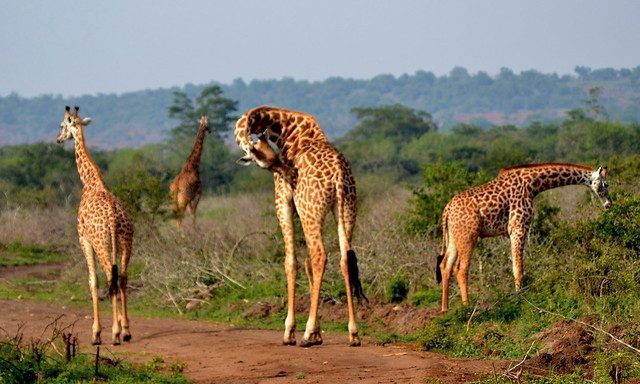
Expectations matter here. An Akagera wildlife safari rewards patience more than a big Kenyan reserve does, because the south is thick bush and the predators are still filling the space. What turns up on almost every drive is the plains game: impala, topi, defassa waterbuck, Burchell’s zebra, warthog, olive baboon and vervet monkey. Buffalo and elephant are seen on most full days. Giraffe browse the acacia in the centre and north.
The lakes are crowded with hippos, and big Nile crocodiles lie out on the banks. Antelope keep coming: eland, roan, oribi, Bohor reedbuck, bushbuck, common duiker, klipspringer on rocky slopes, and the sitatunga, a swamp antelope that hides in the papyrus and is seen more often from the boat than the car. Blue monkeys are shy residents of the forest patches.
Lions are what most people ask about. Resident prides hold the northern plains, and on a full day that reaches the north the odds are good, though nobody can promise them. A half day in the south may miss them. Leopards are present and hard to find. Black rhinos keep mostly to the southern thickets, while the white rhinos graze the open plains in the south and north. Spotted hyena, side striped jackal, serval, genet, civet, porcupine and bushbabies round out the list, mostly after dark.

The park staff name four hot spots for game: the Giraffe Area in the south, the Mutumba Hills, and the Mohana and Kilala plains in the north. Water, fresh grazing after a burn and the season all move the herds around, so ask at reception which of them has been working that week.
Game Drive Safaris in Akagera: Self Drive, Freelance Guides or Park Vehicles
Every Akagera safari tour is built on game drives, and you have three ways to do them. Drive yourself in your own 4×4 with a park map. Drive yourself but pick up a guide at reception, most likely one of the community freelance guides, who know where the lions slept and which track is flooded. Or book one of the park’s open safari vehicles with a driver guide, seating up to seven, for a morning, an afternoon or a full day.
The guide option is the one people mention afterwards. Visitors who went without often say they drove past things they only noticed in other people’s photos, and the park itself recommends a guide on a first visit. If you exit by the northern gate with a guide, you drop them in Kayonza on the way to Kigali so they can get back.
Distance is the thing first timers underestimate. The southern and northern gates are about 100 km apart by the park roads, and the park advises at least five to six hours to cross. Trip reports split neatly: those who did a half day in the south often came away underwhelmed, those who pushed north describe a different park. Start at the gate opening, carry lunch and water, and save the slow birding loops for the afternoon.
The rules are simple and strictly kept. Stay on the tracks. Stay in the vehicle except at reception, campsites and marked picnic spots, because walking in the park is not allowed: buffalo, elephant and hippo are dangerous on foot. Be out of the gates, or at your lodge, by 6pm. Use a 4×4 or a high clearance car, since low ground such as Kilala and Mohana floods in the rains. A second café at Mihindi, about 50 km in, is the halfway stop for coffee and a sandwich.

Lake Ihema Boat Safaris and Sport Fishing on Lake Shakani
After the game drive, the Lake Ihema boat safari is the activity visitors rate highest, and it is the closest you will get to hippos and crocodiles anywhere in Rwanda. Ihema is the second largest lake in the country. The boat follows its forest fringed shore past hippo pods, basking crocodiles, African fish eagles and colonies of cormorants and darters, and birders treat it as a must.
Scheduled trips run four times a day: 7.30am, 9am, 3pm and a longer sunset trip from 4.30pm. Each regular trip lasts about an hour. Private boats can be booked for groups in the late morning slot, between 10.30am and 1.30pm. The sunset departure fills first, so book it when you book your bed. Bring water, a hat and a camera ready for crocodiles slipping off the banks.
Akagera is also the only park in Rwanda where sport fishing is allowed. Anglers fish from the shore of Lake Shakani for tilapia and catfish and can cook the catch over a fire at the Shakani campsite. You need your own rod and tackle, and the hippos have right of way.
Night Game Drive Safaris in Akagera
A night game drive in Akagera is the only way to be in the park after closing, and it shows an entirely different cast. Drives leave at about 5.30pm and return around 8 to 8.30pm, in a park vehicle with a guide and a spotter on the lamp. They pick up from lodges in the south, and Karenge Bush Camp runs its own in the north. Book ahead, because each vehicle carries only a handful of guests.
Bushbabies, genets, civets, white tailed mongoose, spotted hyena, nightjars and owls are the usual finds. Serval and leopard come on good nights, hippos haul out to graze, and the lions sometimes start hunting before you turn for home. Wikipedia’s entry on Akagera nocturnal wildlife and habitats is a useful read beforehand. Take a fleece: an open vehicle rolling at 20 km an hour is colder than you would guess.
Hot Air Balloon Safari, Behind the Scenes Tour and Walk the Line
Akagera runs a handful of activities you will not find in most African parks, and several show how the recovery actually works.
The newest is a hot air balloon safari at sunrise, which the park lists for guests at Ruzizi Tented Lodge and the campsites. Rising over the lakes as the mist burns off gives you the shape of the whole park at once, swamps and all. Flights depend on the weather, so keep a backup plan for that morning.
The behind the scenes tour, about an hour and a half at headquarters, takes you into the operations side: the control room that follows ranger patrols and collared animals, the canine unit and the law enforcement team. It needs a minimum group size. Akagera also employs female guides and rangers, still uncommon on an African safari.
Walk the Line is the one chance to go on foot. You follow a fence attendant for about 7 km along the outside of the boundary fence from the park entrance, climbing for roughly two hours to a ridge with views in every direction, and hear how the fence ended years of conflict between farmers and wildlife. The community cultural experiences run by the freelance guides take you to a dairy farm for milking, a banana beer maker or a honey cooperative, with revenue shared with the families you visit. Both need at least three people.
Birdwatching Safaris in the Akagera Wetlands
An Akagera birding safari is one of the best in Rwanda. The park counts more than 480 species, a big total for its size, because savannah, woodland, swamp and open water all sit within a short drive. Raptors are a highlight, with bateleur, martial eagle and African fish eagle among dozens of species.
The swamps hold the prizes. Shoebill live here, but see one as a bonus rather than a target. Easier specialists include the papyrus gonolek, white winged swamp warbler, swamp flycatcher, red faced barbet and Carruthers’s cisticola. Akagera is also the northern edge of the range for some southern savannah birds such as Arnot’s chat and Souza’s shrike, and from November to April Palearctic migrants swell the numbers.
The boat is the best seat for waterbirds. Pack binoculars; our guide to safari cameras and binoculars explains what works in harsh savannah light. Travelling on to Uganda? Pair Akagera with birding in Bwindi, which brings the Albertine Rift forest endemics that a savannah park lacks.
Akagera Safari Lodges, Bush Camps and Campsites
The list of places to stay is short, which keeps the park quiet but means the best rooms go early, above all on weekends when Kigali residents drive out. Here is how each option suits an Akagera safari stay.
Magashi Camp and the smaller Magashi Peninsula are the luxury choice, run by Wilderness in a private concession on Lake Rwanyakazinga in the north, with eight and four tented suites. Their position puts you on the northern plains at dawn, which means more time with lions and rhinos and less time driving to them.
Ruzizi Tented Lodge belongs to the park. Nine tents stand in riverine forest on the shore of Lake Ihema, joined by boardwalks, with one family tent and a tree top tent four metres up with an outdoor shower. All profits go back into the park, and the boat jetty and headquarters are close, so the boat trip and behind the scenes tour fit in easily.

Karenge Bush Camp is the park’s camp in the north, on a ridge over the Kilala plains. It began as a seasonal mobile camp and now has a fixed site, still built with no permanent materials, taking up to 16 guests on full board with its own vehicles for morning and night drives. Akagera Game Lodge, run by Mantis, sits on a ridge in the south above Lake Ihema and is the biggest place in the park, with a pool, tennis courts and a restaurant open to day visitors. Baboons patrol the grounds, so shut the doors.
Newer names include SALT of Akagera, listed by the park among its lodges, and outside the gate you will find Akagera Rhino Lodge and a few other options for tighter budgets, though sleeping outside means paying entry again each day you drive in.
Campers have four fenced sites. Muyumbu sits high on a ridge above Lake Ihema with views to Tanzania, and Shakani lies on its lake behind a low wall that keeps hippos out. Mutumba, on the highest point of the park, is the most remote and gets cool and breezy at night, and Mihindi in the north has a café and includes breakfast. Shakani and Mihindi have flushing toilets and solar showers; the other two have pit latrines and rainwater tanks. The park will pitch a hired tent for you, but bedding is your own job, and there are no bins, so take your rubbish out. Read recent Akagera traveller reviews before choosing, and see our wider list of safari lodges for the rest of the trip.
Best Time for an Akagera Safari
Akagera is open every day of the year and is drier and warmer than the rest of Rwanda, with roughly 750 to 800 mm of rain a year. For big game, the best Akagera game viewing safari months are June to September, when the grass is short, water is scarce and animals gather near the lakes. The park’s own site points to November to April, the green months with migrant birds, so the honest answer depends on what you came for.
| Months | Rain | Game viewing | Birding |
|---|---|---|---|
| Jan to Feb | Light | Good | Very good |
| Mar to May | Heavy | Fair | Good |
| Jun to Aug | Very low | Best | Fair |
| September | Low | Best | Good |
| Oct to Nov | Moderate | Fair | Very good |
| December | Light | Good | Very good |
June to September is lion and rhino season on the northern plains: long dry days, dust on the tracks and herds close to water. Pack a scarf for the dust and sun cover for an open vehicle. January and February are warm and mostly dry, with migrants still present. March to May brings the heaviest rain; the grass shoots up, the animals spread out, low tracks around Kilala and Mohana can flood and a 4×4 is a must, yet the boat trip runs as usual and the lodges are quiet. October and November bring the short rains, green hills, newborn antelope and the peak of the migrant birds.
Tsetse flies are the other seasonal factor. They live in the southern woodland and go for dark blue and black, so wear khaki, olive or beige and keep repellent close. Our African safari packing list covers clothing that works in both Akagera and the gorilla forests.
Akagera Safari Itineraries with Gorilla Trekking
Most people add Akagera to a gorilla trip rather than come for it alone, and the two fit together well. Gorilla trekking in Rwanda takes place in Volcanoes National Park in the northwest, about five hours by road from Akagera, so the usual route runs Kigali to Akagera, back through Kigali and north to the volcanoes, with Nyungwe Forest for chimpanzees as a third stop. Our 7 day Rwanda safari links all three.
The order of the trip matters because of an RDB rule. From November to May the Rwanda Development Board runs a low season gorilla permit offer for visitors who spend two nights in Akagera or Nyungwe, backed by a paid hotel receipt and one paid park activity, or one night in each on consecutive nights. Each qualifying stay earns one discounted permit per person. Our Rwanda gorilla permits guide explains the steps, and the Rwanda safari cost guide shows what the saving does to a full budget.
Weighing the two countries? Our comparison of Uganda and Rwanda for gorilla trekking sets out the trade offs, and you can read about gorilla trekking in Bwindi or gorilla trekking in Uganda from Kigali. Uganda’s Queen Elizabeth National Park plays the savannah role there that Akagera plays in Rwanda. With the Tanzanian border so close, some travellers also fly on from Kigali for a Serengeti safari or to Nairobi for a Masai Mara safari.
Getting to Akagera National Park from Kigali
Akagera is about 110 km from Kigali, two to two and a half hours. Take the airport road, turn east for Rwamagana, carry on to the Kayonza roundabout, then turn right for about 15 km to Kabarondo and left after the fuel station for the last 24 km to the entrance gate, following the signs. Reception is 3 km further. On a phone map, search for the park’s south entrance. Fill up before Kabarondo; there is no fuel in the park.

Mutumba Gate, reached by dirt road from the Nyagatare road north of Kayonza, can be used to enter or leave if you ask the park a day ahead. The northern gate is exit only and leads about 22 km to the tar road back towards Kayonza. Buses larger than a coaster are not allowed in, and every bus or minibus must take a guide.
The park offers no transfers. Most visitors come with a driver guide from a safari operator; others hire a car, with or without a driver, from a company in Kigali, and should check the spare tyre and tools before leaving. Buses go from Kigali as far as Kabarondo, but motorbike taxis cannot enter the park and you would then have to hire a park vehicle for a half or full day drive, so public transport rarely makes sense. Helicopter transfers exist at the top end. Akagera is a malaria area, so take prophylaxis on medical advice. For flights into Kigali and the land borders to Bwindi, see our getting there guide, and to compare licensed operators who run Akagera trips, use our Rwanda safari companies list.
Akagera National Park Safari FAQ
How much are Akagera National Park entry and activity fees?
On the current Akagera price sheet, international adults pay entry of US$100 for one day or night, US$150 for two nights and US$200 for three, with nothing more for further nights up to a week. Children 6 to 12 pay US$50, US$75 and US$100, and children five and under go free. Foreign residents of Rwanda and the EAC pay US$50, US$75 and US$100, and Rwandan and EAC citizens RWF 15,000, 22,500 and 30,000. Sleeping outside the park makes you a day visitor, paying again each day. The vehicle fee is US$10 a day for a car or minibus and US$20 for a bus; some older sheets charged foreign registered cars more, so confirm at the gate if you drive in on foreign plates. A guide for your own car is US$25 a half day or US$40 a full day. Park vehicle game drives cost US$200 a half day and US$350 a full day, for up to seven people. Night drives are US$40 a person, scheduled boat trips US$35 (sunset US$45) and a private boat US$200. Camping is US$25 a person (US$50 at Mihindi with breakfast) plus US$30 to hire a tent, fishing and the behind the scenes tour US$25 each, and Walk the Line and community experiences US$30 each. Our Rwanda safari cost guide puts these into a full trip budget.
How does an Akagera stay lower the price of a Rwanda gorilla permit?
The RDB gorilla permit costs US$1,500 for foreign non residents. From November to May, two nights in Akagera or Nyungwe, with a paid hotel receipt and one paid park activity, or one night in each on consecutive nights, cuts that by 30 percent to US$1,050. One discounted permit is issued per person per qualifying stay, and applications take about a day.
What do Akagera lodges cost compared with each other?
Camping is the cheapest bed in the park. The park lists rates at Ruzizi Tented Lodge from about US$170, and Karenge Bush Camp from about US$170 per person sharing on full board for EAC residents, with international rates higher. Akagera Game Lodge sits in the mid range, while Magashi is a premium camp that adds a conservation levy. Rates move with the season, so check with each lodge or an operator.
Can you see the Big Five on an Akagera safari?
Yes, all five live here, and it is the only park in Rwanda where they do. Buffalo and elephant turn up on most full days and lions on many, mainly on the northern plains. Rhinos need more luck, and leopards are the hardest of all. Two or three days give you a fair chance at four of the five, but no sighting is guaranteed.
Is an Akagera day trip from Kigali worth it?
It can be, if you leave very early and head straight for the northern plains. The catch is four to five hours of driving and a single crossing at the hottest time of day. One night, ideally two, lets you add the boat trip, drive at dawn and return without rushing.
Can I do a self drive safari in Akagera?
Yes, and the park says it is safe if you follow the rules. Use a 4×4 or high clearance vehicle, stay on the tracks, get the safety briefing at reception and leave by 6pm. On a first visit, take a freelance guide. If you break down, stay in the car and call reception; the park will tow you to the nearest exit for a recovery fee.
Can you walk in Akagera National Park?
Not inside the park. Visitors must stay in their vehicles except at reception, campsites and picnic spots, because buffalo, elephant and hippo are dangerous on foot. The one walking option is Walk the Line, a guided 7 km route outside the boundary fence.
Is Akagera safe, and do I need malaria tablets?
Akagera is fenced, patrolled by armed rangers and well managed, and visitors who follow guide instructions are safe. It is a malaria area, so take prophylaxis on your doctor’s advice and use repellent. Tsetse flies bite in the southern woodland, and neutral colours help.
Is Akagera good for children and families?
Very. Gorilla trekking has a minimum age of 15, but game drives and boat trips suit any age, and children pay reduced rates. Akagera Game Lodge has a pool and family rooms and Ruzizi has a family tent. Plan shorter drives for small children, since the south can be slow going.
How many days should I spend in Akagera National Park?
Two nights suit most travellers: a boat trip, a full day to the north and a night drive or the behind the scenes tour. It also meets the low season gorilla permit rule. Birders and photographers can easily use three or four nights.