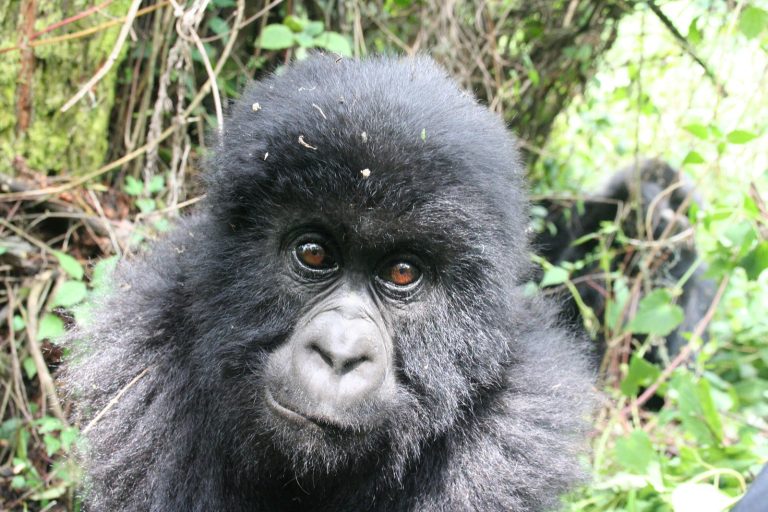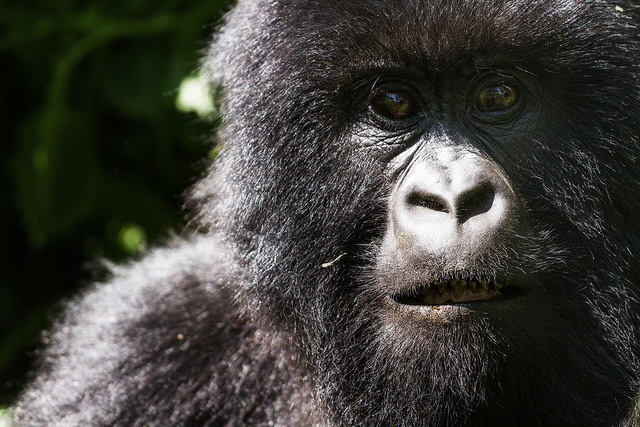
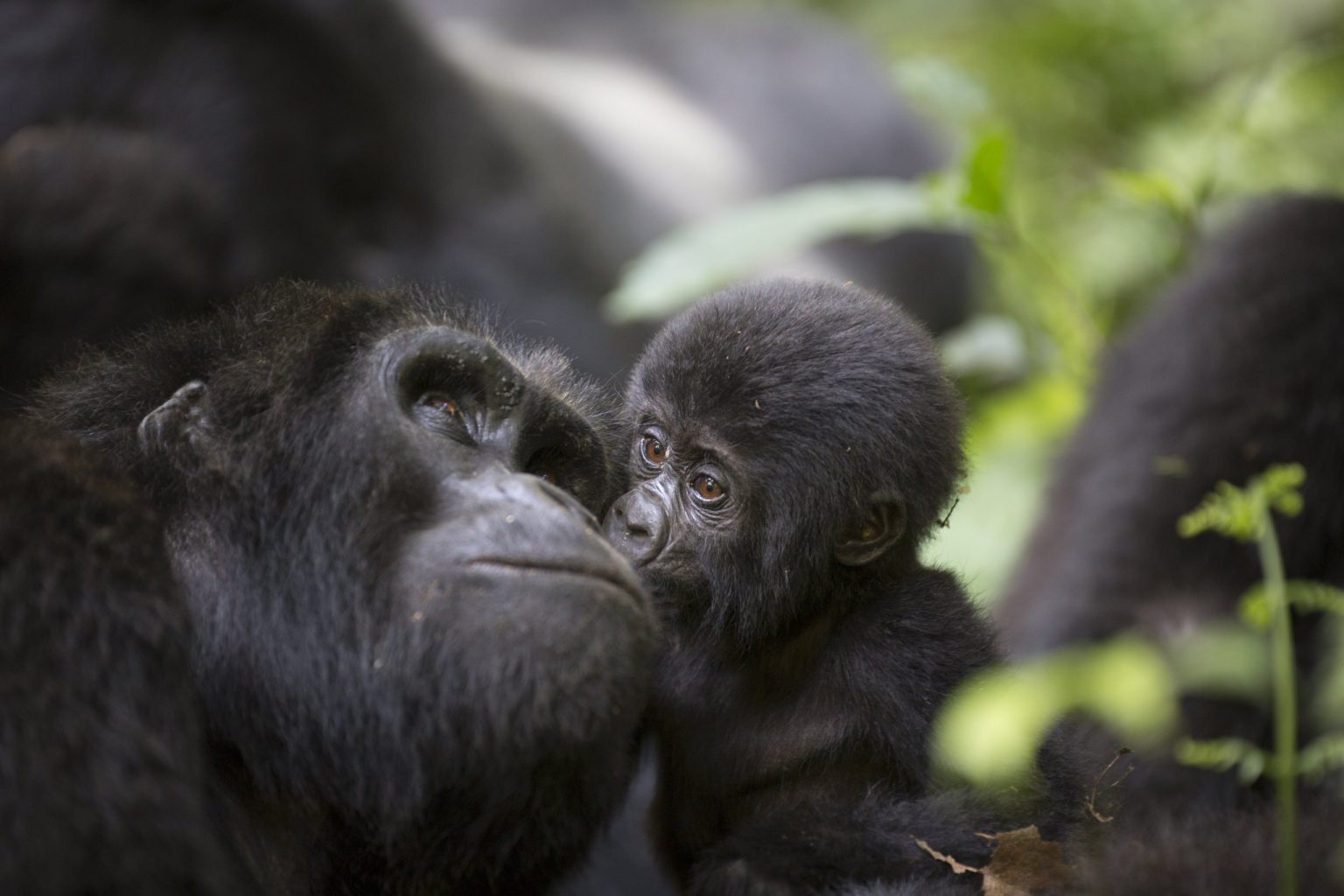
The primates in Bwindi number about eleven species: mountain gorillas and chimpanzees, the daytime monkeys and olive baboons, plus the potto and galagos that come out after dark. Most visitors see them on a gorilla trekking safari or a guided forest walk from Buhoma, Ruhija, Rushaga or Nkuringo. Gorillas are very likely on a trek, monkeys are common, and the wild chimps are rarely seen. Bwindi wildlife also includes forest elephants, duikers and over 350 bird species, all inside a World Heritage rainforest in southwest Uganda.
Bwindi Primate Checklist for a Forest Safari
Ask five guides how many primates live in Bwindi and you will hear ten, eleven or “at least ten”. The difference is not carelessness. The usual count of eleven includes De Brazza’s monkey, whose records in the park are thin, and the night primates have never been surveyed properly. What follows is the working list for a Bwindi primate safari, with how likely you are to see each one.
| Primate | Active | Where to look | Your odds |
|---|---|---|---|
| Mountain gorilla | Day | All sectors | Very high on a trek |
| Chimpanzee | Day | North, Buhoma | Rare |
| L’Hoest’s monkey | Day | Buhoma, trails | Good |
| Black and white colobus | Day | Canopy, Buhoma | Good |
| Red tailed monkey | Day | Lower forest | Good |
| Blue monkey | Day | Ruhija, canopy | Good |
| Olive baboon | Day | Park edges | Good |
| Potto | Night | Canopy | Rare |
| Demidoff’s galago | Night | Vine tangles | Rare |
| Spectacled galago | Night | Forest | Rare |
Two of the eleven are great apes, and both are listed as Endangered by the IUCN. L’Hoest’s monkey is listed as Vulnerable. The other monkeys and the baboon are widespread across Africa and not globally threatened, which makes them no less worth watching. Bwindi has no golden monkeys, grey cheeked mangabeys or red colobus, whatever some lists say; the section on disputed monkeys below explains where to find them.
Mountain Gorilla Trekking: Bwindi’s Headline Primate Safari
Mountain gorilla trekking is the reason most people come, and Bwindi holds close to half of the wild population. The 2018 mountain gorilla census counted 459 gorillas here out of a world total of 1,063. A new census of the park began in May 2025, and its results are still awaited. For the wider picture of where the subspecies lives and how its numbers have recovered, see our guide to mountain gorillas in Africa.
More than twenty habituated families are open to trekkers, spread over four sectors and listed on our Bwindi gorilla families page. Rushaga in the south has the most. Buhoma in the north has the oldest, led by Mubare, which opened to visitors in 1993, with Habinyanja, Rushegura, Katwe and newer groups alongside. Ruhija has Bitukura, Oruzogo, Kyaguriro and Mukiza, and Nkuringo has four families of its own. A family averages about ten gorillas, from a single silverback with a few females to groups of twenty with several adult males.
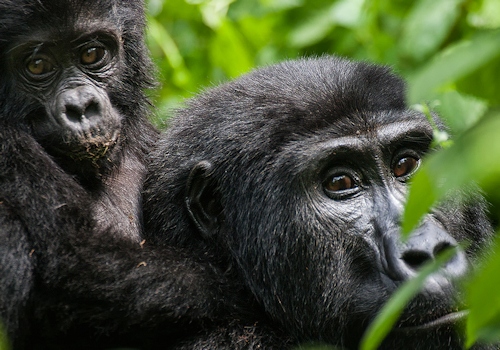
A trek starts with a 7:30 or 8:00 briefing at the sector office. Rangers assign you to a family there, never in advance, and trackers go ahead to find where the group nested the night before. Groups are capped at eight visitors per family. Once you reach the gorillas you get one hour with them, and the Uganda Wildlife Authority asks visitors to keep at least 10 metres away, wear a mask when told to, and stay home if they have a cold.
How long it takes is anyone’s guess. Some groups turn up within forty minutes of the trailhead. Others mean five or six hours of steep, muddy slopes, and the walk back can be the harder half. Gardening gloves come up again and again in trip reports, because you grab vines and stinging nettles all day.
The full Bwindi gorilla trekking guide covers sectors, fitness and booking. If one hour feels short, the gorilla habituation experience in Rushaga gives four visitors up to four hours with a family still being used to people.
Chimpanzees of Bwindi: the 426 Census and Chimp Tracking Prospects
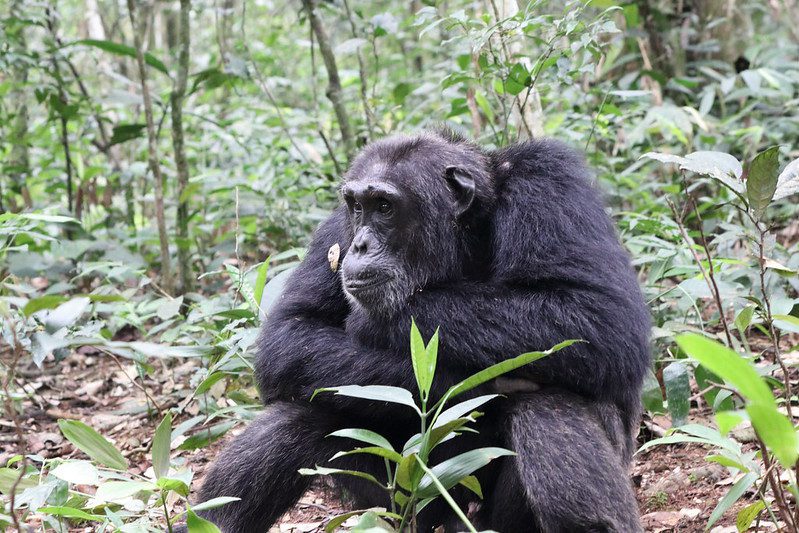
Bwindi is one of very few forests where mountain gorillas and chimpanzees share the same habitat, and until recently nobody had counted the chimps properly. Earlier estimates were a by product of gorilla surveys. The first dedicated census, run by the Jane Goodall Institute Uganda with the Uganda Wildlife Authority, sent teams along transects in two sweeps between May and September 2025 and estimated 426 chimpanzees in the park.
Nobody counted 426 animals one by one. Chimps are hard to see in dense forest, so the surveyors counted sleeping nests and worked back to a population using how often chimps build nests and how long a nest lasts before it rots. The results put chimps mostly in the northern part of the park and around Buhoma, while gorillas favour the south, with overlap in between.
Chimp society works differently from a gorilla family. A community of several dozen animals shares a territory but rarely moves as one; it splits into small parties that forage apart through the day and regroup, a pattern biologists call fission and fusion. They also eat a far wider menu, with ripe fruit at the centre, and they use sticks and leaves as simple tools. All of that makes them faster, louder and much harder to follow than gorillas.
Here is the catch for a chimpanzee tracking trip. Bwindi’s chimps are not habituated, and there is no chimp tracking permit in the park. UWA has said it will look at new tourism products in the northern sector, so that may change, but for now a chimp sighting in Bwindi is a lucky bonus. Rangers on Buhoma walks sometimes point out fresh nests or hear pant hoots echo across a valley, and that is as close as most visitors get. Our guide to things to do in Bwindi lists the walks where other primates turn up.
Anyone who wants reliable time with chimps should add Kibale chimpanzee trekking to the route. Kibale holds about 1,500 chimpanzees, its habituated Kanyanchu community has a sighting rate above 90 percent on UWA’s figure, and the drive north from Bwindi through Queen Elizabeth National Park makes a natural loop.
Monkey Watching Safari in Bwindi: L’Hoest’s, Colobus, Red Tailed and Blue Monkeys
Monkeys are the primates you will see most on a Bwindi safari, often before you even reach the trailhead. Four species turn up regularly on gorilla treks and forest walks, and each has habits that help you tell them apart in poor light.
Several trip reports say the monkeys were the surprise of the day: a troop of red tails crashing through the canopy above the trail on the way to the gorillas, or L’Hoest’s monkeys on the lodge lawn at dawn. Rangers will stop for them if you ask, as long as the group is not pressed for time.
Rare and Disputed Monkeys on Bwindi Primate Tour Lists
Read enough operator pages and the Bwindi primate tour list grows to include monkeys that few people have seen in the park. It helps to know which ones to expect and which ones belong to another forest.
Older lists sometimes add species seen once or never confirmed at all. Those records are thin or doubtful for Bwindi itself, so treat anything beyond the checklist above as unconfirmed rather than a species to look for.
Baboons and Nocturnal Primates on a Bwindi Forest Trek
Olive baboons live on the forest edges and around farmland at the park boundary, more than in the deep interior. You are most likely to see them from the vehicle on the drive into Buhoma or along the road between Ruhija and Kabale. Troops range from a handful to well over fifty animals, and the large males, with long canines, are worth giving space. Baboons are bold around people where nobody chases them, which is why farmers at the park edge name them among the crop raiders they complain about most.
After dark, a different set of primates takes over. The potto is a slow moving, thick furred animal that creeps along branches feeding on fruit, gum and insects, and the galagos, or bushbabies, are tiny leapers with huge eyes. Demidoff’s dwarf galago, small enough to sit in a palm, is the species most often listed for Bwindi, and the larger spectacled galago, named for the dark rings around its eyes, appears on most park lists too.
Seeing them is hard. UWA does not run a regular night walk programme in Bwindi the way Kibale does, so the realistic chance is from a lodge veranda with a torch, listening for rustling and looking for eye shine. Some forest lodges near Buhoma and Ruhija can point you to spots where galagos feed at night, but none can promise a sighting. Anyone set on pottos and galagos should book the guided night walk in Kibale.
Where to See Bwindi Primates: Sector by Sector Trekking Guide
Bwindi has four trekking sectors, and the primates you meet on a forest trekking day depend on altitude and forest type as much as luck. The table gives the short version, and the notes below fill it in.
| Sector | Altitude | Primates | Extras |
|---|---|---|---|
| Buhoma | About 1,500 m | Gorillas, monkeys, wild chimps | Waterfall trail |
| Ruhija | About 2,300 m | Gorillas, blue monkeys, colobus | Elephants, birds |
| Rushaga | About 2,000 m | Gorillas, monkeys | Habituation |
| Nkuringo | About 2,100 m | Gorillas, monkeys | Volcano views |
Buhoma, in the north, is the lowest and warmest sector and the best all round primate base. The forest here is closest to the type chimps prefer, L’Hoest’s monkeys visit the lodges, and the Buhoma nature walk options, including the Munyaga waterfall trail, add colobus, red tailed monkeys and birds to a gorilla day. Walks usually leave in the morning and take two to four hours.
Ruhija sits high on a ridge in the east. It is colder, misty at dawn, and the best sector for elephants and montane birds. Blue monkeys and colobus are the usual primates. Rushaga and Nkuringo in the south hold most of the gorilla families, and the gorilla trek itself is where you will see monkeys there, usually red tailed and blue monkeys crossing the canopy as you climb.
Sector choice also decides where you sleep, since the drive between north and south takes several hours. Our Bwindi lodges guide lists where to stay in each.
Best Time, Trails and Tips for Primate Watching Tours in Bwindi
Primates live in Bwindi all year and none of them migrate, so a primate watching tour works in any month. The drier spells, June to August and December to February, give firmer trails and easier walking. March to May and October to November bring heavier rain, muddier slopes and quieter lodges, and the forest is at its greenest. Birding stays good in the wet months, when many species breed.
Time of day matters more than the month. Monkeys feed hardest in the first hours after dawn and again in late afternoon, and L’Hoest’s monkeys in particular use the paths early. By midday most troops rest in the canopy and the forest goes quiet. Plan a nature walk for the morning after your gorilla trek, or the late afternoon of arrival day.
The trails that turn up the most primates are the Munyaga River trail, a short and easy walk along the forest edge below Buhoma, the Waterfall trail, with colobus and L’Hoest’s monkeys on the way to the falls, and the paths around Ruhija, where blue monkeys are almost a fixture. Every walk goes with a UWA guide, which helps: guides know where troops sleep and which fig is fruiting this week.
Binoculars make a big difference. Much of the action is thirty metres up, and a pair of 8×42 glasses turns a blur of moving leaves into a monkey you can name. Our safari binoculars and camera guide covers what works in low forest light. Wear muted greens and browns, keep voices down, move slowly when a troop is near, and switch off the flash. A zoom lens of 100 to 400 millimetres covers most canopy monkeys.
Primate Conservation in Bwindi: Threats Along the Gorilla Trekking Trails
Every gorilla trekking permit pays for rangers, trackers and vets, and that money is the main thing keeping Bwindi’s primates safe. The threats are still real, and knowing them explains several rules you meet on the trail.
Tourism money flows back in several ways. A share of park revenue goes to neighbouring communities, lodges run by village associations fund schools and water projects, and the charity Conservation Through Public Health, based in Buhoma, links human and gorilla health; its Gorilla Conservation Camp puts guests’ money into that work. The forest’s first people, the Batwa, were moved out when the park was created in 1991, and the better cultural programmes now run with them rather than for them.
Forest Elephants, Duikers and Other Mammals on a Bwindi Safari
Around 120 mammal species live in Bwindi, which is a lot for a forest of this size, yet most are small, shy or active at night. Nobody books a Bwindi wildlife safari for the big mammals, though a few are worth knowing about.
Forest elephants are the headline. A small population moves through the park, mostly in the higher eastern forest around Ruhija and the Mubwindi swamp. Sightings are rare, and you are far more likely to see dung, broken bamboo and footprints on the trail than the elephants themselves. Rangers read the signs well and will steer a group away from fresh tracks; elephants in thick forest are not animals to surprise.
Duikers are small forest antelopes that live low and bolt into the undergrowth when disturbed. Black fronted and yellow backed duikers are both recorded, and Weyns’s duiker is sometimes seen on Buhoma walks. Most visitors get a flash of a brown back and nothing more. The bushbuck turns up in clearings and at forest edges.
The rest of the list runs to giant forest hogs, bushpigs, side striped jackals, the African golden cat, civets, genets, tree pangolins and many squirrels, rats and bats. Almost all are nocturnal or secretive. If they matter to you, ask your guide to look at tracks and droppings rather than expecting a sighting. For the full savannah list of lions, buffalo and antelope, a Bwindi trip pairs with a game drive in Queen Elizabeth, covered in the trips section below.
Bwindi Birding Tours, Butterflies and the Smaller Wildlife
Birders rank Bwindi among the top sites in Africa. UWA lists over 350 species, including 23 of the Albertine Rift endemics, and a Bwindi birding tour is the other main reason people stay longer than one gorilla day. The African green broadbill, Shelley’s crimsonwing, handsome francolin and several turacos head most wish lists.
The walk down to the Mubwindi swamp from Ruhija is the classic birding route: steep, wet and slow, with a long climb back. Buhoma’s waterfall trail and the “neck” road between Buhoma and Ruhija are the other favourites. Full routes, target species and the best months are on our Bwindi birding guide.
Butterflies are the quiet extra. More than 200 species fly here, eight of them Albertine Rift endemics, and sunny mornings on the forest edge after rain are the time to see them.
Primate Safari Trips Beyond Bwindi: Kibale, Mgahinga, Queen Elizabeth and Lake Bunyonyi
Bwindi works best as the centre of a wider primate safari in Uganda, and the parks within a day’s drive fill in what the forest cannot promise. Lemur fans can stretch the idea further with our Madagascar and Uganda itinerary.
Kibale Forest National Park holds the highest density of primates in East Africa, with thirteen species and habituated chimp communities. Chimpanzee tracking, guided night walks for pottos and galagos, and lodges where you hear red colobus and grey cheeked mangabeys in the morning make it the obvious partner to a gorilla trek. Some lodges near the park also get forest elephants passing through.
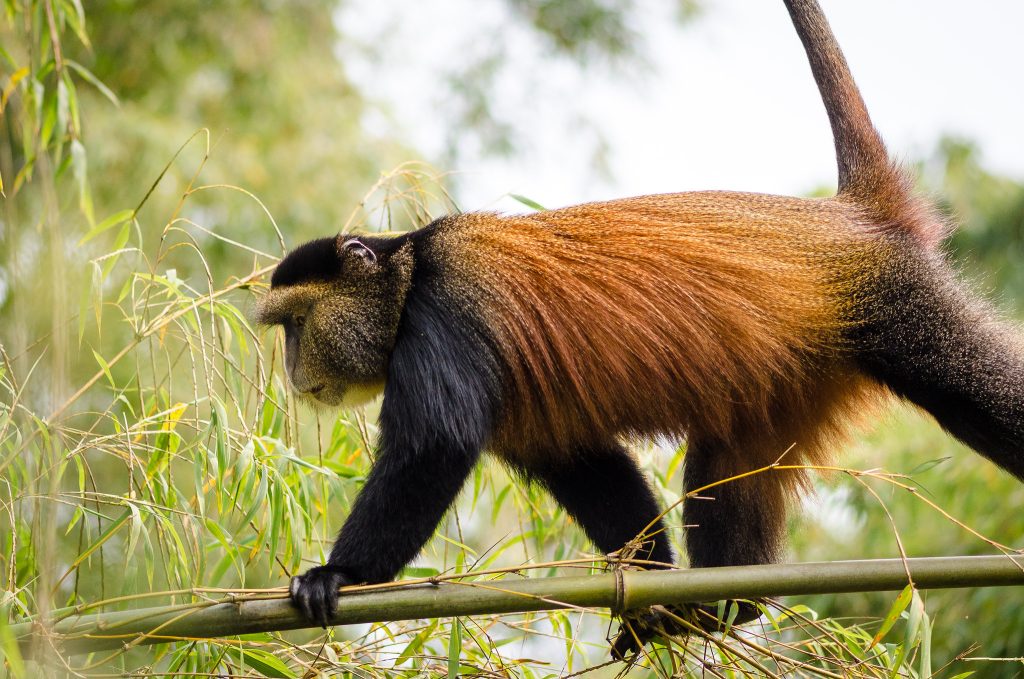
Mgahinga Gorilla National Park, a short drive from Nkuringo through Kisoro, is the place for the primate Bwindi does not have: the golden monkey. A golden monkey trekking trip in the bamboo zone pairs well with Mgahinga gorilla trekking and volcano hikes, with Lake Mutanda nearby for a quiet night.
Queen Elizabeth National Park lies north of Buhoma and brings the savannah side: tree climbing lions in Ishasha, boat trips on the Kazinga Channel, and chimpanzee tracking in the Kyambura Gorge, with lower odds than Kibale. A 5 days Uganda Wildlife Safari is a common way to join gorilla trekking in Bwindi with game drives there, and it fits well into a Safari within Uganda.
Lake Bunyonyi, near Kabale, is one of the deepest lakes in Africa and is widely described as free of bilharzia. Its islands, terraced hills and dugout canoes make it the usual rest stop after a southern Bwindi trek, with crayfish on lodge menus and short hikes between the islands.
Lake Mburo National Park breaks the long drive between Kampala and Bwindi, with zebras, impala and boat trips. On the way back to Entebbe airport, the Uganda Wildlife Education Centre or the Zika Forest Uganda. walk fills a spare morning, the latter with red tailed monkeys and forest birds.
Further afield, Rwanda’s Nyungwe Forest adds chimps and big colobus troops to Rwanda gorilla trekking, and many travellers fly on from Entebbe to Kenya for the Masai Mara. Primate fans who want something completely different can look at the lemurs in our primates of Madagascar guide.
Getting to Bwindi for a Primate Safari
Bwindi is remote, and the route you pick decides which sector is easiest. By road from Entebbe or Kampala the drive takes eight to ten hours, usually broken at Lake Mburo. Scheduled light aircraft fly from Entebbe to Kihihi in about an hour and a half, and Buhoma is roughly an hour’s drive from the airstrip; Kisoro airstrip serves Rushaga and Nkuringo in the south. From Kigali, the southern sectors are about four to five hours by road including the border.
Pick the sector first, then the route. A trip built around chimps in Kibale and savannah in Queen Elizabeth reaches Buhoma or Ruhija from the north, while a trip from Rwanda lands in the south. Our guide to getting to Bwindi compares the road, air and Kigali options in detail.
Bwindi Wildlife and Primate Safari Questions
How many primate species live in Bwindi?
About eleven are usually listed: mountain gorilla, chimpanzee, L’Hoest’s monkey, black and white colobus, red tailed monkey, blue monkey, De Brazza’s monkey, olive baboon, the potto, Demidoff’s galago and the spectacled galago. Checklists differ by one or two species, mostly because De Brazza’s records are thin and the night primates are poorly surveyed.
Can I go chimpanzee tracking in Bwindi?
Not yet. The park has about 426 chimpanzees, but they are not habituated and UWA sells no chimp tracking permit for Bwindi. For dependable chimp tracking, add Kibale, where UWA puts the sighting rate above 90 percent, or the Kyambura Gorge in Queen Elizabeth, where the odds are lower.
What is the minimum age for chimpanzee tracking in Uganda?
The UWA tariff sets it at 12 years. Gorilla trekking in Bwindi is limited to visitors aged 15 and over, and rangers check ages at the briefing, so carry passports.
How many gorilla families can you trek in Bwindi?
More than twenty habituated families are open to trekkers across Buhoma, Ruhija, Rushaga and Nkuringo, with Rushaga holding the most. UWA counts more groups once research and habituation families are included. Your permit is for a sector, and rangers assign the family on the morning of the trek. See our gorilla families directory for every group.
Will I see monkeys on a gorilla trek?
Often, but not always. Red tailed and blue monkeys, colobus and L’Hoest’s monkeys are common sightings on the way to a gorilla family, and a guided nature walk in Buhoma raises the odds.
Are there golden monkeys in Bwindi?
No. Golden monkeys live in the bamboo forest of the Virunga volcanoes. In Uganda you track them in Mgahinga Gorilla National Park, a short drive from the southern Bwindi sectors.
Can I see Bwindi’s primates without a gorilla permit?
Yes. Guided nature walks from Buhoma and Ruhija need only the park entry and walk fee, and they regularly turn up L’Hoest’s monkeys, colobus, red tailed and blue monkeys. Baboons are often seen from the road. Gorillas themselves need a trekking or habituation permit.
Are there elephants in Bwindi, and are they dangerous?
Yes, a small population of forest elephants lives in the park, mostly around Ruhija. They are rarely seen. Armed rangers walk with every group and steer clear of fresh signs, so the risk to visitors is low.
What is the best time of year for Bwindi wildlife?
The drier months, June to August and December to February, give firmer trails and easier walking. Primates are present all year, and birding is good in the wetter months too, when many species breed. See our guide to the best time for gorilla trekking in Uganda, and pack with our gorilla trekking packing list.
How much do gorilla and habituation permits cost in Bwindi?
A gorilla trekking permit costs US$800 for foreign non residents, US$700 for foreign residents and UGX 300,000 for East African citizens. A low season rate of US$600 for non residents and US$500 for foreign residents has been announced for April, May and November; those permits cannot be rescheduled. The habituation experience costs US$1,500, and UWA has announced a rise to US$1,800 for foreign non residents from the coming January, so confirm the rate for your travel dates. Permits are paid in full at booking. Our gorilla permits guide explains how booking works.
Can children join primate walks in Bwindi?
Gorilla trekking is limited to visitors aged 15 and over. Younger children can join shorter nature walks and community walks around Buhoma, which still give a good chance of seeing monkeys.