Gorilla trekking gaiters are waterproof sleeves worn over the boot top and lower leg to block safari ants, stinging nettles, thorns, mud and forest debris. Knee-high versions in the 10 to 15 inch range protect best, and many lodges near the park lend them free or hire them for a few dollars. On a gorilla trekking safari in Bwindi Impenetrable National Park or Volcanoes National Park in Rwanda, everything below your knee spends the day in wet undergrowth.
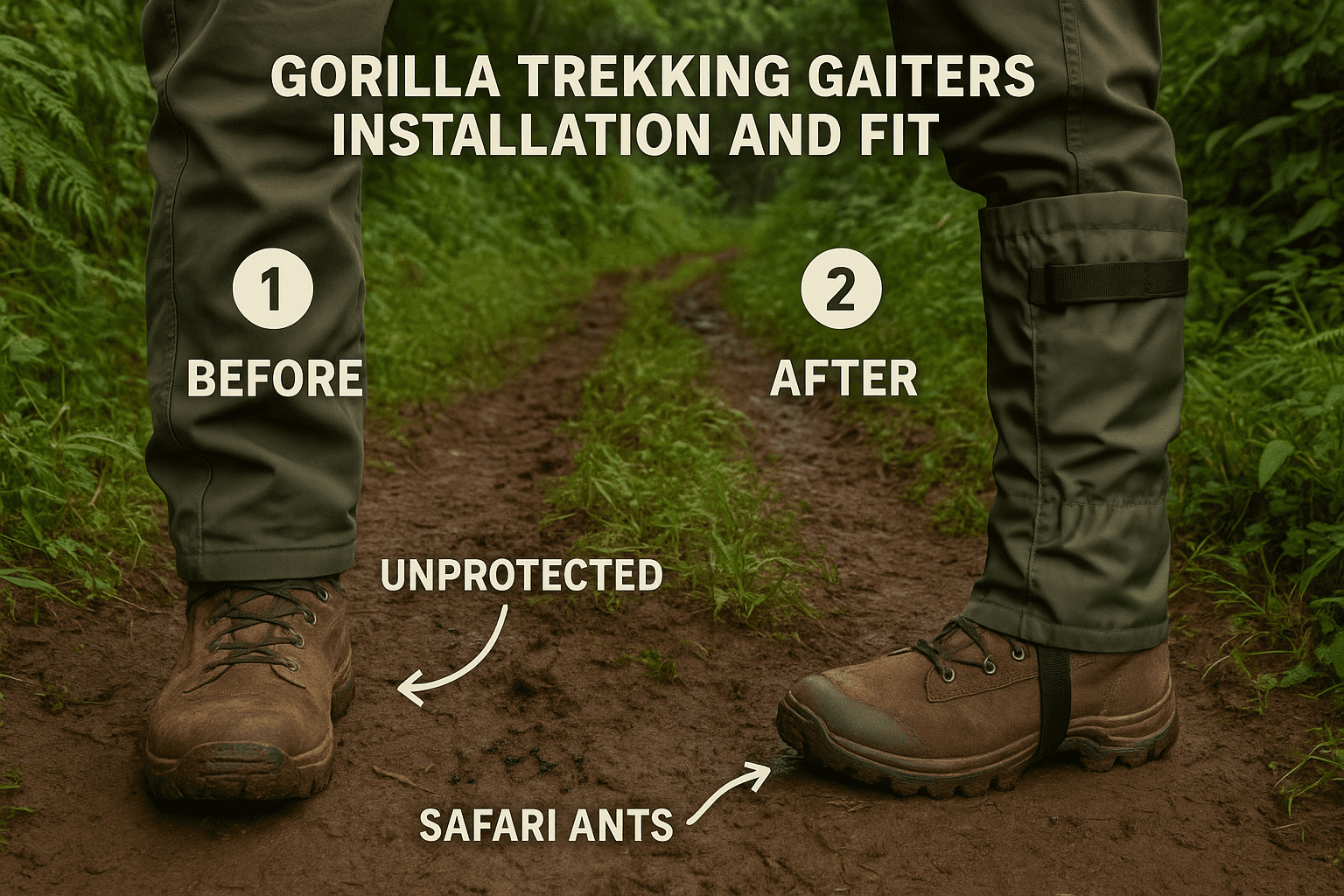
Gorilla Trekking Gaiters and What They Protect You From
Gaiters look faintly ridiculous. Then you spend four hours in Bwindi and understand exactly what they are for.
A gaiter closes the one gap your boots and trousers cannot. Your boot ends at the ankle, your trouser cuff hangs loosely over it, and between the two sits an opening that mud, seeds, twigs and ants all find within minutes. Waterproof boots are useless once water goes in over the collar. The gaiter turns two separate items into one sealed unit from knee to sole.
Four hazards make the case on a gorilla trekking safari. Safari ants come first and cause the most misery. Stinging nettles come second. Mud and debris in the boot come third. Thorns and sharp grasses come fourth. A gaiter handles all four at once, which is unusual value for a piece of kit that costs less than a permit tip.
Safari Ants and Why Gaiters Beat Repellent on a Gorilla Trekking Safari
Safari ants, also called driver ants, travel in dense columns across the forest floor and defend those columns aggressively. Step into one and you have hundreds of insects on your boots within seconds, all working upward.
Their bite is genuinely painful and it leaves welts that itch for a day or two. What makes them a real problem rather than a nuisance is timing. Trekkers who get ants inside their trousers have to stop, strip and deal with it, and sometimes that happens in the middle of the walk in or, worse, during the hour you paid a great deal of money to spend with the gorillas.
Insect repellent does nothing here. Ants are not deterred by DEET the way mosquitoes are, and in any case the humidity, sweat and constant contact with wet vegetation wash repellent off your legs within the first hour. This is a physical barrier problem, not a chemical one.
The smooth outer surface of a nylon gaiter gives the ants very little to grip. Combined with your trouser cuffs tucked into tall socks underneath, you end up with two barriers rather than one, and that is what actually works.
Stinging Nettles and Thorns on Bwindi Gorilla Trekking Trails
Local guides call the nettles bad grass, which is a fair description. The variety growing through Bwindi and the Virunga slopes stings hard and the burning lasts.
These plants grow at exactly ankle and shin height along narrow trail sections, so your lower legs make contact repeatedly whether you are careful or not. One trekker on a Uganda forum reported being stung straight through a pair of jeans, which gives you a sense of what thin trekking trousers alone are up against.
Thorny vines add a second problem. They catch, they tear fabric, and they scratch skin through the tear. Sharp grasses and bamboo shoots hide under larger vegetation and slice at whatever brushes them.
A gaiter made from tough nylon or Cordura spreads the force of a thorn across a wider area instead of letting the point concentrate, so it resists puncture far better than trouser fabric. The smooth face also lets vegetation slide off rather than catching, which makes pushing through dense undergrowth less of a fight.
Gaiter Height and Sizing for a Gorilla Trekking Safari
Height is the decision that matters most, and taller wins here more clearly than in most hiking contexts.
Fit around the calf matters as much as height. Too loose and you have created a funnel rather than a seal. Too tight and you will be adjusting it every twenty minutes and cutting off circulation on the climbs. Look for adjustable straps or an elastic panel so you can adjust it properly once you are wearing your actual trekking trousers.
At the bottom, the opening needs to sit securely over your boot without straining the fabric. Most designs include an instep strap that passes under the sole to stop the gaiter riding up, and that strap is what keeps everything in place across a five-hour walk.
Nylon Versus Cordura Gaiters for Gorilla Trekking Tours
Both materials work on gorilla trekking tours. The choice is about how many treks you plan.
Waterproof nylon is light, flexible, sheds water well and resists the constant moisture of a rainforest without degrading. For a single trip it does everything asked of it, and it costs less. The weakness is puncture resistance over time, since repeated thorn contact eventually finds a weak spot.
Cordura is the heavier-duty option and it is what to buy if you are trekking more than once or adding a habituation day. The fabric takes repeated thorn strikes without developing holes, and it survives being dragged through bamboo and vines. You pay for that in weight and price. Knee-high waterproof hiking gaiters in either fabric are the category to shop, and the taller listings are the ones worth filtering for.
Beyond the fabric itself, check the stitching and the closure. Double-stitched seams at the stress points stop failures when a gaiter catches on a vine and pulls hard. Closures come as full-length zips, part zips with a Velcro storm flap, or wrap-around Velcro. Zips seal most reliably but fail badly if damaged in the field, whereas Velcro adjusts easily and loses grip once mud works into it. A zip with a Velcro flap over the top is the most forgiving combination for these conditions.
Dark colours are the sensible pick. Bwindi’s red clay will coat them regardless, and brown, black or forest green hide it far better than anything pale.
Fitting Gaiters Over Boots and Trousers Before Your Trek
Most gaiter failures are fitting failures. Get the order wrong and you have carried the thing all day for nothing.
Boots go on first, trousers hang normally over the boot top, then the gaiter goes on over the trousers. Never underneath. A gaiter worn under the trouser cuff leaves the exact gap it exists to close, and ants will find it.
Start at the bottom. Fit the opening snugly over the boot, then run the instep strap under the sole and tighten it enough that the gaiter cannot ride up when you lift your knee high. Not so tight that it digs in.
Close the main seam next, checking the full length rather than assuming. A zip half-engaged near the top is the most common mistake, and Velcro needs firm pressure along its whole run to hold once it is wet.
The top edge should sit snug against your leg with no gap you could slide a finger into. That upper seal is the critical point for insects.
Renting Gaiters Near Bwindi and Volcanoes National Park
You may not need to buy any. This is worth checking before you spend money on a piece of gear you might use once.
A number of lodges around Bwindi and in the Kinigi and Musanze area kit guests out at breakfast, handing over gaiters along with ponchos, daypacks, walking sticks and water bottles. Several of the higher-end properties treat this as standard, and at least one well-known lodge near Volcanoes National Park hires them out to anyone staying there.
Where the lodge does not supply them, hiring at the park offices is usually possible. In Rwanda the going rate has sat around five US dollars, or roughly five thousand Rwandan francs, per pair. Availability and sizing vary, and both get thinner during the busiest months, so a short email a few weeks ahead is worth the effort.
Fuller detail on what is realistically available locally, including boots and gumboots, sits in the guide to renting gorilla trekking gear.
Two arguments for owning your own anyway. Fit is consistent and you know it works, and hygiene is your own business rather than a question about how thoroughly the last pair was cleaned.
Seasonal Use of Gaiters on Gorilla Trekking Trips
Bwindi takes roughly 2,400mm of rain a year and has no genuinely dry season, so gaiters are never pointless. Their value does move with the calendar.
Alternatives to Gaiters on a Gorilla Trekking Adventure
If you arrive without gaiters and none are available, you are not stuck. Some options work better than others.
Tall socks with your trouser cuffs tucked inside them are the standard fallback and the one rangers actually recommend. It looks unfashionable and it works. This is the minimum acceptable barrier against safari ants, and plenty of trekkers do the whole thing this way in June or July without incident. Tall over-the-calf merino socks are the ones to look for, since crew height leaves nothing to tuck into.
Knee-high gumboots solve the problem differently by removing the boot collar entirely. Nothing gets in over the top because there is no gap. What you give up is arch support and cushioning, which starts to hurt on a long trek in a steep sector.
Waterproof overtrousers with an elasticated or cinched ankle help with mud and water, though they do less against thorns and nothing much against determined ants.
Duct tape around the trouser cuff and boot top is the improvised version. It genuinely works for one trek and it is what some guides suggest when a guest turns up unprepared. It is not comfortable.
Cleaning and Care After a Gorilla Trekking Safari
Your gaiters will come back unrecognisable. Deal with them the same evening rather than a week later.
Rinse off the clay before it dries. Wet mud comes away with a hose or a bucket and a cloth in a couple of minutes, whereas dried clay bonds into the fabric weave and takes real work. Most lodges will happily rinse gear for guests.
For a proper clean at home, mild detergent and cool water is right, by hand or on a gentle machine cycle. Hot water and harsh detergent strip the waterproof coating, which is the whole point of the item.
Air dry, always. Machine heat damages synthetic fabric and the coating with it, and putting them near a fire at the lodge is a good way to ruin them.
After several washes the water repellency fades and can be restored with a proofing spray made for outdoor fabric. Store them dry and out of direct sun, and check the zips and instep straps before the next trip rather than discovering a failure at a trailhead.
Frequently Asked Questions About Gorilla Trekking Gaiters
How much do gorilla trekking gaiters cost to buy or hire?
Hiring near Volcanoes National Park has typically cost about five US dollars, or roughly five thousand Rwandan francs, per pair, and rates around Bwindi are broadly similar. A good number of lodges lend them to guests at no charge alongside ponchos and daypacks, so ask before you buy. Buying outright sits in the same territory as a decent pair of hiking socks rather than anything resembling the cost of boots, with heavier Cordura models at the upper end and basic nylon at the lower.
Do I really need gaiters, or can I skip them?
You can trek without them and many people do. Tall socks with trousers tucked in is the workable minimum and it holds up reasonably in June and July. What you give up is shin protection against nettles and any real defence when mud gets deep. In April, May, October and November, going without moves from a mild compromise to a decision you will regret by mid-morning. Given what a pair costs to hire at the park office, it is a strange thing to economise on.
What height of gaiter should I buy?
Ten to twelve inches suits most trekkers in most months, giving full coverage at the boot collar plus the lower shin where nettles sit. Fourteen or fifteen inch knee-high versions protect more and are worth it for the wet season or the steeper sectors like Nkuringo and Ruhija. Eight inch ankle gaiters keep grit out of your boots but leave your shins bare, so treat them as the floor rather than the target.
Do gaiters go over or under your trousers?
Over, without exception. Wearing them under the trouser cuff recreates the exact gap they exist to seal, and safari ants will find it within minutes of you stepping into a column. Boots on first, trousers hanging normally over the boot top, gaiters over the trousers, instep strap under the sole, closure fully engaged and the top edge snug against your leg.
Will gaiters keep my feet dry?
Not by themselves. Gaiters stop water and mud entering at the boot collar, which is a real and common way feet get wet, but the waterproofing has to come from the boot. If you wade a stream above the gaiter line, water goes in regardless. Think of the two as a system, with the boot handling immersion and the gaiter handling everything arriving from above and the sides.
Are gaiters useful in the dry season too?
Yes, though less critically. June, July and August bring the least rain, with July averaging about 77mm across seven rainy days, so mud is a smaller factor. Safari ants and stinging nettles are unaffected by the season, and the forest canopy keeps the undergrowth wet even on clear days. Mid-height gaiters in the drier months and knee-high in the wet is a sensible split.
Can I use ordinary hiking gaiters from home?
Usually yes, provided they are tall enough and made from something tough. Standard temperate-climate gaiters built for scree and snow tend to be fine on fabric strength, and the main thing they get wrong is height, since many are cut short for trail use. Check yours reach at least ten inches and that the closure still seals properly. Lightweight running gaiters are too flimsy for thorns and too short to matter.
Continue With the Rest of Your Gorilla Trekking Gear
Gaiters are the layer above the boot. The full checklist sits in the guide to what to pack for gorilla trekking.
For what goes underneath them, see boots for gorilla trekking. For everything worn above the knee, work through what to wear for gorilla trekking, and if you would rather hire than buy, see renting gorilla trekking gear.