Golden monkey trekking in Uganda takes place in one park only: Mgahinga Gorilla National Park, where rangers lead small groups from Ntebeko gate into the bamboo to spend an hour with a habituated troop. Permits are booked through a licensed safari company that is a recognised member of AUTO, the Association of Uganda Tour Operators, which buys them from the Uganda Wildlife Authority in your name, and most travellers pair the trek with gorillas. Mgahinga sits on the Virunga volcanoes in far southwest Uganda, beside Rwanda and Congo.
Golden Monkey Trekking in Uganda: Why Mgahinga Is the Only Place
Golden monkey trekking in Uganda is limited to Mgahinga for a simple reason. The monkeys live in mountain bamboo, and the only Ugandan bamboo they occupy grows on the northern slopes of Muhabura, Gahinga and Sabyinyo, the three extinct volcanoes that make up the park. Bwindi, for all its primates, has none.
Mgahinga is small. At about 33.7 square kilometres it is Uganda’s smallest national park, yet it climbs from farmland at around 2,227 metres to moorland above 4,000, and it forms the Ugandan corner of the Virunga Mountains conservation area. No fence divides it from Volcanoes National Park in Rwanda or Virunga National Park in Congo, so monkeys, gorillas and buffalo cross freely.
Vegetation runs in bands up the mountain. Montane forest gives way to a wide bamboo belt, and above that come giant lobelias and groundsels. The golden monkey tracking safari stays in the bamboo, which is why it is a shorter outing than most gorilla treks: the troop rarely ranges far beyond the lower slopes near Ntebeko. Our full Mgahinga Gorilla National Park guide covers the park as a whole.
The Golden Monkey: What You Are Tracking in the Bamboo
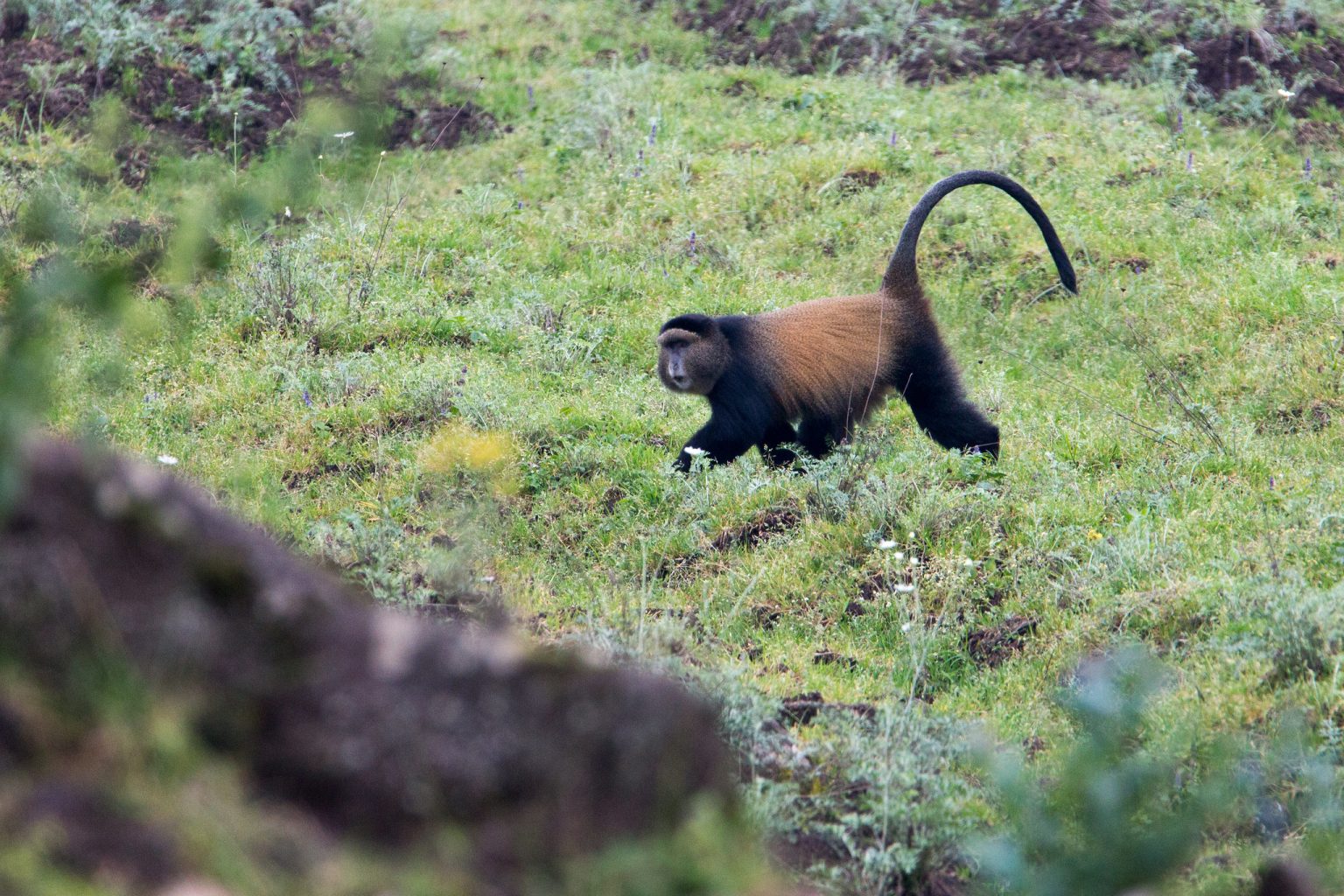
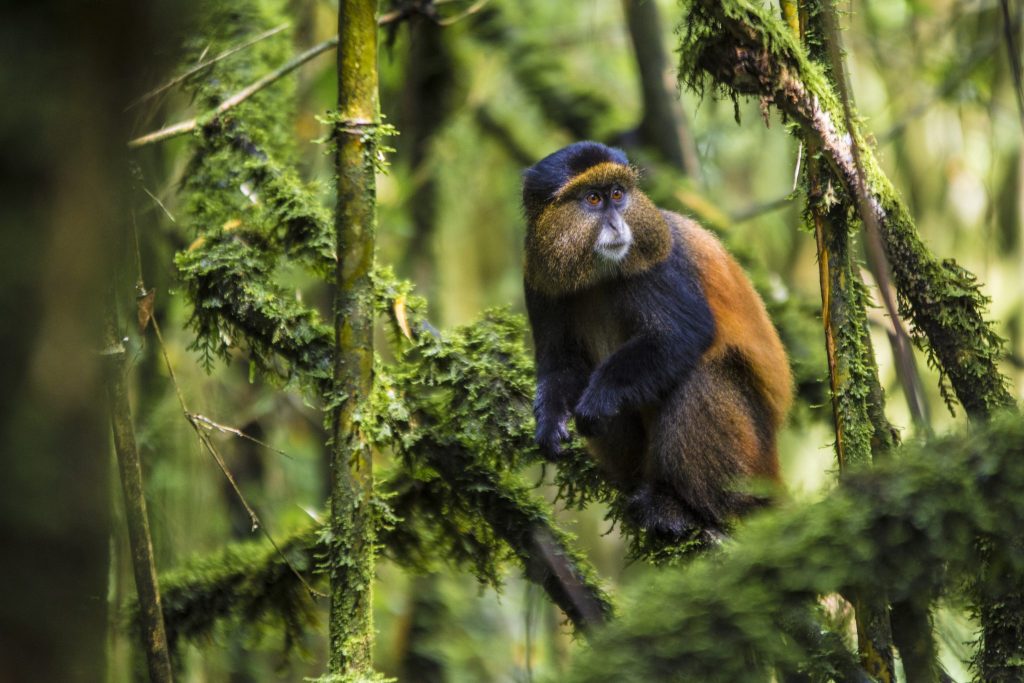
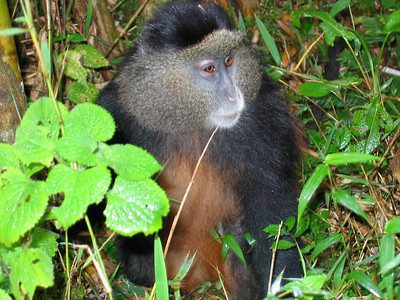
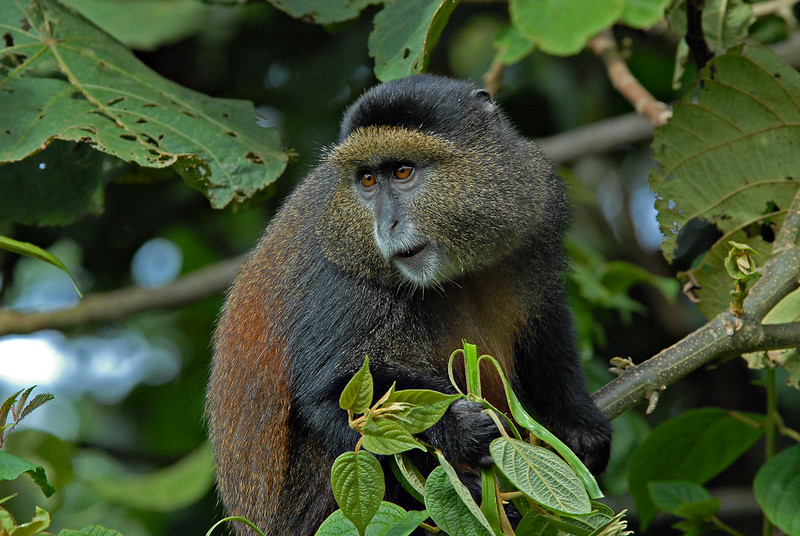
The animal on this primate trek is a localised form of the blue monkey, often listed as Cercopithecus mitis kandti and classed as Endangered on the IUCN Red List. Its back and flanks are a bright orange gold, the limbs, crown and tail are dark, and the face is grey. In the low light of a bamboo thicket the colour shows up well, which is half the pleasure of the hour.
Its range is tiny. Golden monkeys live in the Virunga volcanoes and in one forest in western Rwanda, Gishwati, and nowhere else. Survey estimates for the whole population sit in the low thousands, with the Uganda Wildlife Authority putting it at roughly 2,000 to 4,000 animals, and the golden monkey is one of about 20 primate species found in Uganda. Habitat loss on the farmland below the parks is the main pressure, which is why the bamboo inside Mgahinga matters so much.
Bamboo is the core of their diet. They eat young shoots and leaves, add fruit, flowers and lichens when they are in season, and pick at insects and larvae. When fresh bamboo shoots come up after rain, the troop can stay in a small patch for days.
Troops are large and loud. Operator reports put Virunga troops anywhere from about 30 to near 100 animals, and the habituated group at Mgahinga numbers several dozen. Adult males call to hold territory, females keep the group together with contact calls, and juveniles chase each other through the stems. Unlike gorillas, golden monkeys do not build fresh ground nests each night, so trackers find them by fresh feeding signs, droppings and noise rather than by following the trail from the previous night’s nest.
Mgahinga works with two kinds of troop. The fully habituated troop is the one visitors track on the standard one hour trek. A second, semi habituated group is still being accustomed to people, and it is the one used for the longer habituation experience, where you spend the morning with the rangers and researchers doing that work.
A Golden Monkey Tracking Day at Ntebeko, Hour by Hour
A golden monkey tracking day in Mgahinga follows a set pattern, and knowing it in advance takes a lot of the uncertainty out of the morning.
The walk itself is usually gentle by Virunga standards. The first stretch crosses potato and bean gardens where farmers have stacked volcanic stones into neat piles, then a stone wall marks the park edge. Inside, the trail climbs steadily on soft soil and bamboo litter. Guides cut a path where the monkeys have moved off the track.
Then the hour, which is busy. Golden monkeys rarely sit still, and you will spend much of it tilting your head back as they leap between stems, or crouching as a group drops to the ground to feed on shoots. Rangers ask visitors to keep several metres back and to step aside if a monkey comes close; most guides use about seven metres as the working distance. For the gorillas next door the Uganda rule is stricter, 10 metres, so treat the monkeys with the same care.
Group sizes are small in practice. There is no fixed daily cap like the eight places on a gorilla family, but groups are usually kept to around eight, the number of visitors on any one morning is modest, and Mgahinga is a quiet park.
Golden Monkey Trek Rules and Safety in Mgahinga
The rules on a golden monkey trek are short and enforced by the ranger guide, and most of them protect the monkeys rather than you. Primates catch human colds and stomach bugs, so anyone who is ill should not go, and rangers may ask you to wear a face mask near the troop. Keep the distance the guide sets, which in practice is about seven metres, do not eat or drink near the monkeys, keep voices low, never use flash and never try to touch or feed an animal, no matter how close it comes. The hour is timed from the first sighting.
Safety on the mountain is well handled. An armed ranger walks with every group because forest elephants and buffalo share the bamboo, though sightings of either on the trek are uncommon and rangers keep groups well clear. Guides carry radios and know the slopes; the commonest injuries by far are twisted ankles and falls on wet ground, which is where good boots and a walking stick earn their place. The nearest hospital and pharmacies are in Kisoro town, under an hour from Ntebeko, and evacuation from the trail is organised by the rangers if anyone cannot walk out.
Weather adds its own risks. Wind, rain and mist can roll over the volcanoes quickly, cutting visibility in the bamboo and making slopes slick, and rangers will shorten or turn back a trek in bad conditions. Treat that as part of the deal rather than a lost day: the troop is there tomorrow.
The Golden Monkey Habituation Experience: Four Hours with Researchers
The golden monkey habituation experience is the longer version of the trek. Instead of one hour with a fully habituated troop, you join rangers and researchers for up to four hours with a group that is still getting used to people.
The difference is noticeable. A semi habituated troop is warier, so you watch more of how trackers read signs, record behaviour and move into position slowly. You see fewer close portraits and more of the ordinary life of the troop: feeding bouts, rests, quarrels, the long pauses between. Photographers and anyone who found the standard hour too short tend to rate it highly.
It starts from Ntebeko like the standard trek and runs most of the morning, so it does not fit on the same day as a gorilla trek. Some operators sell it as a half day, others as a longer outing, and the time with the troop depends on how the monkeys move. Spaces are limited and are booked through a licensed operator that is a recognised AUTO member. If the longer format appeals, the gorilla habituation experience in Bwindi’s Rushaga sector works the same way with gorillas, and the two make an unusual pair for a primate focused trip. Our guide to things to do in Bwindi covers the forest’s other activities.
Golden Monkey Trekking Difficulty, Fitness and the Best Months
Golden monkey trekking is easier than gorilla trekking. UWA itself describes it as less exhausting, and most visitors who walk regularly at home manage it without trouble.
Altitude is what catches people. You start above 2,300 metres and climb from there, and anyone who flew in from sea level a day or two earlier will notice the thin air on the steeper pitches. Take the first half hour slowly. Walking sticks are handed out at Ntebeko, and porters from the community association will carry a daypack and offer a hand on muddy slopes; hiring one also puts money straight into local households.
Trek times swing with the season. In the dry months, from June to September and December to February, the walk in is often an hour or so. In the rains, roughly March to May and October to November, trails turn to clay, vegetation grows taller and the troop can be harder to see. Visitor reports describe treks of five hours in a wet spell against two or three in the dry season.
Rain has its upside. New bamboo shoots come up after the first heavy showers, and the troop often concentrates in those patches to feed, sometimes low and close to the ground. The park is also quieter. If you go in the wet months, budget an extra morning in case cloud or mud slows things down. Our guide to the best time for gorilla trekking in Uganda covers the same seasons month by month.
Children are a common question. Golden monkey treks accept younger visitors than gorilla treks, but published minimum ages differ between sources: most operators quote 12, at least one lodge sets 15 for its guided outing, and the UWA tariff does not print an age for this activity. Confirm the current rule with your operator before you plan around it.
Booking a Golden Monkey Tracking Permit in Uganda
A golden monkey tracking permit is booked in advance through a licensed safari company that is a recognised AUTO member, which buys it from UWA in your name. UWA sells these permits to licensed operators, not to visitors. UWA’s tariff marks the activity as prior booking only, so do not count on buying a place at Ntebeko on the morning. Payment is in full when the permit is issued, and you carry the receipt or permit with your passport to the briefing.
Most travellers let their operator handle it alongside the gorilla permit, transport and lodges, since the dates need to fit together. If you are travelling independently and already have a vehicle and a room near the park, an operator can still book the golden monkey permit on its own. Either way, the permit names a date, not a time slot, and is for the standard trek or the habituation experience, not both. Prices and what the fee covers sit in the FAQ below.
Packing and Photography for a Golden Monkey Trek
Kit for a golden monkey trek is much the same as for gorillas, scaled down for a shorter day. Waterproof boots with real grip come first, because volcanic soil on a slope is slippery even in the dry months. Long trousers tucked into socks or gaiters keep out ants and nettles, and a long sleeved shirt protects your arms from bamboo edges. Gardening gloves are worth having for grabbing stems on the climb.
Protect what you carry, too. A dry bag or a simple rain cover for the camera, and a plastic bag for your phone and passport, save a lot of worry when a shower comes through the bamboo.
Weather on the volcanoes changes quickly. Mornings at Ntebeko can be cold and misty, and showers roll in without much warning, so carry a light rain jacket and a warm layer even under blue sky. Take at least a litre of water, a snack, insect repellent and sunscreen for the open farmland stretch. The full list is in our gorilla trekking packing list.
Photography is harder than it looks. The monkeys are small, quick and often backlit against bright sky between the bamboo, so:
Phones do better than people expect when a troop drops to the ground. Many trip reports suggest putting the camera down for part of the hour, because it passes quickly.
Golden Monkey Trekking in Uganda Versus Rwanda
The same monkey lives on both sides of the border, so the choice between a Uganda golden monkey trek and one in Rwanda’s Volcanoes National Park comes down to logistics and the rest of your trip rather than the animal.
| Point | Uganda | Rwanda |
|---|---|---|
| Park | Mgahinga | Volcanoes |
| Briefing | Ntebeko gate | Kinigi |
| Habituation trek | Offered | Offered |
| Same day as gorillas | Not usual | No |
| Crowds | Very quiet | Busier |
| Permit price | Lower | Higher |
Rwanda’s golden monkey treks report to Kinigi at 7am, the same time as gorilla treks, so the two always fall on different days, and RDB caps each golden monkey group at 16. The Rwandan troops are habituated and used to more visitors. Our page on Rwanda golden monkey treks covers that side, and the exact Rwandan fees sit in our Rwanda gorilla permit guide.
Uganda’s advantages are price and quiet: Mgahinga sees a fraction of the visitors, and a Ugandan golden monkey permit costs well under the Rwandan one (figures in the FAQ). Rwanda’s advantage is access, since Kinigi is a short drive from Musanze and around two and a half hours from Kigali. If your gorillas are in Rwanda, track the monkeys there. If they are in Mgahinga or southern Bwindi, do it in Uganda. Travellers on a two country trip often split it: Rwanda gorilla trekking in Volcanoes, then Uganda for a second gorilla family and the golden monkeys, crossing at Cyanika.
Combining Golden Monkey Tracking with Gorilla Trekking and Volcano Hikes
Few people drive to Kisoro for golden monkeys alone. Mgahinga is the only park in Uganda where you can do gorilla trekking and golden monkey tracking from the same gate, with the Nyakagezi family as the one gorilla group Mgahinga permits are sold for. A Rwandan family, Hirwa, crossed into the park some years ago and is now listed under Mgahinga by the International Gorilla Conservation Programme, though some reports say it went back to Rwanda, so check with your operator before planning around it. Our Mgahinga gorilla trekking guide covers that trek, and comparing gorilla trekking in Bwindi and Mgahinga sets the two parks side by side.
Southern Bwindi is the other common partner. The Rushaga sector has the most gorilla families in Uganda and is about an hour and a half from Kisoro, and Nkuringo is closer still. A typical plan looks like this:
Order matters less than you might think. Many people track the monkeys first as a gentle warm up at altitude, which makes the gorilla day easier. Others save them for the end as a lighter morning before a long drive.
Of the volcano hikes, Mount Gahinga is the gentlest, about 8 kilometres return to a swampy summit crater, and the trail passes through the same bamboo where golden monkeys sometimes appear. Sabyinyo’s ladders lead to a summit where Uganda, Rwanda and Congo meet; Muhabura, at 4,127 metres, is a full day for fit hikers. The Batwa Trail to Garama Cave adds the human history of the forest.
Primate trips also stretch well beyond the Virungas. Many travellers fly on from Uganda to Kenya to watch the river crossings on a Masai Mara safari, putting gorillas, golden monkeys and big cats in one East Africa holiday.
Mgahinga Lodges for a Golden Monkey Safari
Where you sleep decides how early you rise. Lodges near Ntebeko put you minutes from the briefing; Kisoro town and Lake Mutanda add 30 minutes to an hour on dirt road but offer more choice. The choice falls into three rough tiers: one upmarket lodge at the gate, a handful of mid range lodges on Lake Mutanda and the hills around Kisoro, and simple guesthouses and the community camp for travellers watching their budget.
Mount Gahinga Lodge, run by Volcanoes Safaris just outside the park, is the top option nearest the gate, with stone cottages facing the volcanoes. Amajambere Iwacu Community Camp, right at Ntebeko, is a simple community run base with bandas and camping. In Kisoro, Traveller’s Rest Hotel is one of the oldest guesthouses in the region, with a long link to early gorilla researchers, and several budget guesthouses sit nearby. Lodges on Lake Mutanda suit travellers combining Mgahinga with Rushaga or Nkuringo. Kisoro also has ATMs and pharmacies, which helps because phone signal fades as you climb. For Bwindi stays, see our Bwindi lodges guide.
Getting to Mgahinga for Your Golden Monkey Trek
All routes end in Kisoro. By road from Kampala or Entebbe the trip is roughly 480 to 510 kilometres through Masaka, Mbarara and Kabale, taking eight to ten hours, and most people break it at Kabale or Lake Bunyonyi. Drivers usually stop at the equator crossing near Kayabwe for photographs and at the Igongo Cultural Centre outside Mbarara for lunch, which turns the long drive into a day with a few points of interest. From Kisoro a dirt road climbs about 14 kilometres to Ntebeko; after rain a 4×4 handles it best. Golden monkey treks start from Ntebeko, not from the park’s eastern Muhabura gate, which serves the Muhabura climb.
Flying saves a day: scheduled and charter flights from Entebbe or Kajjansi reach Kisoro airstrip in a little over an hour. From Kigali, the drive to Kisoro is about two and a half to three hours through the Cyanika border, which makes Mgahinga an easy addition to a Rwanda trip. Full routes are on our getting there page.
Golden Monkey Trekking in Uganda: Frequently Asked Questions
How much does golden monkey trekking cost in Uganda, including the habituation experience?
Under the current UWA conservation tariff, a golden monkey tracking permit in Mgahinga is US$60 for foreign non residents, US$50 for foreign residents and UGX 40,000 for East African citizens. The golden monkey habituation experience is US$100, US$80 and UGX 100,000 for the same three groups. Both fees exclude park entry, which is US$40 a day for foreign non residents, US$30 for foreign residents and UGX 20,000 for East Africans, so a foreign visitor who is not gorilla trekking in Mgahinga that day pays US$100 in all for the standard trek. On a day your gorilla permit already covers Mgahinga entry, you pay only the activity fee. Porters and tips are paid separately, and UWA can revise its rates, so confirm with your operator before paying.
Is a golden monkey trek cheaper in Uganda than in Rwanda?
Usually. Rwanda Development Board lists golden monkey tracking in Volcanoes National Park at US$100 for foreign visitors, against US$60 plus park entry for the standard trek in Mgahinga, which comes to the same US$100 unless your gorilla permit already covers that day’s entry. The animal and the bamboo habitat are the same, so the saving is real, but only worth chasing if the rest of your trip already brings you to southwest Uganda.
Can I do gorilla trekking and golden monkey tracking on the same day?
Not as a rule. Both start from the same morning briefing, and a gorilla trek can run past midday. Plan them on separate days: most visitors spend two nights near Ntebeko or Kisoro and do one each morning.
Are golden monkey sightings guaranteed in Mgahinga?
No, but they are very likely. The troop is habituated and trackers locate it before your group sets off, so most treks find it. Wild animals move, though, and on a wet day the search can take longer and the views can be partial.
How fit do I need to be for golden monkey trekking?
Moderately. Anyone who can walk two or three hours on uneven ground can manage it. The altitude makes slopes feel steeper than they look, so take it slowly, use the walking stick offered at Ntebeko and hire a porter if your knees or breathing worry you.
Can children go golden monkey trekking in Uganda?
Older children can, and it is the usual primate activity for families whose children are too young for gorillas, where the minimum age is 15. Published minimum ages for golden monkeys differ between sources, so check the current rule with your operator when you book.
How much does it cost to trek with a gorilla in Uganda?
A Uganda gorilla trekking permit is US$800 for foreign non residents, US$700 for foreign residents and UGX 300,000 for East African citizens, the same in Bwindi and Mgahinga, with park entry included. UWA has announced a low season rate of US$600 for non residents and US$500 for foreign residents in April, May and November, on permits that cannot be rescheduled, and permits are paid in full at booking. The four hour gorilla habituation experience in Bwindi is US$1,500, with a rise to US$1,800 announced by UWA.
How safe is gorilla trekking in Uganda?
Gorilla and golden monkey treks in Bwindi and Mgahinga are well organised and safe for most visitors. Armed rangers walk with every group, groups are small, and the guides read the animals closely. The real hazards are slippery slopes, nettles and fatigue at altitude. Check your government’s current travel advice before you book, and see our page on whether Uganda is safe to visit.
Which month is best for gorilla trekking in Uganda?
June to September and December to February are the drier months, with firmer trails and shorter treks, and they are the most popular, so permits sell out first. March to May and October to November are wetter but quieter, and the same seasons apply to golden monkey treks in Mgahinga.
Which is better for gorilla trekking, Rwanda or Uganda?
Rwanda is quicker to reach, with Volcanoes National Park around two and a half hours from Kigali. Uganda has more gorilla families, a lower permit price and the four hour habituation experience, plus golden monkeys in Mgahinga at a lower crowd level. Many travellers do both, crossing at Cyanika; our guide to Uganda vs Rwanda for a safari sets them side by side.
How far ahead should I book a golden monkey permit?
Permits are far easier to get than gorilla permits, but book a few weeks ahead for June to September and December to February, and longer if you want the habituation experience. Licensed operators listed on our gorilla safari companies page can book both, and our gorilla permit guide explains how operator bookings work.