The biggest gorilla ever reliably recorded in the wild was a silverback shot near Ambam in southern Cameroon, reported at 1.83 m tall and 267 kg. The tallest wild gorilla, killed in eastern Congo in 1938, measured 1.95 m. Zoo gorillas have grown heavier, up to about 310 kg, while the silverbacks visitors meet on a Bwindi gorilla trek are far smaller. Gorillas are the largest living primates.
Search for this topic and you will find figures from 400 lb to 860 lb, a famous Rwandan silverback crowned as the record holder, and even an extinct Asian ape counted as a gorilla. Most of it traces back to a handful of old measurements, a few zoo weights and a lot of copying. This guide sets out what was actually measured, what was only estimated, and what has no source at all.
Heaviest and Tallest Wild Gorillas Measured Before the Trekking Era
Every wild size record comes from a dead animal. Wild silverbacks are almost never weighed alive, so the record book is a product of colonial era hunting and museum collecting. Most of the figures quoted today come from Gerald Wood’s Guinness Book of Animal Facts and Feats, which pulled together hunters’ and naturalists’ reports.
The heaviest wild gorilla on that list is a silverback shot near Ambam, a town in southern Cameroon close to the borders of Gabon and Equatorial Guinea. Wood gives him a height of 1.83 m (6 ft) and a weight of 267 kg (589 lb). Ambam lies in western lowland gorilla country, which makes him a western gorilla, the species usually described as the smaller one. Some pages call him an eastern lowland gorilla. That is a geography error.
Treat the number with some caution. Hunters in that era weighed carcasses with whatever scales they had, sometimes in pieces, and a gorilla’s gut can hold several kilograms of leaves and stems. The record may be accurate. It has never been checked.
The tallest wild gorilla is better documented. Guinness World Records lists a bull shot in the eastern Congo on 16 May 1938 at 1.95 m (6 ft 5 in), measured from the top of the crest to the heel. Wood’s account adds an arm span of 2.7 m, a chest measurement of 1.98 m and a weight of 219 kg (483 lb), and places the kill near Alimbongo in northern Kivu.
Two details matter here. The height was taken on a body lying flat, which stretches the legs and spine in a way a standing gorilla never does, so a living animal of that frame would have stood noticeably shorter. And while Guinness calls him a mountain gorilla, Alimbongo sits in what is now considered Grauer’s gorilla country; records of that time often lumped all the eastern gorillas together. A version of this specimen also turns up online as a “482 lb gorilla from Lake Kivu, 1929”, which looks like the same record retold with the details shuffled.
One more figure sits in the background of the record books: a male shot in 1932 and reported at 2.06 m (6 ft 9 in) and 218.6 kg (482 lb). It would beat the 1938 bull by more than ten centimetres, yet nobody has been able to tie it to a museum specimen or a published measurement, so it stays in the unconfirmed column. The weight is almost identical to the Kivu animal, which again hints at one record being copied and altered.
How do these compare with what scientists record today? Field and museum data give adult mountain gorilla males roughly 1.6 to 1.7 m in standing height and somewhere around 120 to 190 kg, with an average close to 155 to 160 kg. Every one of the hunting records sits well above that, which is exactly why they became records.
Captive Giants: Phil, N’gagi and the Zoo Weight Records
Zoo gorillas hold the heaviest weights ever recorded, for reasons covered further down. Wood’s figure for overweight captive males is up to about 310 kg (683 lb). Two individual zoo gorillas get most of the attention.
N’gagi was a wild born male, caught in the Kivu region of what was then the Belgian Congo and usually described as a mountain gorilla, who arrived at the San Diego Zoo in 1931 and died there in 1944, aged about 18. Older Guinness editions credit him with 636 lb (about 288 kg), which made him the heaviest gorilla in captivity for decades. Other accounts treat 636 lb as his weight at death and give a higher lifetime peak of about 310 kg (683 lb), the same figure usually quoted as the ceiling for overweight zoo males. A zoo postcard from the 1940s, now in a university archive, labels him at 535 lb, so his weight clearly swung through his life. Whichever number you take, it was a peak, not his usual size.
Bushman is the other early heavyweight that lists mention. Found as an infant in Cameroon in 1928, he reached Chicago’s Lincoln Park Zoo in 1930 and died of heart disease on New Year’s Day 1951, aged 22. Popular pages put him at around 1.83 m and 250 kg, but the Field Museum, where his preserved body still stands at the East Entrance, gives no weight in its own account of his life. Treat the figure as a newspaper era estimate.
Phil is the gorilla behind the most dramatic number online. He was caught in West Africa as an infant, reached the Saint Louis Zoo in 1941 weighing about 30 lb, and died on 1 December 1958. He was a local celebrity, and a statue of him stands at the zoo today. Newspaper coverage from December 1953 put his estimated weight at about 525 lb. The figure of 860 lb (390 kg) repeated across trekking blogs has no traceable source: no zoo record, no dated newspaper weighing, nothing beyond other websites. Until a primary record turns up, it should not be treated as the heaviest gorilla ever.
Height claims from zoos are just as shaky. Wood records a western lowland male called Gust at Antwerp Zoo as 2.20 m tall, which would make him taller than any measured wild gorilla by a wide margin; most primatologists would want to see how that was measured before accepting it.

Titus the Silverback and Other Unverified Claims on Gorilla Trekking Sites
Many gorilla trekking sites name Titus as the biggest gorilla ever, usually with a weight of 267 kg and a height of 1.95 m. Look at those two numbers again: they are the Ambam weight and the 1938 Kivu height, borrowed from two different dead gorillas and pinned on a living one.
Titus was real and very famous. Born in August 1974 and first recorded by researchers at the Karisoke Research Center in Rwanda, he grew up in Dian Fossey’s study groups, lost much of his family to poachers, and went on to lead one of the largest groups in the Virungas. He starred in the BBC documentary Gorilla King. The Dian Fossey Gorilla Fund reported that trackers found him dead in Volcanoes National Park on 14 September 2009, aged 35, and he was buried at Fossey’s old camp. What the Fund never published is a weight, because none was taken. Titus was a large, long lived mountain silverback. He was not a measured record.
A few other claims are worth flagging:
Fame and size are different lists. The gorillas most people can name, such as Koko, the signing female western lowland gorilla who died in 2018, Harambe at the Cincinnati Zoo, Snowflake the albino male at Barcelona Zoo, and Digit, the Virunga gorilla Dian Fossey studied before poachers killed him in 1977, are famous for their lives, not their weight. None of them appears in any credible size record, and Koko, as a female, would have been around half a silverback’s mass.
Bwindi has its own legends too. Ruhondeza, the silverback of the Mubare family, became famous for his age rather than his size, living past 50.
Which Gorilla Subspecies Grows Biggest: Size by Type for Safari Planning
There are four types of gorillas, and the record holders came from more than one of them. On average, though, one stands out.
The eastern lowland gorilla, also called Grauer’s gorilla, is the largest. Guinness World Records lists it as the largest living primate, with males standing about 1.75 m upright and weighing up to around 210 kg. It lives only in eastern DR Congo, where gorilla tourism in Kahuzi Biega National Park is currently halted by fighting around Bukavu. Check current travel advisories before planning any visit.
Mountain gorillas, the type you trek in Bwindi and the Virunga Mountains, and western lowland gorillas come out close to each other in published body mass data, with wild males averaging somewhere around 150 to 170 kg and big silverbacks of either kind passing 180 kg. The Cross River gorilla is similar in build to the western lowland but so rarely seen that reliable weights barely exist.
| Type | Wild male | Female | Seen where |
|---|---|---|---|
| Grauer’s | Up to 210 kg | About 80 to 100 kg | DR Congo |
| Mountain | 150 to 180 kg | About 70 to 100 kg | Uganda, Rwanda |
| Western lowland | 140 to 180 kg | About 70 to 90 kg | Congo, Gabon |
| Cross River | Little data | Little data | Not visitable |
Treat these as rough ranges, not exact means; sample sizes in the wild are small. Size does not track rarity either. Mountain gorillas are listed as Endangered by the IUCN, with 1,063 counted at the last full census, while Grauer’s, western lowland and Cross River gorillas are all Critically Endangered. The western lowland gorilla is by far the most numerous and is the gorilla almost every zoo holds. The mountain gorilla vs lowland gorilla comparison goes into fur, diet and build in more detail.
How Big a Typical Silverback Is on a Gorilla Trekking Safari
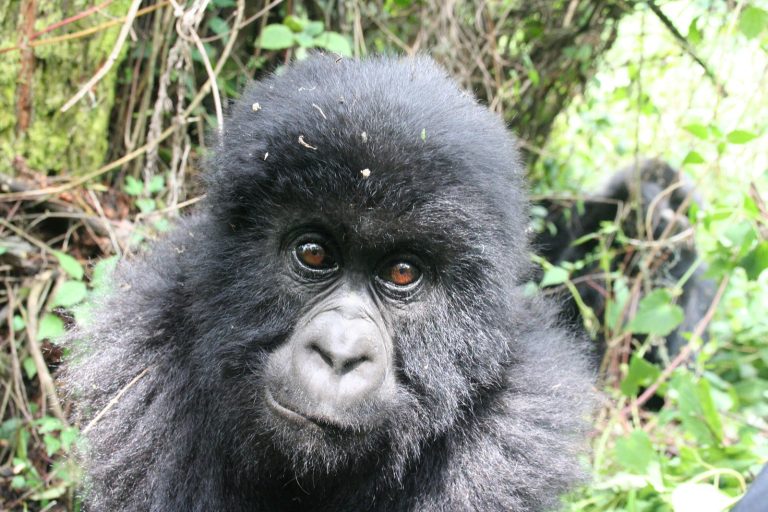
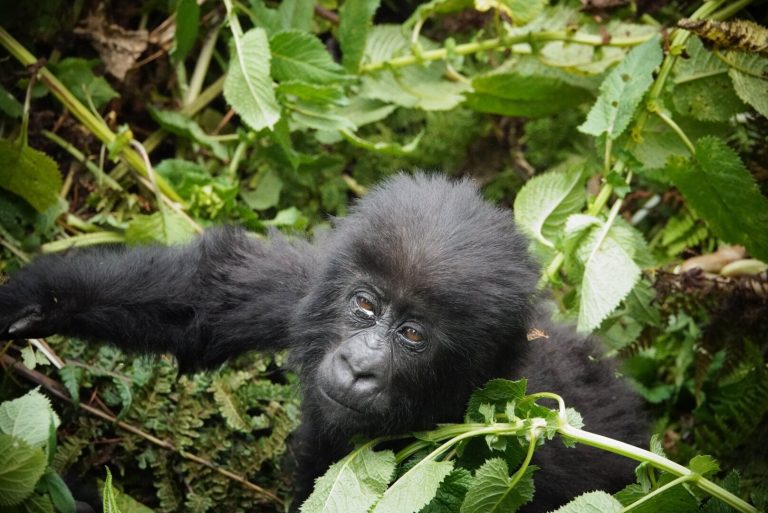
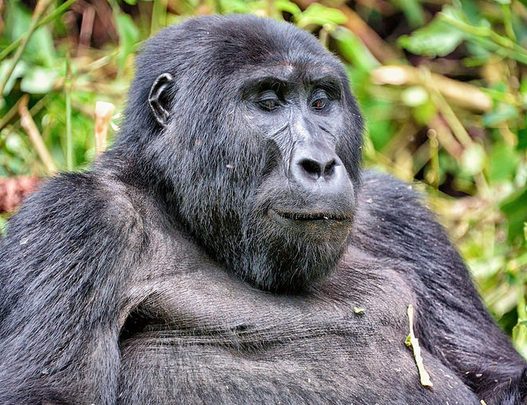
Forget the records for a moment. The silverback you meet on a gorilla trekking safari in Uganda or Rwanda will average around 160 kg, with larger males past 180 kg, about twice as much as a heavy adult man. Standing upright, which he rarely does, he would be about 1.6 to 1.8 m tall. On all fours, his back comes up to somewhere around an adult’s waist.
Height undersells him. Adult males have arm spans of around 2.3 to 2.6 m, a chest like a barrel, and a bony crest on the skull topped with muscle that makes the head look enormous. Females are much smaller, roughly half the male’s weight, which is one of the biggest size gaps between the sexes of any primate. Our silverback gorilla facts page covers how males grow into that size, from blackback to silverback at around 12 years old.
Why are males so much bigger? A silverback has to win and then hold a family against rival males, and across generations the heavier, more intimidating males fathered more young. Size became a signal in its own right: a study of silverbacks in Rwanda’s Volcanoes National Park found that bigger males produce deeper chest beats, so rivals can judge a male’s bulk from the sound before they ever see him. Females, at roughly 70 to 100 kg and up to about 1.5 m, never faced that pressure. A newborn, by comparison, weighs only about 1.8 kg.
Published figures vary for a simple reason. Some sources quote averages for wild males, some quote the largest wild males, and some quote zoo males, and the three get blended online. WWF gives an average silverback up to about 180 kg; general reference works quote 136 to 227 kg (300 to 500 lb) for adult males of all types, a range that only zoo animals and the heaviest wild Grauer’s gorillas reach at the top end.
Trekkers’ accounts say much the same thing in plainer words: the silverback looks bigger in the forest than in any photo, and a tall visitor still feels small beside him. Part of that is the setting. You are often on a slope, in thick vegetation, with a 160 kg animal sitting a few metres above you.
Why Zoo Gorillas Outweigh the Silverbacks You See on Safari
Wild gorillas live on bulky, low calorie food. A big male can eat around 18 kg of leaves, stems, bark and fruit a day, and spends a large part of his waking hours feeding just to keep his weight. He walks and climbs every day, sleeps in a new nest each night, and loses condition in hard seasons. There is a natural ceiling.
Zoos removed that ceiling for most of the twentieth century. Captive gorillas ate richer food, moved far less and lived longer, which is how weights like N’gagi’s were reached. Many also died young of heart disease, now the leading cause of death in male zoo gorillas. Modern zoos feed leafier diets and build larger enclosures, and today’s captive males are usually kept far below the old record weights.
So when you read that the biggest gorilla ever weighed well over 300 kg, the honest answer is that the heaviest gorillas were almost all overweight zoo animals, and that a heavy captive gorilla tells you about captivity rather than about wild gorilla size.
Gigantopithecus: The Giant Ape That Was Never a Gorilla
Gigantopithecus blacki often appears in lists of the biggest gorillas. It does not belong there. This extinct ape lived in the forests of southern China and is known only from four lower jaws and around 2,000 teeth, with no skull or skeleton ever found.
Protein recovered from a fossil tooth shows that its closest living relatives are the orangutans, not gorillas. Estimates of its size come from scaling up those jaws and teeth: a weight of roughly 200 to 300 kg is the figure most researchers use, and the popular image of a three metre giant is an educated guess. A study published in Nature in 2024 concluded that it died out between about 295,000 and 215,000 years ago, when its forest habitat gave way to more open country and it could not switch to other foods.
It may have been the largest ape that ever lived. It was not the biggest gorilla ever, because it was never a gorilla.
Seeing Big Silverbacks on a Bwindi Gorilla Trek
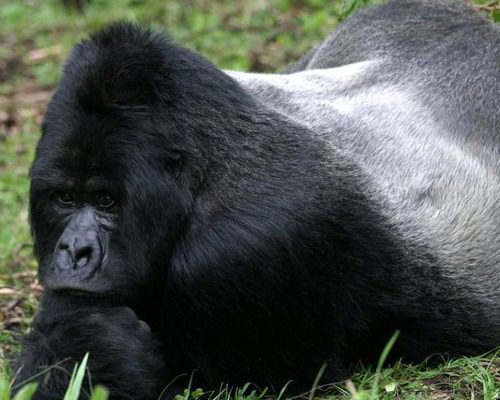
Bwindi held 459 mountain gorillas at the last published census, close to half of the world’s 1,063 (a newer Bwindi count is under way, and its results are not yet confirmed), and every habituated family is led by at least one silverback. Gorilla trekking in Bwindi runs from four sectors, Buhoma, Ruhija, Rushaga and Nkuringo, with groups of up to eight visitors and one hour with the family once it is found. Under UWA rules you keep a distance of 10 metres. Silverbacks often rest during the visit while the rest of the group feeds around them, which gives you a good look at how big a mature male really is. Several families, such as Mubare, the first group habituated for tourism, have changed silverbacks over the years, and our Bwindi gorilla families guide lists the current silverbacks by sector.
If seeing a big silverback up close is the point of your trip, the four hour gorilla habituation experience in Bwindi’s southern sector gives far more time with a family still being habituated. Rwanda’s Volcanoes National Park, home of Titus’s old groups, is covered on our Rwanda gorilla trekking page.
Planning a Gorilla Trekking Trip to Bwindi and Beyond
Permits are limited, so book them early through our guide to Uganda gorilla permits or through licensed gorilla safari companies. The drier months from June to September and December to February make trails easier, as explained in the best time to go gorilla trekking. Gloves, gaiters and waterproofs are on the gorilla trekking packing list, and Bwindi safari lodges are listed by sector.
Plenty of visitors combine Bwindi with a savanna safari: the Masai Mara or the Serengeti for the migration, or a western lowland gorilla trip to Gabon or Congo for a different kind of gorilla altogether.
What is the biggest gorilla ever recorded?
In the wild, a silverback shot near Ambam in Cameroon, reported at 267 kg (589 lb) and 1.83 m. The tallest was a male killed in eastern Congo in 1938 at 1.95 m. Captive males have reached about 310 kg, but those were overweight zoo animals.
Was Titus the biggest gorilla ever?
There is no evidence for it. Titus was a famous mountain silverback in Rwanda who died in 2009, but he was never weighed or measured. The figures attached to him online belong to other gorillas.
Did Phil the gorilla really weigh 860 pounds?
No reliable record supports it. Phil lived at the Saint Louis Zoo from 1941 to 1958, and newspaper estimates from the 1950s put him at around 525 lb. The 860 lb figure has no traceable source.
How big is the biggest silverback in Bwindi?
Nobody knows exactly, because wild gorillas are rarely weighed. Large mountain gorilla silverbacks pass 180 kg, and the dominant males in Bwindi’s habituated families are in that range by eye.
Is a gorilla bigger than a human?
Much heavier, not taller. A wild silverback stands about 1.6 to 1.8 m upright, similar to a tall man, but weighs roughly twice as much and has an arm span well over 2 m.
Who was the biggest gorilla in Rwanda?
Guhonda, the veteran silverback of the Sabyinyo family in Volcanoes National Park, is the name most often given. He is clearly a very large male, but the 220 kg figure attached to him is an estimate by eye, and no Rwandan gorilla has a published weight.
Which type of gorilla is the biggest?
The eastern lowland, or Grauer’s, gorilla of eastern DR Congo is the largest living primate on average, with males up to about 210 kg. Mountain and western lowland males are lighter and close to each other in weight.
How tall is a gorilla standing up?
An adult male stands about 1.6 to 1.8 m when upright and a female up to about 1.5 m. Gorillas rarely stand for long, though; they knuckle walk on all fours, which is why they look shorter and wider in the forest.
Are big silverbacks dangerous to trekkers?
Habituated silverbacks are used to visitors and serious incidents are rare. A male may bluff charge if people crowd him or a guide misjudges the distance. Stay with the ranger, keep the 10 metre distance in Uganda, crouch and look down if he charges, and never run.
How many gorillas are left in the wild?
Mountain gorillas numbered 1,063 at the last full count. Grauer’s gorillas are estimated at a few thousand, Cross River gorillas at about 250 to 300, and western lowland gorillas in the hundreds of thousands, Mountain gorillas have been rising slowly, while the other three are declining.
How much does it cost to see a silverback on a gorilla trek?
A Uganda gorilla permit costs US$800 for foreign non residents, US$700 for foreign residents and UGX 300,000 for East African citizens, with a US$600 low season rate announced for April, May and November. The habituation experience costs US$1,500, and UWA has announced a rise to US$1,800 for foreign non residents. Rwanda charges US$1,500 per trek.