The best camera for safari for most travellers is an APS C mirrorless body with animal eye autofocus paired with a 100 to 400mm zoom; if you never want to change a lens, a 1 inch sensor bridge camera reaching about 600mm is the simpler pick. On a game drive or gorilla trek, reach, quick focus and dust sealing count for more than megapixels. A phone covers camp life and scenery, not a leopard far up a tree.
This page is about choosing and using the camera. For optics, see our best binoculars for safari guide; for both on one page, the safari camera and binoculars overview. Forest settings for the gorillas have their own page in gorilla trekking and photography.
How to Choose a Safari Camera: Reach, Autofocus, Sensor, Speed and Sealing
A safari camera works in conditions most holiday cameras never see. Animals sit far away, move without warning and are busiest in the weak light of dawn and late afternoon. The vehicle rocks. Dust blows in through the roof hatch, and in the forests of Uganda and Rwanda rain can arrive in minutes. Five qualities decide whether the pictures work.
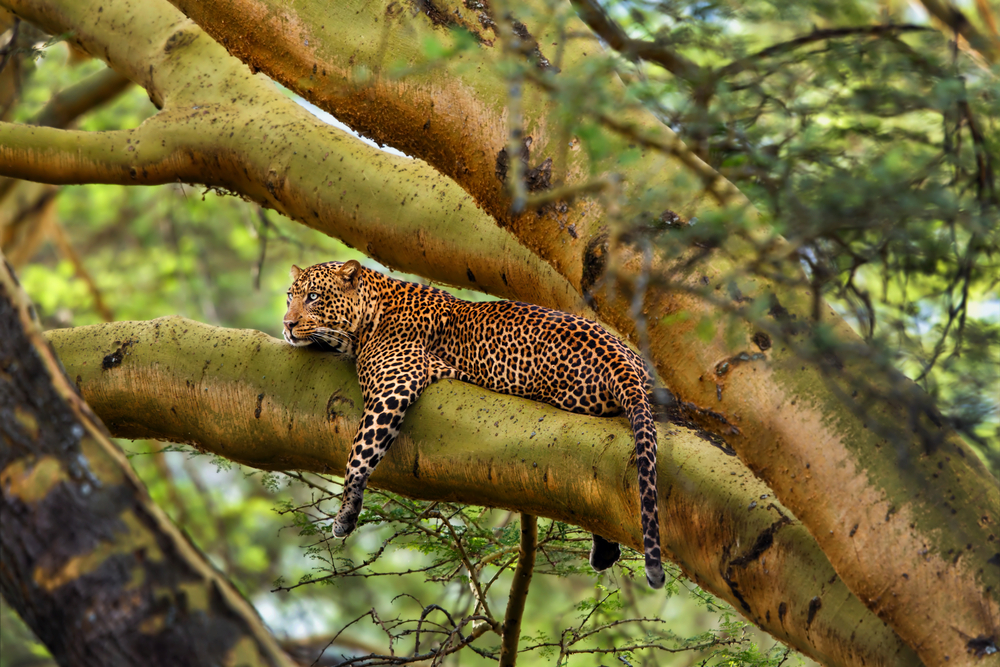
Reach. Guides and working wildlife photographers broadly agree on about 400mm full frame equivalent as the useful minimum for game drives, with 500 to 600mm better for birds and shy cats. Shorter than that and most frames become a small animal in a big field of grass.
Autofocus that finds eyes. Current mirrorless bodies detect animal and bird eyes and track them across the frame, so the camera stays locked as a cheetah turns or a bee eater lifts off. Older systems tend to focus on the grass in front.
Sensor size. Larger sensors give cleaner files at high ISO, which dawn, dusk and a forest canopy all demand. Smaller sensors give up some of that in exchange for reach and less weight. Neither is wrong; it depends on where you are going.
Burst rate. Ten frames a second or more catches the yawn, the pounce, the eagle’s strike. Faster is a bonus.
Sealing and weight. Seals keep dust and drizzle out of the body and lens. Weight decides whether your kit fits a 15kg bush flight allowance, and whether you still want to lift it on the eighth morning.
Choose in that order: lens reach first, autofocus second, then sensor, then everything else. Spending on the lens before the body is the single piece of advice that comes up most among people who have done several safaris.
Safari Camera Types Compared: Phone, Superzoom, Bridge, Mirrorless and DSLR
Every route to good wildlife safari photos sits somewhere between simple and high quality. Here is how the main camera types compare on a typical East African trip.
| Camera type | Reach | Low light | Ease |
|---|---|---|---|
| Phone | Short | Fair | Easiest |
| Small sensor zoom | Very long | Poor | Easy |
| 1 inch bridge | Long | Fair | Easy |
| Micro four thirds | Long | Fair | Moderate |
| APS C mirrorless | Long | Good | Moderate |
| Full frame | Lens led | Best | Harder |
Phones. Good for scenery, lodges, sundowners and animals right beside the vehicle, and recent phones handle gorillas at seven to ten metres well in decent light. They also shoot excellent 4K video. Digital zoom falls apart at distance, so anything beyond about fifty metres comes out soft and noisy. Clip on telephoto attachments help a little; a dedicated camera helps far more.
Small sensor superzooms. The Nikon Coolpix P950 (24 to 2000mm equivalent) and Panasonic Lumix FZ80D (20 to 1200mm) put enormous zoom in one light body at a low price. In bright midday sun they give sharp record shots; at dawn or under a forest canopy the tiny sensor struggles, and at full zoom you need to brace the camera on something. Canon’s PowerShot SX70 HS, long a favourite in safari blogs, has been discontinued, and its smaller sibling the PowerShot SX740 HS is the pocket travel zoom still widely sold.
1 inch sensor bridge cameras. Sony’s RX10 IV, with a fixed 24 to 600mm equivalent lens and fast autofocus, became the classic one camera safari kit. It has been marked discontinued in Japan with no successor announced, though stock remains at many retailers. Panasonic’s FZ1000 II covers a shorter range on a similar sensor. One body, no lens swaps in the dust, and files a clear step above small sensor zooms.
Micro four thirds. OM System and Panasonic bodies have the smallest interchangeable lens sensor, which doubles a lens’s apparent reach. A 100 to 400mm lens on a body such as the OM System OM 5 frames like 200 to 800mm on full frame, in a kit that fits a small daypack. Low light is weaker than larger sensors. A micro four thirds 100 to 400mm lens is a favourite with birders and walkers.
APS C mirrorless. The best balance for most people. Crop bodies multiply reach by about 1.5 (Sony, Nikon, Fujifilm) or 1.6 (Canon), so a 400mm lens frames like 600 to 640mm. Canon’s R7 and R10, Sony’s a6700 and Nikon’s Z50 II are typical choices with animal eye detection. Older bodies such as Sony’s a6000 and a6400 still turn up in safari blogs as budget picks; they focus well in daylight but lack current animal tracking.
Full frame mirrorless. The low light leader, which counts on gorilla treks, in forest and on cloudy dawn drives. Canon’s R6 Mark II and newer R6 Mark III, Sony’s a7 IV and Nikon’s Z6 III are common, and Canon’s R8 gives a full frame sensor in a body of about 461g, light enough for walking safaris though without in body stabilisation. You lose the crop reach bonus and carry more weight.
DSLRs. Still capable, and guides see plenty every day. New lens development has moved to mirrorless, so if you are buying from scratch, mirrorless is the better long term choice. Already own a good DSLR and a long lens? Take them, and spend the money on the trip. Canon owners moving to mirrorless can keep their EF lenses with an EF to RF lens adapter.
Best Safari Camera Kits from First Safari to Professional
The right safari camera kit depends on how much you want to learn and how much you want to carry. Each tier below works on safari, with a search link for each type. Bodies are replaced every few years, so look at the current model and recent reviews within each type.
Two rules hold at every level. Put money into the lens before the body: a mid range camera with a good 400mm zoom beats a flagship with a short one. And learn the camera before you fly. Opening a new body on the first morning drive is one of the commonest regrets in safari trip reports, close behind not knowing how to switch on burst mode as the lions start to move. Practise on birds at a local park or zoo; moving birds teach autofocus faster than anything.
Safari Lens Guide: Which Focal Length for Which Game Drive
On a game drive safari, the lens shapes your pictures far more than the body does. This is how the main lens classes compare.
| Lens class | Weight | Best for | Drawback |
|---|---|---|---|
| 100 to 400mm | Light | Most drives | Short for birds |
| 100 to 500mm | Medium | All round | Slow aperture |
| 150 to 600mm | Heavy | Reach on a budget | Bulk |
| 200 to 800mm | Heavy | Birds, plains | Too long close |
| Fast primes | Very heavy | Low light | Weight, cost |
| 24 to 105mm | Light | Scenery, camp | No reach |
100 to 400mm zooms are the most versatile safari lens: light enough to hold all day, wide enough at 100mm for elephants beside the vehicle, long enough on a crop body for most birds. Canon’s RF 100 to 400mm is a light, inexpensive example, and Sony, Nikon, Sigma and Tamron make equivalents. Plenty of long time Kenya and Tanzania visitors report theirs surviving the dustiest parks without trouble. Canon’s RF 100 to 500mm adds reach and sharper optics at a higher weight.
150 to 600mm and 180 to 600mm zooms give serious reach. Sigma and Tamron make 150 to 600mm lenses for several mounts, and Nikon’s Z 180 to 600mm is a popular choice. Expect close to two kilograms, so they spend more time on a bean bag than in your hands, and some photographers report that older third party versions focus less reliably than newer native lenses. Browse 150 to 600mm telephoto zooms for your system, and see our guide to the best zoom lens for safari for a closer comparison.
200 to 600mm and 200 to 800mm zooms suit open plains and birding. Sony’s FE 200 to 600mm is the standard choice for Sony shooters, and Canon’s RF 200 to 800mm reaches further at a similar weight of around two kilograms. Both are too long for anything near the vehicle. Compare Sony FE 200 to 600mm lenses or Canon RF 200 to 800mm lenses.
Fast primes and teleconverters. Professionals rank the 400mm f/2.8 and 600mm f/4 at the top for their low light speed and soft backgrounds, but they weigh and cost far more than most travellers want. A cheaper route to some of that brightness is a 70 to 200mm f/2.8 with a 2x teleconverter, which turns it into a 140 to 400mm f/5.6 and leaves you a bright short zoom for close animals. Teleconverters cost a little sharpness and focus speed.
All in one zooms. Tamron’s 50 to 400mm and 18 to 400mm cover everything with one lens, which keeps dust out of the body. Image quality drops at the long end and in low light, a fair trade for travellers who refuse to swap lenses.
A short lens. A second lens covers scenery, camp life and animals that walk right up. A 24 to 105mm standard zoom is the usual choice, a 16 to 35mm wide angle suits baobabs and big skies, or simply use your phone. Serious photographers carry two bodies, one long and one short, so they never change lenses in the dust. Forum complaints about dust come mostly from people who swapped lenses in open vehicles.

Matching Your Camera to the Safari: Savannah, Gorilla Trek, Birding, Walking and Boat Trips
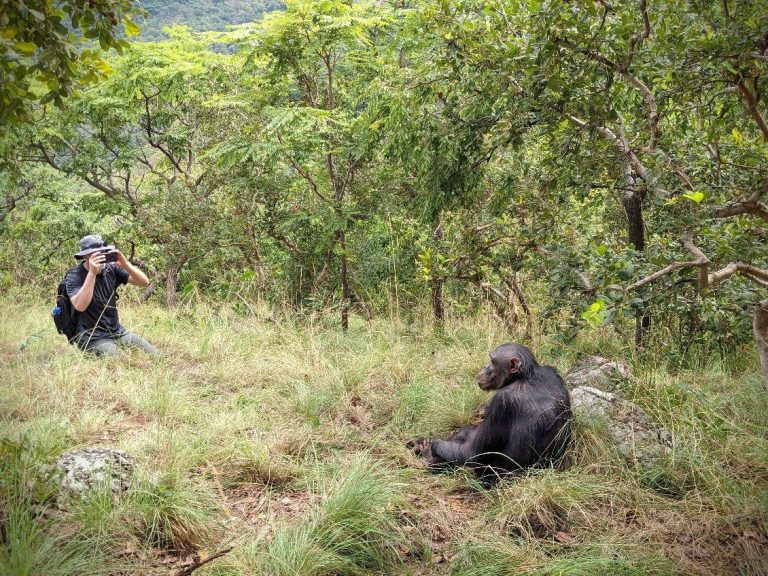
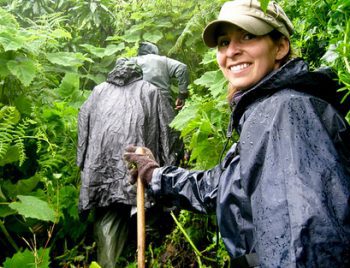
On a gorilla trekking safari, park rules shape everything. You get one hour with the family, you keep about 10 metres back in Uganda and 7 metres in Rwanda, and flash photography is not allowed. Turn off the flash and the autofocus assist lamp before you set out. Under the canopy, ISO 1,600 to 6,400 is normal, and 1/250 second or faster freezes playful juveniles. Underexpose a touch so black fur keeps its detail. The gorilla habituation experience gives photographers four hours with a family instead of one.
Bwindi trip reports keep coming back to one lesson: the hour disappears. Shoot in short bursts, then lower the camera and just watch for a while. People rarely regret the frames they missed. They do regret seeing the whole hour through a viewfinder.
Safari Photography Settings for Game Drives and Video
You do not need to master manual exposure before a safari tour. A few settings, set up at home, cover most of what happens on a drive.
Mode. Shutter priority or aperture priority with auto ISO. Shutter priority holds the speed where you need it; aperture priority wide open lets the camera pick the fastest speed the light allows. Beginners on bridge cameras can stay in auto and watch the animal.
Shutter speed. A simple rule is at least twice the focal length, so about 1/800 second at 400mm. Go to 1/1,000 second or faster for running animals and birds in flight, and around 1/500 second will do for a resting lion with a stabilised lens. Raise ISO before you drop the shutter speed. A noisy sharp frame beats a clean blurred one.
Focus. Continuous autofocus with animal or bird eye detection on, and a tracking area. Back button focus helps once you are comfortable with it.
Burst. High speed continuous drive, in short bursts when something starts to happen. On some bodies the electronic shutter is silent, useful at a quiet sighting, though fast panning can bend straight lines on older sensors.
File format. RAW plus JPEG if your cards allow, so difficult dawn exposures can be rescued later.
Video. A short clip of an elephant drinking or a gorilla feeding often means more back home than another still. Hybrid bodies such as the a7 IV and R6 Mark III record 4K well; use stabilisation, brace on the bean bag, and keep clips short to save cards and battery.
Light and terrain. The first and last two hours of the day give the warmest light and the most activity. In open grassland you can use the longest lens; in thick bush animals appear closer and a shorter zoom is often quicker to frame.
Lock the dials. On rough roads a mode dial or exposure compensation wheel can turn without you noticing, and a whole sighting comes out three stops too dark. Use the dial locks, or glance at the screen after every bump. Ask your driver to switch the engine off for long lens shots, because the vibration shows.
Safari Camera Accessories Worth Packing
A bean bag. Tripods are close to useless inside a safari vehicle. A bean bag over the window frame or roof hatch steadies a heavy lens and spares your arms. Some operators keep bean bags in their vehicles, so ask before buying. Otherwise pack a camera bean bag for safari vehicles empty, fill it with rice or beans on arrival in Kampala, Nairobi or Arusha, and leave the filling with your guide or lodge at the end. Clamp mounts work in some vehicles but are fussier.
Batteries and charging. Mirrorless bodies with electronic viewfinders drain fast, and cold mornings make it worse; carry at least two spares, three for full day drives. Many safari vehicles have charging sockets, not all do, and remote solar camps may charge only at set hours. A dual USB C camera battery charger refills two batteries overnight from one socket or a battery pack, and our guide to battery packs and solar chargers for safari covers the rest. Uganda and Kenya use the British three pin plug, Tanzania uses British and older round pin sockets, and Rwanda uses the European two pin.
Memory cards and backup. A cheetah hunt shot in bursts can fill a card in minutes. Carry several mid size cards rather than one huge one, so a lost card does not take the whole trip with it. Fast V60 or V90 SD cards clear bursts quickly; flagship bodies with CFexpress slots can write to both cards for an instant copy. Back up each evening to a phone, tablet or a rugged portable SSD, since park internet is too slow for cloud uploads. Most current cameras can also send selected JPEGs to your phone over Wi Fi for sharing from camp.
Rain cover and dry bags. Weather sealing is not waterproofing. A camera rain cover for telephoto lenses belongs on every gorilla trek and in the rains. Pack bodies and lenses in roll top dry bags inside your daypack for gorilla trekking.
Cleaning kit. A blower, lens pen and microfibre cloths live in every safari photographer’s bag; take three cloths, because one is always dusty. A clear protective filter on a long lens takes the sandblasting instead of the front element.
A better strap. A padded shoulder or sling strap carries a long lens far more comfortably than the thin strap in the box.
Keeping Safari Cameras Safe from Dust, Rain, Humidity and Theft
Dust is the dry season problem, worst in open vehicles on the tracks of the Serengeti, Tarangire, Tsavo and Murchison Falls. Fine red or orange dust works into zoom barrels, and some long zooms draw air in as they extend. Keep the camera under a jacket or in a closed bag on the seat between sightings. Change lenses only inside the vehicle, back to the wind, body pointing down. Blow grit off before you wipe glass, and never aim canned air at a sensor.
Bridge cameras need a word of warning. Because the lens is fixed, dust that gets inside cannot be cleaned without a service, and photography forum users who drove the fine Tsavo dust describe bridge cameras they could not clean afterwards. A rain cover or a cloth draped over the camera on dusty stretches prevents most of it.
In the forest, humidity takes over. Moving gear from a cool room into warm, wet air fogs the glass, so leave the bag closed for a few minutes to warm up. Silica gel sachets in the bag overnight help. Kenya, Rwanda and Tanzania ban plastic carrier bags, so pack proper dry bags. Your rain jacket for gorilla trekking doubles as a camera shelter in a downpour.
Theft is rare in camps, and common sense covers it. Keep cameras in hand luggage on flights, use a plain bag that does not advertise the brand, leave expensive kit in the lodge safe or a locked vehicle in city centres, and check your travel insurance covers its full value. Drones are a separate matter: all four East African countries restrict them in parks, and our camera and binoculars guide explains the permits.
Renting, Bush Flight Weight Limits and Safari Camera Mistakes
Renting makes sense when you already own a compatible body and only need a long lens for two weeks, and several safari operators recommend it, since few travellers use a 600mm lens again at home. Rental houses in the US, UK and Europe ship before you fly; renting in East Africa itself is patchy, so do not count on it. If you rent, collect the lens a week early and practise.
Weight is the next limit. Light aircraft into Bwindi’s Kihihi and Kisoro airstrips and most Kenyan and Tanzanian bush airlines allow 15kg per person including hand luggage, in soft bags. A full frame body and a 600mm lens alone can weigh four kilograms. Photographers with heavy kit often pre book excess baggage or an extra seat; check the details in our guide to getting to Bwindi.
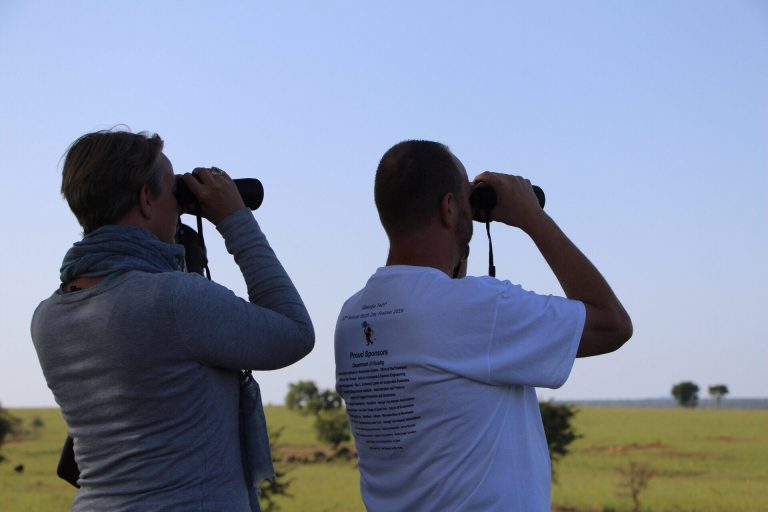
Experienced photographers say the same thing in different words: preparation beats price. Knowing your autofocus modes, being ready before the guide stops, and reading behaviour so you see the yawn or the leap coming does more than any upgrade. Binoculars still earn their place, too. You find the action with them, then lift the camera when it starts.
Fitting Your Camera Kit to the Safari Itinerary
The itinerary shapes the kit as much as the budget. A Bwindi gorilla trek rewards a bright, weather sealed setup; the plains of the Serengeti and the Masai Mara reward reach. Combined trips such as gorillas in Rwanda followed by the Mara, or a Tanzania safari with gorilla trekking, are where a 100 to 400mm zoom on a sealed body pays its way. In Uganda, Queen Elizabeth and Murchison Falls pair naturally with Bwindi on one itinerary.
Season changes the kit too: the rains call for covers and dry bags, the dry months for dust control. See the best time for gorilla trekking in Uganda, the African safari packing list and the rest of our safari gear and clothing guides. Our guide to camera bags and rain covers for safari covers how to carry it all.
Best Camera for Safari FAQ
What is the best camera for an African safari right now?
For most travellers, a current APS C mirrorless body with animal eye autofocus, such as Canon’s R7, Sony’s a6700 or Nikon’s Z50 II, paired with a 100 to 400mm zoom. For low light and gorilla treks, a full frame body such as the Canon R6 Mark III, Sony a7 IV or Nikon Z6 III with a 100 to 500mm or 200 to 600mm zoom. For simplicity, a 1 inch bridge camera such as the Sony RX10 IV while stock lasts.
What is the best camera for a safari on a budget?
A small sensor superzoom such as the Panasonic Lumix FZ80D or Nikon Coolpix P950 gives the most reach for the money in good daylight. A used APS C body with a 100 to 400mm lens, or a rented long lens on a camera you already own, gives better pictures at dawn and dusk. The FZ80D launched at about US$479, which makes it one of the few long zoom cameras near a US$500 budget.
How much does a good safari camera setup cost?
Roughly, small sensor superzooms run from about US$400 to US$1,000, 1 inch bridge cameras about US$1,000 to US$1,800, and an APS C mirrorless body with a 100 to 400mm lens about US$1,500 to US$3,000. Full frame bodies with 200 to 600mm class lenses usually cost US$4,000 or more, and flagship kits far beyond that. Renting a long lens for two weeks often costs a small fraction of buying one. Prices move often, so check current listings.
How do I choose a camera for a safari?
Start with reach: aim for about 400mm full frame equivalent or more. Then look for animal eye autofocus, a burst rate of ten frames a second or faster, weather sealing and a weight that fits a 15kg bush flight limit. Decide whether you will change lenses; if not, a bridge camera is the answer.
What kind of camera lens do I need for a safari?
A telephoto zoom reaching at least 400mm full frame equivalent. A 100 to 400mm is the most versatile, a 150 to 600mm or 200 to 600mm gives more reach for birds and shy cats, and a 24 to 105mm or your phone covers scenery. On a crop body, a 100 to 400mm frames like roughly 600 to 640mm.
What is the best camera for a safari for beginners?
A 1 inch bridge camera with a zoom to about 600mm equivalent, or an entry APS C mirrorless body with a 100 to 400mm zoom used in auto ISO. The bridge camera is simpler; the mirrorless kit gives better pictures at dawn and dusk and grows with you.
Is a point and shoot camera good enough for a safari?
A long zoom point and shoot is fine for daylight game drives and far better than a phone at distance. It struggles in low light and under forest cover, and dust inside a fixed lens needs a service to clean, so keep it covered on dusty tracks.
Is a phone good enough for a safari?
For scenery, camp life, video and animals close to the vehicle, yes. For distant cats, birds and most game drive sightings, no: digital zoom produces soft, noisy pictures beyond about fifty metres. Many travellers carry a phone plus one zoom camera.
Mirrorless or DSLR for an African safari?
Mirrorless if you are buying new: lighter bodies, animal eye autofocus and silent shutters suit safari, and new lenses are mirrorless. A DSLR and long lens you already own and know well still work fine.
What is the best camera for gorilla trekking?
A weather sealed mirrorless body with clean high ISO files and a zoom from about 24 to 200mm, or a 100 to 400mm used at the short end, plus a rain cover. Flash is not allowed, and the gorillas are usually 7 to 10 metres away, so very long lenses are rarely needed.
How many memory cards and batteries should I take on safari?
At least two spare batteries for mirrorless bodies, three for long days, and enough cards for a few thousand frames, split across several cards. Back up each night to a phone, tablet or portable drive.
Do I need a tripod on safari?
Not for game drives, where a bean bag on the vehicle frame works far better. A small tripod helps for night sky shots at camp or for video, and a monopod can help on boat trips.