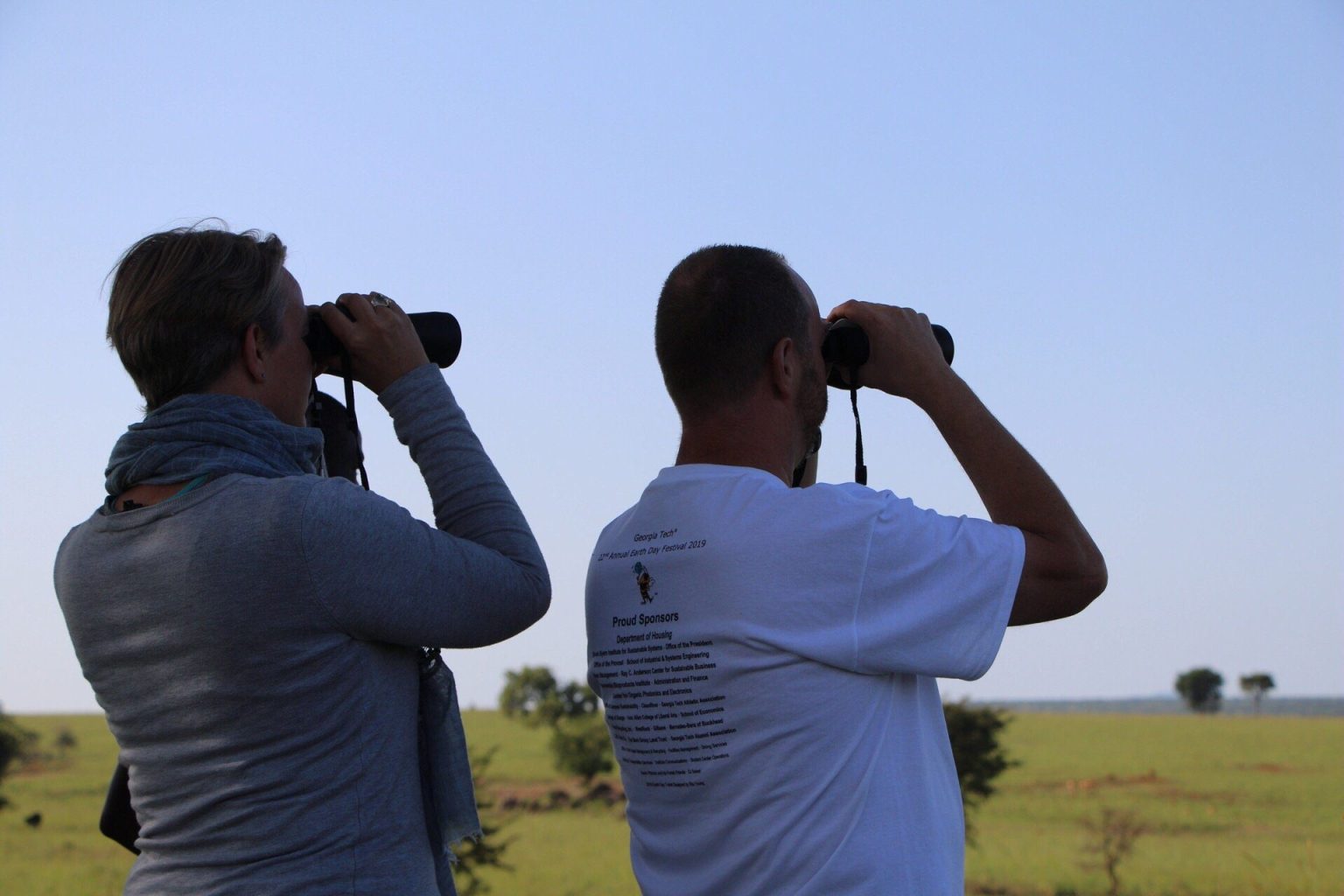
The best binoculars for safari are a sealed, waterproof 8×42 roof prism pair with ED glass and a wide field of view, because it stays steady in a vehicle and bright at dawn. Choose a 10×42 if your trip is mostly open plains or birding at range, and a lighter 8×32 for gorilla treks, walking safaris and 15kg bush flights. For an African safari, fit and sealing count for more than the brand on the hinge.
This page is the buying guide. For how to set up, carry and look after binoculars on the trip itself, our safari camera and binoculars guide covers packing and field use, and the companion best camera for safari guide deals with bodies, lenses and settings.
Do You Need Binoculars on an African Safari
Yes, and one pair per person. Binoculars are the one piece of safari gear that guides say guests forget most, and the one people miss within the first hour of the first game drive. They do a job your camera cannot. You find an animal in seconds, watch it for twenty minutes without a battery warning, and see what your guide sees when he points at a leopard’s tail hanging below a sausage tree branch.
The camera argument comes up often. A long zoom lens does give reach, and a few repeat travellers who shoot with a 600mm lens say they stopped carrying binoculars after many trips. For everyone else, looking through a viewfinder all day is tiring, narrow and slow to swing onto a moving bird. Glass that sits ready on your chest gets used far more.
Sharing is the false economy most trip reports warn about. A serval crosses the track, it stays visible for fifteen seconds, and two people want the same pair. Some operators carry a spare set in each vehicle and a few lodges lend them, but the quality is a lottery and they are passed around six seats. Ask your operator what they supply, then bring your own anyway.

Safari Binocular Magnification: 7x, 8x or 10x for Game Drives
Two numbers are stamped on every pair. In 8×42, the 8x is magnification, so an elephant 400 metres off looks as it would at 50. The 42 is the width of each front lens in millimetres: bigger lenses pull in more light and add weight. On a game drive safari the useful magnification sits between 7x and 10x, and nearly every guide, optics writer and forum thread on the subject lands on the same pair of answers, 8×42 or 10×42.
8x is the forgiving choice. Each breath moves the image less. The view is wider, so a lilac breasted roller in flight or a jackal at a trot stays in frame. In an open vehicle with half a dozen people moving their weight around, steadiness matters more than reach, which is why first timers are steered towards 8×42 again and again. Seven times works too, with an even wider and calmer view, though fewer modern models come in 7x.
10x earns its place on open ground. On the short grass of the Serengeti or the Mara, cheetahs and lions often rest a kilometre out, and the extra reach turns a pale shape into a mother with cubs. Shake shows more and the field narrows. Rest your elbows on the hatch rim and most adults hold a 10×42 well. One limit rarely mentioned in shops: by late morning, heat shimmer over the plains softens a 10x view more than an 8x one, so the gain is largest at dawn and in the late afternoon.
In thick bush and woodland the logic flips. Animals appear at 30 metres between trees, and some hunters and optics writers prefer 6x or 7x there for the wide, bright view. For most mixed itineraries 8x covers that country well enough.
Above 10x, handheld glass becomes a blur from a vehicle, idling engine or not. Twelve times needs a brace or stabilisation. Zoom binoculars that slide from 10x to 30x sound clever on the box and give dim, narrow views with poor sealing. Neither belongs on a safari packing list.
| Format | Suits | Low light | Weight |
|---|---|---|---|
| 8×42 | Most safaris | Very good | Medium |
| 10×42 | Open plains | Good | Medium |
| 8×32 | Treks, walks | Fair | Light |
| 10×32 | Light reach | Fair | Light |
| 10×50 | Hides, boats | Very good | Heavy |
| 8×25 | Kids, spare | Poor | Very light |
Buying one pair for the whole trip? Start your search with 8×42 roof prism binoculars with ED glass. If you know you will spend most days on the plains, or you bird at distance, compare wide field 10×42 ED binoculars against them on field of view and weight. Birders who set up at waterholes and on boats sometimes go up to 10×50 waterproof binoculars and accept the heavier body for the brighter view.
Field of View, Exit Pupil and Brightness for Dawn Game Drives
Field of view is how wide a slice of the scene you see, printed on the box in degrees or as feet at 1,000 yards. On safari it decides how fast you find a moving animal. Typical 8x42s show about 7 to 8 degrees, roughly 120 to 140 metres across at a kilometre; typical 10x42s sit nearer 6 to 6.5 degrees. Anything below about 6 degrees feels like looking down a tube. Compare that printed figure before you compare price.
Exit pupil is the small disc of light you see floating in each eyepiece with the binocular held at arm’s length. Divide lens width by magnification. An 8×42 gives 5.25mm, a 10×42 gives 4.2mm, an 8×32 and a 10×40 both give 4mm, a 10×50 gives 5mm.
At noon your own pupil shrinks to two or three millimetres and all of those look alike. At first light on a morning game drive, when cats are still moving, your pupil opens and the bigger exit pupil starts to show. Aim for 4mm or more if you care about the first and last hour. Coatings matter as much as the arithmetic, though. A poorly coated 8×42 can look darker than a well made 8×32, so the specification sheet tells half the story.
Depth of field is the quiet advantage of 8x. More of the scene stays sharp from front to back, and you refocus less as a herd walks through tall grass or a warbler hops through a thicket.
Prisms, Coatings and Waterproofing for Safari Conditions
Every binocular uses prisms to turn the image upright. Porro prisms give the older wide, offset body. They deliver a bright, deep image for very little money, and some optics writers rate a good porro above a cheap roof pair at the same price. The catch is bulk, and fewer porros are fully sealed. Roof prisms sit in straight tubes, pack slimmer and seal well, which is why nearly every guide wears one. On a tight budget, waterproof porro prism binoculars are a fair first pair; for a trip that runs from dusty tracks into rainforest, a sealed roof prism is the safer buy.
The coating line on the box tells you more than the logo. Fully multi coated means every glass surface has several anti reflection layers. BaK4 prisms pass more light than cheaper BK7. Phase correction keeps a roof prism image crisp, and dielectric mirror coatings brighten it, while plain aluminium mirrors are a sign of corners cut. ED or HD glass trims the purple fringe around a dark eagle against a pale sky. Ten years ago that full set marked a premium pair. Plenty of mid range models carry all of it now.
Sealing is where cheap pairs fail on safari. A binocular labelled only “weather resistant” may survive a dry August in northern Tanzania, then mist up inside after a single shower in Bwindi. Buy a pair marked waterproof and fogproof, sealed with O rings and filled with dry nitrogen or argon. Without that purge, warm humid air meets cool glass and clouds the inner lenses, and wiping the outside does nothing. Water repelling outer coatings, sold under names such as LotuTec, Guard ion or Swaroclean, help rain and dust wipe off cleanly.
Toughness is the last check. Rubber armour grips with wet or sweaty hands and soaks up knocks against the roll bar. Recessed front lenses resist scratches from thorny scrub. Tethered lens caps stay attached instead of rolling under a seat. When a new pair arrives, an optics writer’s tip is worth copying: hold it under a running tap or sit it in a sink for a minute. If it leaks or fogs, you can still send it back, rather than discovering the fault on day two of a Masai Mara safari.
Compact Safari Binoculars for Walking Safaris and 15kg Bush Flights
Size classes run by lens width. Full size pairs with 40mm to 50mm lenses weigh roughly 600 to 900 grams. Mid size pairs with 30mm to 36mm lenses come in near 400 to 600 grams. Compacts with 20mm to 28mm lenses drop to 250 to 400 grams. Two hundred grams sounds trivial in a shop. It is not, four hours into a forest trek or at a light aircraft check in.
Light aircraft into Bwindi’s Kihihi and Kisoro airstrips, along with most Kenyan and Tanzanian bush airlines, cap baggage at about 15kg per person in soft bags, hand luggage included. A camera, a long lens and two full size binoculars can swallow a third of that. Couples flying between camps often pack one 8×42 and one 8×32 rather than two big pairs. Our guide to getting to Bwindi sets out the flight options, and the African safari packing list shows how the rest of the weight adds up.
For walking safaris in Zambia or Zimbabwe, or a morning on foot in Lake Mburo, the 8×32 class is the sweet spot. In daylight it shows nearly as much as an 8×42 and only falls behind in the last half hour of light. Browse lightweight 8×32 ED binoculars from makers such as Hawke, Nikon, Opticron or Vortex if grams count. Travellers who want reach without bulk can look at compact 10×32 waterproof binoculars, a size that forum regulars suggest for keeping weight down on fly in trips.
Pocket pairs have a narrower role. Folding 8x25s slip into a shirt pocket beside a phone and suit a partner who would otherwise borrow yours. Small eyepieces and a dim image at dusk make them spare glass, not the main pair.
Best Safari Binoculars by Budget: Entry, Mid Range and Top Tier
The step from a department store binocular to a sealed roof prism with good coatings is huge. The step from there to the very top is real but smaller, and you see it mostly in forest gloom, at sunset and around the edges of the image. Buy at the level that matches how often you will use them once you are home.
What do the guides carry? Ask around camps in Kenya, Tanzania and Zimbabwe and you hear the same short list: Nikon Prostaff and Monarch pairs, Leica Trinovids, and Swarovskis bought years ago and worn smooth, almost always 8×42 or 10×42. People who use glass every working day pick a sealed 42mm roof prism first and a brand second. That is a useful rule for a buyer too.
For a first safari without a birding habit, a good mid range pair is the sensible buy, and you can step up later once you know how much you reach for them. Trip reports carry regrets in both directions. Some travellers who bought top tier glass for a single trip wished they had spent the difference on an extra night in the Mara; others who saved on a cheap pair regretted it on the first dawn drive. If you can, hold two or three pairs in an outdoor shop for a few minutes each. How the eyecups sit on your face and how quickly your finger finds the focus wheel vary from person to person, and no review settles that for you.
Image Stabilised Binoculars and Specialist Optics for Safari Birding
Image stabilised binoculars use a battery powered system to cancel hand shake. Press the button and a jittery 10x or 12x view settles, which is why owners describe it as close to magic for long looks from a parked vehicle. Canon makes the best known range, with 10×32 and 10×42 models popular on safari, and Kite and Opticron make stabilised pairs too. They weigh more than a fixed pair of the same size, they need batteries, and stabilisation helps little while the vehicle is actually bouncing along. If shake worries you, try Canon image stabilised binoculars before buying a higher fixed magnification.

Spotting scopes belong in hides, on river boats and on lodge decks, set on a small tripod or window clamp. A compact travel scope picks out raptor markings on a far tree in Murchison Falls or waders across an Okavango lagoon. On a moving drive it is slow and awkward.
Thermal binoculars and smart pairs that name species now turn up in optics reviews. They are heavy and costly. Thermal only helps on night drives in private concessions that allow spotlights, and species recognition apps are no match for a trained guide. Interesting kit, not a first purchase.
Phone photos through binoculars, called digiscoping, are a cheap add on that many travellers enjoy. A small binocular phone adapter clamps the phone over one eyepiece for record shots of distant birds without a long lens. Our guide to the best zoom lens for safari covers the camera side.
Binoculars for Gorilla Trekking and Bird Watching Safaris
A gorilla trekking safari in Bwindi asks something different of your glass. Once you reach the family you stand about 10 metres away in Uganda and 7 metres in Rwanda, so the gorillas themselves need no magnification. Binoculars earn their weight on the walk in, for turacos, hornbills and L’Hoest’s monkeys in the canopy, and on the long transfer drives between parks.
Weight decides the pair. A trek can last forty minutes or six hours over steep, muddy slopes, and an 8×32 riding flat on a chest strap beats a 10×42 swinging from your neck. Forest light is dim, so stay at 8x. Full waterproofing is not optional here: the pair will be rained on, and between sightings it lives in a dry bag inside your gorilla trekking daypack.
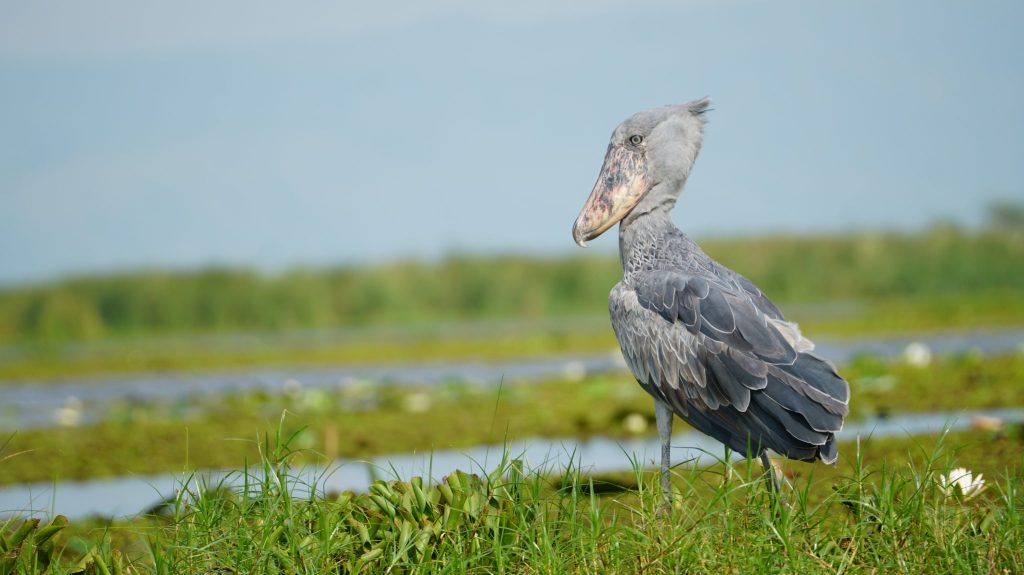
Africa’s birdlife is the other reason to buy well. Uganda alone records over a thousand species, and a bird watching safari pushes binoculars harder than any game drive. For dedicated birding in Bwindi, especially the Ruhija sector and the Mubwindi Swamp trail, birders usually take an 8×42 for brightness under the canopy and hand it to a porter on the steep sections. Open country birding, from shoebills in Mabamba to raptors over the Mara, favours 10×42, and a few birders take 10×50 for wetlands and boat trips. The same thinking applies to chimpanzee tracking in Kibale, where chimps sit high in flickering light. The gorilla trekking packing list has the rest of the forest kit.
Fit Checks and Accessories Worth Buying for Safari Binoculars
Before you pay, check the pair fits your face. Glasses wearers need enough eye relief, the distance your eye can sit behind the eyepiece and still see the full circle; look for about 15 to 16mm or more, with eyecups that twist down. The hinge should close far enough for narrow set eyes. The dioptre adjustment, which balances a difference between your two eyes, should lock or click into place: a loose ring or a push and pull wheel gets knocked out of setting on a corrugated road. Anyone with sight in only one eye can carry a good 8×42 monocular instead, at half the weight.
Accessories are cheap and change how much you use the glass. A thin neck strap swings, thumps your sternum over every rut and leaves a sore neck by lunch. A binocular chest strap holds the pair flat and spreads the load over both shoulders, and you will see one on many guides.
Dust on dry season tracks and rain in the forest are the two enemies. A lens pen and blower cleaning kit weighs almost nothing and saves the coatings from being scrubbed with a dusty shirt. A small roll top dry bag keeps even a sealed pair dry in a downpour, and it matters more because Kenya, Rwanda and Tanzania ban plastic carrier bags. Your rain jacket for gorilla trekking can shelter the pair in a sudden storm too.
Children are the easiest buyers to forget. A small pair of their own, such as shockproof 8×21 kids binoculars with real glass rather than toy lenses, keeps them busy through long afternoon drives. Our notes on family safaris in Africa cover the rest. For field technique, from setting the dioptre to bracing on the hatch and storing glass overnight, see the packing and field use section of the safari camera and binoculars guide.
Safari Binocular Buying Mistakes to Avoid
The commonest regret is not about brand at all. It is leaving the binoculars at home, or packing them deep in a duffel in the hold where they stay until the last night. Keep them in hand luggage; you will want them on the transfer from the airstrip.
Matching Your Binoculars to Your Safari Itinerary
The trip picks the glass. A Bwindi gorilla trek rewards a light 8×32. The savannah parks of Queen Elizabeth, Murchison Falls, the Serengeti and the Masai Mara reward an 8×42 or 10×42. Plenty of travellers combine the two, gorillas in Rwanda followed by the Mara, say, or a Tanzania safari with gorilla trekking, and an 8×42 is the one pair that handles both halves.
Water based trips in the Okavango Delta add mokoro and boat days, where full waterproofing matters most of all. For clothing and the rest of the kit, see what to wear on safari, our pick of the best safari hats, the Uganda gorilla trekking packing list and the full gear and clothing section. When the trip itself is still taking form, the Bwindi safari lodges guide helps with where to stay.
Best Binoculars for Safari FAQ
What are the best binoculars to take on an African safari?
A waterproof, fogproof 8×42 roof prism with ED or HD glass and a field of view of at least 7 degrees. It is bright for dawn drives, steady from a vehicle and wide enough to follow birds. Mid range pairs such as the Nikon Monarch, Vortex Diamondback HD or Viper HD, or Zeiss Conquest HD, cover this well, and Swarovski, Zeiss and Leica sit at the top.
Is 8×42 or 10×42 better for safari?
For most people, 8×42. It shakes less, shows a wider view and is easier for anyone new to binoculars. Choose 10×42 if you will spend most of the trip on open plains such as the Serengeti or the Mara, or if you bird at range and have steady hands. Bracing your elbows on the vehicle frame makes 10x comfortable for most adults.
What binoculars are best for a safari on foot or in the forest?
A light 8×32 or 8×30, waterproof and carried on a chest strap. It suits gorilla trekking, chimpanzee tracking and walking safaris, where you carry the weight for hours and forest light favours 8x. A 10×32 gives more reach in a similar body.
Should you bring binoculars on a safari?
Yes, one pair per person. Guides rank them among the things guests most often forget, and shared pairs mean missed sightings. They let you find animals quickly, watch behaviour for long periods and spot birds your camera would miss.
How much should I spend on safari binoculars?
As a rough guide, sealed entry level roof prisms sell for around US$100 to US$250, good mid range pairs with ED glass for about US$250 to US$700, and top tier Swarovski, Zeiss or Leica glass from about US$1,000 to well over US$3,000. Image stabilised models cost noticeably more than fixed pairs of similar optical quality, and a decent porro prism costs less than a roof pair of the same quality. Prices vary by retailer and model, so check current listings before you buy.
Do safari operators provide binoculars?
Some do, usually one or two pairs per vehicle, and a few lodges lend them. Quality varies and they are shared among everyone on board. Ask your operator what they supply when you book, and bring your own pair regardless.
Do I need binoculars for gorilla trekking?
Not for the gorillas, which you watch from about 10 metres in Uganda and 7 metres in Rwanda. They are worth carrying for forest birds, monkeys and the drives between parks. A light, waterproof 8×32 on a chest strap is the easiest pair to trek with.
Are image stabilised binoculars worth it for an African safari?
For dedicated birders and anyone who wants 10x or 12x views from a parked vehicle, yes. They cancel hand shake at the press of a button. They are heavier, need batteries and help little while the vehicle is moving, so most first time visitors do better with a fixed 8×42.
Can I use binoculars with glasses on safari?
Yes. Pick a pair with about 15 to 16mm or more of eye relief and eyecups that twist down, and keep your glasses on. Check the printed eye relief before buying, because some compact models fall short.
Is it cheaper to rent safari binoculars?
Camera and optics rental shops in the US, UK and Europe hire out quality binoculars by the week, usually against a deposit, and weekly rates vary widely by model. For trips longer than a week, a mid range pair you keep often makes more sense. In Uganda you can rent gorilla trekking gear near the park, but binoculars are rarely part of it.
Porro or roof prism binoculars for a safari tour?
Roof prism for most travellers. They are slimmer, easier to seal against dust and water, and what most guides use. Porro prisms give a bright, deep image for the money, which makes them a fair budget choice if you find a fully waterproof model.