The best daypack for gorilla trekking holds 20 to 30 litres, with an integrated rain cover, a padded hip belt and a ventilated back panel, and keeps your camera, mask and water reachable without unpacking. A porter will probably carry it for much of a gorilla trekking safari, which changes what matters. In Bwindi Impenetrable National Park the trek runs one to eight hours through wet undergrowth, then the pack rides on your lap on the bush flight.
Daypacks for Gorilla Trekking and the Porter Who Carries Them
Almost every daypack buying guide assumes you carry your own bag. On a gorilla trek that assumption is usually wrong, and it changes what you should buy.
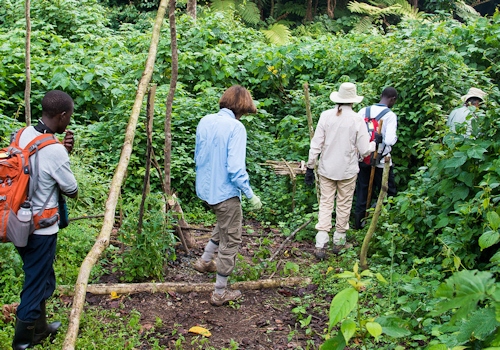
Porters wait at every trailhead in Bwindi and at Kinigi in Rwanda. Most trekkers hire one, and they should. A porter carries the pack, steadies you on slick descents, pushes from behind on the climbs and takes the fleece you peel off after the first hill. The fee goes straight into households beside the park, many of them families who once relied on the forest itself.
So your pack spends much of the day on somebody else’s back. Two things follow from that.
Grab handles, tough fabric and simple straps that adjust quickly matter more than a perfectly tuned suspension system, because the pack will be swung onto different shoulders, set down in mud and passed across a stream. And whatever you need constantly, meaning camera, mask, water and rain shell, should live where you can reach it while your porter walks a few metres behind or ahead. Trip reports keep mentioning the same irritation: the camera was in the bag, the bag was with the porter, and the porter was round the corner.
Weight is less of a worry than on a self supported hike. An extra two hundred grams of rain cover and padding is worth having when you are not the one hauling it uphill at 2,300 metres. Even so, a sensible target is a loaded pack of around three to five kilograms, which keeps it pleasant on the stretches where you do carry it.
Daypack Size for a Gorilla Trekking Safari: 20 to 30 Litres
Twenty to thirty litres is the working range for a gorilla trekking daypack, and there is a reason it sits there.
You are carrying two to three litres of water, a packed lunch from the lodge, a rain jacket, a fleece, gloves, two or three masks, sunscreen, repellent, wet wipes, toilet paper and a camera. That fills twenty litres once the water goes in. A little headroom helps when you strip the fleece off after the first climb and need somewhere to put it.
Go below twenty litres and the shell ends up strapped to the outside, where it snags on vines and stinging nettle. Go above thirty five and you fill the space with things you never open, while a bulky pack catches on vegetation in the narrow sections where the trackers have cut a path with a machete. Kilimanjaro is different: summit night layers need 30 to 35 litres, as our guide to the best backpack for Kilimanjaro explains.
The gorilla habituation experience pushes the number up. Four hours with a family still being habituated, plus a longer walk each way, means more water, a bigger lunch and perhaps a sit mat, so the top of the range makes sense. Hiking daypacks in the 20 to 30 litre range with a rain cover is the search that lands in the right territory.
| Trip | Pack size | Water |
|---|---|---|
| Gorilla trek | 20 to 25 L | 2 to 3 L |
| Habituation day | 25 to 30 L | 3 L |
| Chimp tracking | 15 to 22 L | 1.5 to 2 L |
| Game drive | 18 to 25 L | 1 L |
| Bush flight | 20 to 30 L | Bottle |
One pack can cover the whole trip. If you are pairing Bwindi with a Masai Mara safari or a Serengeti safari, a 22 to 25 litre pack does the trek, the game drives and the flights without anyone noticing it was a compromise.
Rain Covers and Waterproofing for Gorilla Trekking Tours
This is the single most useful feature, and it is missing from a surprising number of packs.
Almost no daypack is waterproof. The fabric may shed a shower, but zips leak, seams leak, and rain in Bwindi does not arrive as a shower. It comes in hard and often without much warning, in the wet months and the dry ones. Trekkers who wrote up their trips repeatedly describe arriving back at the trailhead with everything inside the pack damp, including things they thought were safe.
An integrated rain cover, stowed in its own pocket at the base, solves most of that in about five seconds. It is one of the few rare features worth hunting down on purpose. Osprey’s Hikelite range and several Gregory models include one. Look for a cover in a dark or muted colour; a fluorescent cover is great for mountain rescue and less so for sitting quietly near a silverback.
Where a pack has no cover, buy one separately, sized to the pack’s litre capacity. Backpack rain covers weigh almost nothing and pack into a fist sized pouch. A cover with an elastic edge and a buckle strap stays put when a porter swings the pack about; a loose one blows off on the first exposed ridge.
Covers have one weakness. Water runs down your back and the porter’s back, soaks the shoulder straps and hip belt and wicks into the pack through the back panel, which the cover leaves open. That is why the inside matters too. A waterproof pack liner turns the whole main compartment into a dry bag and costs far less than a ruined camera.
Cheap ponchos are a weak substitute. Several trekkers report that they tore on thorns within the hour and flapped across the camera at the worst moment. A proper shell, covered in the guide to rain jackets for gorilla trekking, does the job far better, and it rides in the stretch front pocket of the pack when the sun comes out.
Waterproof Backpacks for Gorilla Trekking: Roll Top Packs or a Rain Cover
Is a fully waterproof backpack worth buying for the gorilla trek? The question turns up again and again in traveller groups, usually followed by a request for brands and litres. For most people on a gorilla trekking safari, an ordinary hiking daypack with a cover and a liner still wins. Not always, though.
A truly waterproof pack is really a dry bag with shoulder straps. Coated or laminated fabric, welded seams and a roll top closure keep a downpour out completely, and makers such as Ortlieb and Sea to Summit sell them in the 20 to 30 litre range. Nothing blows off on an exposed ridge. Your porter can set it down in a puddle at the river crossing and the contents stay dry, which is a real comfort for anyone trekking with a camera in April, May or November.
The costs show up after the first hour of climbing. Most roll top packs have a flat, unventilated back, so your shirt is soaked where the pack sits. Few carry hip belt pockets or a stretch front pocket, which means unrolling the top every time you want a mask or a lens cloth, and rolling and clipping the closure is slow and faintly noisy at close range.
So the choice runs like this. If you sweat easily or want fast access, pick a ventilated hiking daypack, then add a rain cover outside and a liner inside. If a dry camera matters more to you than a dry back, a waterproof roll top hiking backpack of around 25 litres is a fair pick, ideally one with a padded hip belt and an outer mesh pocket for the wet shell. Small, light and frameless suits both styles, because the pack also has to squash into a light aircraft pod or sit on your knees.
Read labels carefully. “Water resistant” on an ordinary pack means the fabric sheds a shower and nothing more, while “waterproof” on a pack with sewn seams and a zipped lid usually means the fabric alone. Only welded seams and a roll top earn the word in a Bwindi downpour.
Dry Bags Inside Your Gorilla Trekking Daypack
Rain cover outside, dry bags inside. That pairing is what keeps a gorilla trekking day from ending with a dead phone.
A roll top dry bag sized to your camera body and lens is the simplest answer, and it doubles as somewhere to put a soaked fleece on the way out. Roll top dry bags in the 5 to 10 litre range cover most kit. A lightweight dry bag set in three sizes lets you split the load: one for the camera, one for spare socks and the warm layer, one for the passport copy, permit and cash for tips.
Your phone wants its own pouch. A waterproof phone pouch on a lanyard lets you take pictures through the clear window in a downpour and keeps the phone off the forest floor.
Mind the plastic. Rwanda bans single use plastic bags and confiscates them on arrival at Kigali, and Uganda restricts thin polythene carrier bags, with a wider single use ban announced. Supermarket bags and ziplocks are a poor plan here. Reusable dry bags and stuff sacks avoid the question. For boat trips and dusty game drives later in the trip, see our guide to the best dry bags for safari.
Hip Belts, Back Panels and Torso Fit on the Trek
Even with a porter, you will carry the pack for part of the gorilla trek, and fit still decides whether that part is pleasant.
A padded hip belt moves the weight off your shoulders onto your hips, which is the difference between comfortable and sore across several hours on slopes that can feel close to vertical in places. Thin webbing belts, common on smaller and cheaper packs, do very little once the pack holds three litres of water. They keep the bag from swinging, and that is about all.
Hip belt pockets are quietly excellent. A phone, lip balm, a spare mask and a lens cloth all fit, and you reach them without taking the pack off or calling your porter over. If your chosen pack has a bare belt, a clip on hip belt pocket adds the same convenience.
A ventilated back panel matters more in equatorial humidity than in temperate air. Suspended mesh systems hold the pack a finger’s width off your spine so air moves, and across four hours the difference in sweat is plain. Foam panels with channels are a middle ground. Flat padded backs are the hottest choice and the slowest to dry.
Torso length, not height, decides fit. Women often get a better fit from a women’s specific pack, with shorter torso sizing and a different cut of strap and belt, and men with shorter torsos frequently do too. Check the maker’s stated torso range before choosing a size, and if you can, try the pack loaded in a shop before ordering online.
A sternum strap is worth having. It stops the shoulder straps sliding outward when you lean into a climb, and a whistle built into the buckle costs nothing to carry.
Hydration Reservoirs and Bottles on a Gorilla Trek
Water is the heaviest thing in the pack and the thing people most often run short of on a long gorilla trekking tour.
Carry two to three litres. Lodges usually fill bottles at breakfast, and some hand out a bottle at the trailhead, but there is nowhere to refill in the forest.
A reservoir in the pack’s hydration sleeve lets you sip without stopping. That matters on a climb where the group keeps a steady pace behind the ranger, and it means you drink more than you would from a bottle you have to dig out. A 2 or 3 litre hydration reservoir with a wide opening is easiest to fill from a lodge jug and to dry out afterwards.
There are trade offs. Bladders are harder to clean on a multi stop trip, and you cannot see how much is left. Bottles are simple to refill, easy to share with a porter who has run dry, and they double as a cold compress after a nettle sting. Many trekkers carry both: a reservoir for the walk and a bottle in a side pocket. A collapsible water bottle rolls flat once it is empty and earns its place on the bush flight home.
Eating and drinking are not allowed near the gorillas, so during the hour itself the hose stays tucked away. Put the bite valve under a shoulder strap clip so it does not swing against your face as you crouch.
Camera Access and Pocket Layout for the Hour With the Gorillas
This is where most packs fall short, and where a bit of planning before the gorilla trek pays off.
During your hour with the gorillas you move slowly and quietly, often on a slope, changing camera settings and holding position. You should not be rummaging through a main compartment, and the porter carrying it may be ten metres back. Everything for that hour wants its own reachable home.
Your lid or top pocket takes the masks, so you can put one on at the briefing and swap when the first is damp. Hip belt pockets take a lens cloth and lip balm. A stretch front pocket takes the rain shell and the fleece you peeled off on the climb, both of which will be wet and should not go in with lunch.
The camera itself is better on your body than in the pack. A quick release camera clip for a backpack strap holds a mirrorless body or compact camera at chest height, out of the mud and ready in a second, and it leaves both hands free for the walking stick. Some trekkers prefer a chest strap system or a short sling. Either way, the pack then carries the spares rather than the camera itself.
When the camera does travel inside, a padded camera insert turns an ordinary daypack into a camera bag and stops the body knocking against a water bottle for four hours. Packs with side or back panel access to the main compartment let you reach the insert without taking everything else out, which is worth looking for if photography is the reason you came. Choose zips over roll tops for anything you open often; a roll top is slow and noisy at close range.
Spare batteries and memory cards want their own small pouch rather than rolling loose. Cold damp mornings drain batteries faster than the rated figures suggest, and there may be no charging point between lodges.
Full camera backpacks are a poor fit for this trek. They trade the rain cover, hip belt and ventilation you need for compartments you do not. Hybrid travel and camera packs, such as the Peak Design Everyday backpack, sit between the two: quick side access and good padding, but most lack a rain cover and a padded hip belt, so add a cover and expect to hand the pack to a porter on the steep sections. There is more on lenses and glass in the guide to the best camera and binoculars for safari, and on settings under the canopy in gorilla trekking and photography.
Daypack Models That Suit Gorilla Trekking Adventures
These packs meet the criteria above and are widely stocked. Torso fit outranks everything else, so treat this as a shortlist for your gorilla trekking trip rather than a ranking.
Whichever you choose, pick a muted colour: olive, grey, khaki or dark blue. Bright colours are not banned on the trek, but dark and earthy fabrics show the mud less and suit the quiet hour with the family.
What to Pack in Your Daypack for a Gorilla Trek
A pack is only as good as what goes into it. A trek can finish in ninety minutes or run past six hours, and nobody knows which until the trackers radio in, so load your gorilla trekking daypack for the long version every time.
One pack per person works better than sharing. Two trekkers splitting one bag end up waiting on each other for water, and a porter carries one load, so a couple is better served by two small packs than one big one.
The season changes the load more than most people expect.
| Item | Dry months | Wet months |
|---|---|---|
| Rain jacket | Top of pack | Worn or on top |
| Rain trousers | Optional | Pack them |
| Spare socks | One pair | Two pairs |
| Warm layer | Light fleece | Fleece, thermal |
| Dry bags | Camera, phone | Everything |
Dry here means June to August and December to February; the wet months run from March to May and September to November. Even in July the shell stays in the pack. For the whole trip beyond the daypack, the Uganda gorilla trekking packing list and the habituation experience packing list go item by item.
Daypacks for Gorilla Trekking in Rwanda’s Volcanoes National Park
Anyone hunting for the best daypack for gorilla trekking in Rwanda needs the same pack as in Uganda, with a few tweaks for the Virungas. A gorilla trek in Volcanoes National Park starts with a briefing at Kinigi, then a drive to the trailhead and a walk through farmland and bamboo onto the volcano slopes.
Altitude makes the difference. Many Rwandan gorilla families range higher up the volcanoes than most Bwindi treks climb, so mornings are colder and rain feels colder too. A warm layer earns its place, and a few spare litres of capacity help once you peel it off on the climb. Treks to the nearer families can be shorter than in Bwindi, yet the far groups still take most of the day, so pack the same water and food.
Bamboo and nettles crowd the lower paths, and packs with dangling straps or loose bottles in open side pockets snag on them. Tuck spare strap ends away and pick side pockets with a drawcord or compression strap.
Plastic is the other point. Rwanda bans single use plastic bags and checks luggage on arrival at Kigali, so wet clothes, food and toiletries belong in reusable dry bags or stuff sacks. Lodges around Kinigi often lend packs, walking sticks and gaiters, and porters wait at every trailhead, as in Uganda. The Rwanda gorilla trekking packing list covers the rest of the bag, and the guide to Volcanoes National Park explains the park itself.
Daypack for Safari: Bush Flights, Soft Luggage and Using Your Pack as a Cabin Bag
Most gorilla trips involve at least one light aircraft. Scheduled flights from Entebbe or Kajjansi land at Kihihi for Buhoma and the northern side of Bwindi and at Kisoro for the southern sectors, and safari combinations add more hops into the Mara, the Serengeti or the Okavango. The daypack for safari you choose has to work on those flights and on the trail alike.
The rules are close to identical across East Africa. Aerolink in Uganda, Safarilink in Kenya and Coastal Aviation in Tanzania all publish an allowance of about 15 kilograms per person, and that figure includes your hand luggage. Bags must be soft sided so they can be squeezed into a small cargo pod. A few coastal routes allow 20 kilograms, and dimensions vary by operator, so check yours. The detail people miss is the “including hand luggage” part: a daypack loaded with a camera, lenses and binoculars can weigh four or five kilograms on its own, leaving ten or eleven for everything else.
The answer is a soft safari duffel for the main bag and a daypack that doubles as your cabin bag. A water resistant soft duffel in the 40 to 60 litre range with backpack straps fits the cargo pods and carries across a muddy airstrip. A digital luggage scale weighs almost nothing and saves an argument at a grass strip check in.
On the long haul flight into Entebbe or Kigali, the daypack is your carry on, unless you fly with a dedicated travel carry on backpack. Pack it as if your checked bag might arrive a day late: boots worn on the plane or packed in the daypack, the rain shell, one change of trekking clothes, medication, camera and chargers. A 20 to 30 litre pack fits within the cabin size limits of most international airlines, though deeper packs with a full hip belt can be tight under the seat in front.
On the light aircraft itself there are no overhead bins, and usually no space under the seat. The daypack rides on your knees, which is a strong argument for a soft pack with no rigid frame, under 30 litres and not stuffed to bursting. Keep the camera in the daypack rather than the duffel, since bags in the cargo pod are loaded and unloaded quickly on dusty strips.
Some travellers bring a second, ultralight pack for game drives. A packable 20 litre daypack folds into its own pocket, weighs a couple of hundred grams and is handy in a vehicle when the main pack is still damp from Bwindi. On open safari vehicles, dust gets into everything, so zips with storm flaps and a dust tolerant fabric beat open mesh. The African safari packing list covers the rest of the duffel, and getting to Bwindi explains the flight and road options in full.
What Not to Carry on a Gorilla Trekking Safari
Weight you do not need is weight somebody carries uphill at altitude, so the edit is worth doing for your gorilla trekking day.
Leave the full size tripod, the long telephoto you will struggle to use under the canopy, the laptop, and the third and fourth spare shirt. Binoculars earn their weight on game drives and at the lodge rather than during the viewing hour, when you are close enough not to need them.
Drones need written clearance in Uganda and are not allowed over the parks without it, so an unauthorised one is confiscation risk in your bag. Rwanda applies similar rules.
Trekking poles divide opinion. Rangers hand out sturdy wooden walking sticks at the trailhead, and on a gorilla trek those usually beat folding poles, which can bend or snap when wedged between roots on a steep bank. If you bring your own anyway, choose a pack with pole loops so they ride outside when you need both hands. Poles make more sense on the gentler trails of a Kibale chimpanzee trek. An umbrella is no use at all in thick vegetation, so leave it behind.
Everything you carry in comes back out with you, wrappers included. Another small argument for carrying less.
Frequently Asked Questions About Gorilla Trekking Daypacks
What is the best daypack for gorilla trekking?
A 20 to 30 litre hiking daypack with an integrated rain cover, a padded hip belt with pockets, a ventilated mesh back and a hydration sleeve. The Osprey Talon 22 or Tempest 22, the Osprey Hikelite and the Gregory Zulu 24 all fit that description. Torso fit matters more than brand, so choose the model whose size range matches your back.
What is the best waterproof backpack for gorilla trekking?
For most trekkers it is an ordinary 20 to 30 litre hiking daypack with a rain cover and a liner, because it stays ventilated and keeps its quick access pockets. A fully waterproof roll top pack of a similar size keeps everything dry with no cover to blow off, at the price of a hotter back and slower access. Either way, give the camera its own dry bag.
What is the most comfortable day backpack for long day hikes like a gorilla trek?
The one whose torso length matches yours, with a padded hip belt and a suspended mesh back. On a hike of several hours, comfort comes from fit and ventilation far more than from the badge. The Osprey Talon 22 or Tempest 22 and the Gregory Zulu 24 are common picks. Load the pack to around three to five kilograms and walk with it at home before you fly.
What is the best small daypack for hiking and gorilla trekking?
About 20 to 22 litres is as small as works on a gorilla trek, since water, lunch and a shell fill anything smaller. The Talon 22, the Tempest 22 and the Gregory Nano all sit there, and a packable 20 litre pack is a good spare for game drives and chimpanzee tracking.
What should I wear when gorilla trekking?
Long trousers tucked into long socks or gaiters, a long sleeved shirt, broken in waterproof hiking boots, gardening gloves, a hat and a breathable rain jacket, all in muted colours such as olive, khaki or grey. Camouflage is not allowed for civilians in Uganda. The outfit is covered layer by layer in the guide to gorilla trekking clothing and gear, and the shell itself in the guide to the best rain jacket for gorilla trekking.
What should I wear on the gorilla trek in Rwanda?
The same outfit as in Uganda, with a warmer layer. Treks in Volcanoes National Park climb higher on the volcano slopes, so early mornings are cold and rain feels colder. Gloves help with nettles in the bamboo zone, gaiters keep mud out of your boots, and neutral colours suit both countries.
Is the best daypack for gorilla trekking in Rwanda any different?
No. A 20 to 30 litre pack with a rain cover, hip belt pockets and a hydration sleeve suits Volcanoes National Park just as it suits Bwindi. Leave room for a fleece, keep strap ends tucked away from the bamboo, and use reusable dry bags rather than plastic ones, since Rwanda bans single use plastic bags.
What size daypack do I need for gorilla trekking?
Twenty to thirty litres. Two to three litres of water, a packed lunch, rain jacket, fleece, gloves, masks and a camera fill twenty litres comfortably, and a little headroom helps once you strip layers off on the first climb. Below twenty and the shell ends up strapped outside where it snags. Above thirty five and you carry things you never open. For the four hour habituation experience, the upper end of the range makes sense.
How much does a porter cost, and should I still bring a good pack?
Porters at the Bwindi trailheads usually charge in the region of US$15 to US$20 for the trek, paid in cash on the day, with a tip of around US$5 to US$10 on top commonly given. Rates are set locally, so confirm on arrival. Bring a decent pack anyway. You carry it for part of the walk, and the features that matter on a porter carried day are sturdy haul handles and quick access pockets for camera, mask and water.
Do I need a rain cover, or is the pack waterproof?
You need a cover. Almost no daypack is waterproof, since zips and seams leak even when the fabric sheds water, and Bwindi rain is not a passing shower. An integrated cover stowed at the base of the pack is the best answer. Where the pack has none, buy one sized to the litre capacity, and add a liner or dry bag inside for the camera, since water also wicks in through the back panel.
Is a hydration reservoir better than water bottles on a gorilla trek?
For drinking on the move, yes. A reservoir in the hydration sleeve lets you sip without stopping, which helps on a climb where the group keeps a steady pace. Bottles are simpler to refill at the lodge and easier to share. Many trekkers carry a 2 or 3 litre reservoir for the walk and a bottle in a side pocket as backup.
Can my daypack be my cabin bag on bush flights?
Yes, and it should be. Light aircraft operators such as Aerolink, Safarilink and Coastal Aviation allow about 15 kilograms per person including hand luggage, in soft bags only, so the daypack counts toward the total. There are no overhead bins, so it rides on your lap. A soft, frameless pack under 30 litres works best. Excess weight is sometimes carried at a per kilo charge, only when space allows, so do not rely on it.
Should I get a women’s specific daypack?
Often yes, and it is not just a colour change. Women’s packs have shorter torso sizing with shoulder straps and hip belts cut differently, which gives a better fit than a small unisex model. Men with shorter torsos frequently find the same. Check the maker’s stated torso range before choosing a size.
Can I borrow a daypack near the park instead of bringing one?
Often, yes. A good number of lodges around Bwindi and near Kinigi in Rwanda hand guests a daypack at breakfast along with gaiters, a poncho, a walking stick and a water bottle. That makes the pack one of the more reasonable things to leave at home if your bush flight allowance is tight. Still bring your own dry bag for the camera, since those are rarely lent out. The guide to renting gorilla trekking gear covers what lodges typically provide.
What does a good gorilla trekking daypack cost?
Good 20 to 30 litre hiking daypacks from mainstream makers commonly sit somewhere between about US$60 and US$180, with packs that include a rain cover, a padded hip belt and a suspended mesh back toward the upper half of that range. A separate rain cover, a dry bag set and a hydration reservoir add a modest amount on top. Prices change often, so check current listings.
Can I use a camera backpack instead?
It is a poor trade. Dedicated camera packs give you padded compartments but usually lack the rain cover, padded hip belt and ventilated back that matter across several hours in humid air on steep ground. A hiking daypack with a padded camera insert, a roll top dry bag and a strap clip for the camera body gives you the protection and the carrying comfort.
Continue With the Rest of Your Gorilla Trekking Gear
The pack is the container for everything else. The full list of what goes in it sits in the gorilla trekking packing list, and every gear guide on this site is gathered in the gear and clothing section.
For what you wear, see what to wear for gorilla trekking, then the guides to boots for gorilla trekking, gloves for the nettles and gorilla trekking gaiters. Adding a savannah leg? What to wear on safari covers the game drive side.
For timing, permits and where to stay, read the best time to go gorilla trekking, the guide to gorilla permits in Uganda and Rwanda, the Bwindi lodges overview and, if you are trekking across the border, Rwanda gorilla trekking.