The best headlamp for safari is a light, rechargeable model of roughly 300 to 450 lumens with a steady red mode, a lock switch and at least IPX4 water resistance, such as the Black Diamond Spot 400, BioLite Range 400 or Petzl Actik Core. You will use it most in tented camps, on camping safaris, gorilla treks and Kilimanjaro, where it lights the path to your tent, the bathroom after the generator stops and the dark hour before a dawn game drive.
Light is the thing almost nobody plans. Then the camp switches off at ten, the tent goes black, and a phone torch held in one hand turns out to be a poor way to find a contact lens case or pack for a 5.30 start. A hands free lamp solves all of that for very little weight.
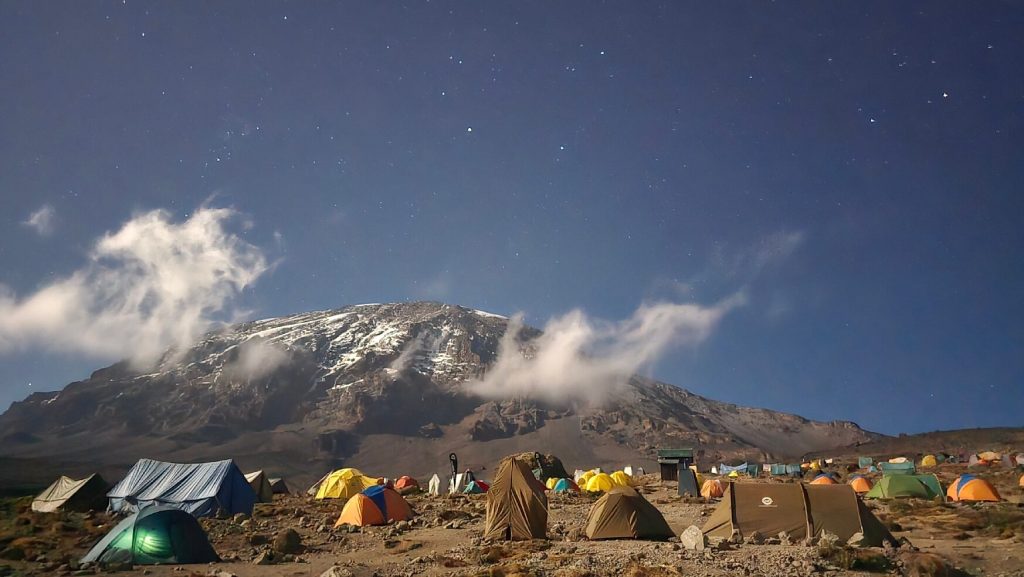
Why You Need a Headlamp on Safari: Camps, Game Drives and Night Paths
A safari headlamp earns its place for one plain reason: your hands stay free. You can carry a camera bag and a coffee to the vehicle before sunrise, zip a tent, sort batteries on your lap or read in bed without holding anything.
Safari trip reports keep repeating one small regret. The traveller packed a torch, but it lived at the bottom of a duffel, and the phone light drained the battery they needed for photos the next morning. A headlamp on the bedside table, or clipped to the tent pole, avoids both problems.
How Many Lumens a Safari Headlamp Needs
Lumens measure how much light a headlamp puts out on its brightest setting. More is not always better. The top mode often runs for only an hour or two, and in a safari camp you will spend most nights on a low setting of 20 to 100 lumens. For a safari, 300 to 450 lumens at maximum is plenty; above about 600 you are paying in weight and battery for light you will rarely switch on.
Reputable brands test to the ANSI FL1 standard, which makes their figures comparable. Under it, runtime is counted until output falls to 10 percent of its starting level, and beam distance is measured to the point where the light is about as bright as a full moon. Two lamps with the same lumen figure can still look very different, because beam shape and how evenly the light falls matter just as much. Several reviewers point out that runtime at a usable middle setting, roughly 100 to 250 lumens, tells you more than the headline figure on the box.
| Task | Lumens | Beam |
|---|---|---|
| Tent, reading | 5 to 50 | Flood or red |
| Camp paths | 100 to 200 | Flood |
| Night hiking | 200 to 400 | Spot |
| Summit night | 300 plus | Spot, mixed |
A flood beam spreads light wide and close, which is what you want for packing, eating and walking a camp path. A spot beam throws a narrow cone further ahead, useful on a mountain trail. The better lamps offer both and switch with one button. Some cheaper lamps sold online advertise a very wide 230 degree strip of light; it is pleasant around a tent but throws little distance.
For most travellers a rechargeable headlamp of about 400 lumens with red light covers every night of the trip.
Best Headlamps for Safari Trips by Budget and Use
The same handful of lamps tops most hiking and backpacking reviews, and they all suit a safari. We have not tested them ourselves; makers update these models often, so check the current version and its rated output before you buy.
Which is the highest rated headlamp? Across the review sites that rank for this search, the Black Diamond Spot 400, the BioLite Range 400 and the Petzl Actik Core appear as a top pick far more often than anything else. None is wrong for a safari. Pick by battery: AAA for remote camping, built in rechargeable for lodges, hybrid for both.
Black Diamond or Petzl for a Safari Headlamp
Both are large, long running outdoor brands with lamps tested to ANSI FL1, and both make a lamp that fits a safari well. The choice comes down to how each one works.
Black Diamond lamps such as the Spot and Storm tend to have more modes, a battery level display and a tap control for instant full brightness, packed into a waterproof housing. The flip side is a learning curve; more than one reviewer found the button sequence confusing at first. Petzl lamps such as the Tikkina, Tikka and Actik Core lean simpler, with fewer modes and a single button, and the hybrid CORE system lets the same lamp run on its rechargeable pack or on AAA cells bought in any town. Petzl rates several of these lamps for splashes rather than submersion.
For a lodge safari, either works. For a long camping trip with patchy charging, Petzl’s hybrid system has the edge. For a wet trek or boat days, the sealed Black Diamond Storm is the safer pick.
Red Light Mode on Safari: Tents, Night Vision and Insects
A red light mode is the feature that separates a safari headlamp from a cheap torch. Red light keeps your eyes adjusted to the dark, so you can switch it off and still see the stars or the outline of the tent. It is also far kinder to whoever shares the tent or sits beside you at the campfire.
Insects are the other reason. Many night flying insects are less drawn to red light than to white, and anyone who has eaten dinner at a camp table on the Okavango or beside Lake Victoria knows how fast a white beam fills with moths and midges. Switch to red while eating and reading, and the cloud around your face thins out noticeably. Pair the habit with a decent repellent from our insect repellent guide.
Check how a lamp reaches its red mode before buying. On some models you must cycle through bright white to get there, which defeats the purpose at 3 a.m. Better designs let you start in red, or hold a button to go straight to it. Hunting lamps such as the Petzl Tactikka RGB, Princeton Tec’s Remix RGB and LuxPro’s multi colour lamps add green and blue. Green is brighter to the eye than red while keeping some night vision, and it is handy for reading a map, but red is the one you will use most on safari.
Rechargeable, AAA or Hybrid: Batteries for Safari Travel
Battery choice depends on where you sleep. On a lodge safari with sockets in every room, a USB C rechargeable headlamp is the obvious pick: no spare batteries, steady brightness, and it charges from the same cable as your phone. Rechargeable lamps tend to hold steady output until they are nearly flat, whereas AAA cells dim slowly as they drain. Prefer USB C over the older micro USB port, so one cable covers everything. Sockets in Uganda, Kenya and Tanzania are the three pin Type G, so charging there needs a Type G travel adapter.
Camping safaris and long treks change the picture. Charging can be days away, and a hybrid headlamp that takes a rechargeable pack or AAA batteries gives you both options. When the built in cell runs out, three AAA cells from any shop in Arusha, Kampala or Nairobi keep it going. A lamp with a sealed, non removable battery is simpler and more waterproof, but once it is flat you wait for a socket.
Keep the lamp topped up from a battery pack on camping trips. Our guide to battery packs and solar chargers for safari covers pack sizes and the airline rules.
Waterproof Headlamps for Rainforest Trekking and Wet Season Safaris
Water resistance is shown as an IP rating. The first digit covers dust and the last covers water; an X means dust was not rated. For a gorilla trekking safari in Bwindi, where it can rain on any afternoon of the year, or a wet season safari in the Mara, an IPX4 lamp is enough. Higher ratings matter for river crossings and boat days, and a rating such as IP67 also tells you the lamp is sealed against dust, which helps on dry season game drives.
If you will be in boats or crossing rivers, a waterproof IPX7 headlamp is the safer pick. On a trek, keep any lamp in the dry bag inside your gorilla trekking daypack and it will survive the rain regardless of rating.
Comfort, Controls and Lock Mode on a Safari Headlamp
A lamp that bounces, pinches or confuses you ends up in the bag. Four details decide whether you wear it.
Fit. Front heavy lamps tip forward when you look down; lamps with the battery at the back of the strap balance better over long hours. Most travellers do well with something under about 100 grams. A tilting head lets you aim the beam at your feet without bending your neck.
Controls. Big buttons you can find with gloves on matter on Kilimanjaro. A memory function that brings the lamp back on at your last setting avoids a blast of full white in a dark tent.
Lock mode. A lock stops the lamp switching itself on in a bag and draining flat or heating up. On safari this is the single most useful feature after red light.
Extras. A battery level display, a rear red light for walking along a road at dusk, and reactive lighting on premium lamps are nice to have. Motion sensors that switch the lamp on with a wave of the hand are common on budget lamps; they are easy to trigger by mistake in a tent.
Headlamp or Handheld Torch on a Safari Trip
People on flashlight forums who answer safari questions online often suggest a powerful handheld torch for spotting eyes in the dark. On a guided safari you rarely need one. Night drives in Uganda’s parks go out with a ranger and the spotlight is handled by the guide, and in unfenced camps the askari carries the torch for the walk to your tent.
A handheld light does earn its place as a backup and on self drive or camping trips, where you may check around the vehicle or the campsite yourself. A small pocket USB C flashlight is plenty for most people; brands such as Acebeam and Olight make brighter long throw rechargeable flashlights for those who want reach. When your headlamp is on charge, the backup goes with you to dinner.
A collapsible rechargeable lantern is the third kind of light worth thinking about. It lights a whole tent for packing. If you lack one, strap your headlamp around a full water bottle, beam facing in, for a soft glow.
Headlamps for Kilimanjaro Summit Night and Other Mountain Treks
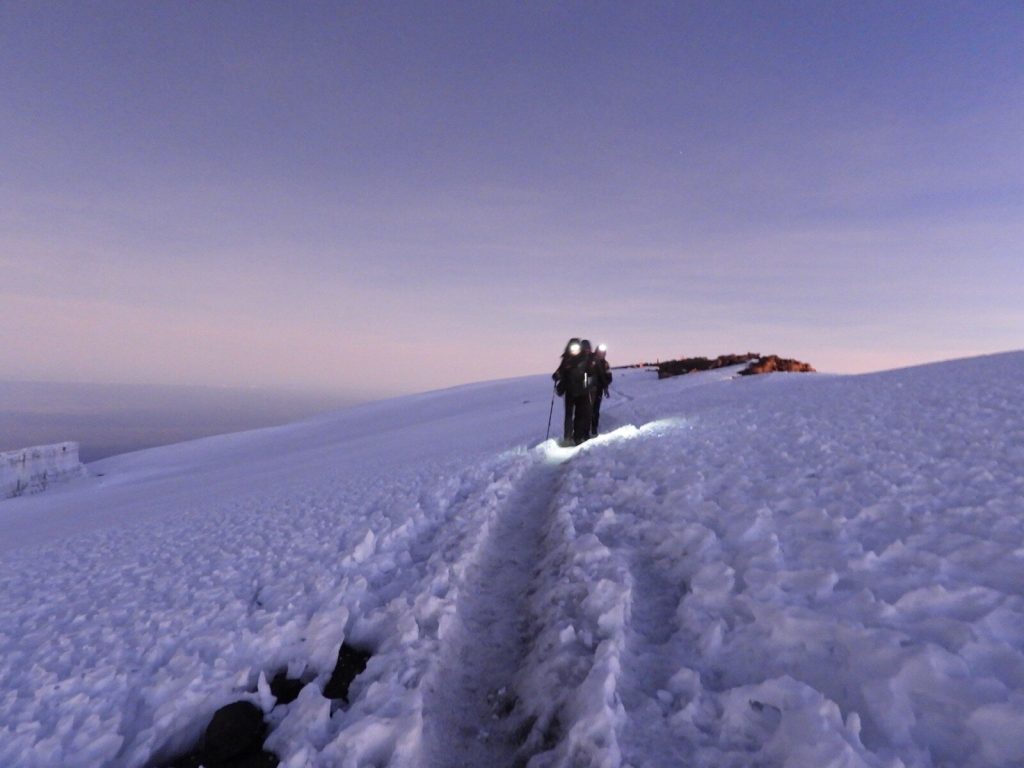
On a Kilimanjaro trek, the summit push usually leaves high camp around midnight, and climbers walk for six hours or more by headlamp before sunrise reaches the crater rim. Temperatures sit well below freezing, and cold drains batteries fast. This is the one night where the lamp has to be good.
Look for at least 300 lumens with a spot beam for the trail, a middle setting you can run for many hours, and a mode that shows battery level. Use lithium AAA cells, or keep a rechargeable lamp and a spare battery in your sleeping bag until departure, then in an inner pocket. Operators’ briefing notes for summit night repeat the same advice: carry spare batteries where body heat keeps them warm, and practise changing them with gloves on before the climb. Our Kilimanjaro gear list covers the rest of the kit.
Mount Nyiragongo in Congo involves a night at the crater rim huts, with the lava lake below, so a lamp is needed for the hut and the toilet path. On a Rwenzori trek, summit days begin before dawn on muddy, rocky ground where a spot beam and IPX4 or better protection pay off. For the boots and clothing side of a climb, see our guide to hiking boots for Kilimanjaro.
Night Safety and Headlamp Manners in Safari Camps
Owning a good headlamp does not mean walking around alone at night. In unfenced safari camps across Kenya, Tanzania and Botswana, the house rule after dark is to call an askari, the camp guard, to walk you between the dining area and your tent. Camps give you a radio, a whistle or a horn for this. Your headlamp lights your own feet and the inside of the tent.
Families should keep children in sight after dark, and some camps assign an askari to family tents. A small headlamp of their own helps children feel at ease without letting them roam. A couple travelling together should pack one lamp each; shared lights end up in the wrong bag every time, and the person without one is the one who needs the bathroom at night.
Headlamps to Skip and How to Pack One for a Safari Trip
Avoid very cheap lamps with no brand and huge claimed outputs. Several thousand lumens from a lamp the size of a matchbox is not a real figure, and these lights often have flimsy battery doors and no lock. The best seller lists on Amazon are full of multi packs of wide beam motion sensor headlamps. They are fine as cheap spares for a family or for camp chores, but check that one has a steady red mode and a lock before you rely on it. Skip lamps whose red mode only blinks, any model where every press starts in full white, and heavy rear battery lamps built for caving unless you are actually going caving.
Packing is simple. Lock the lamp or reverse one battery so it cannot switch on in your bag; a lamp that cooks itself flat in a duffel is the commonest headlamp failure on safari. Keep it in the top of your daypack or the door pocket of the tent. Wipe off dust after game drives and dry it after rain. For long storage at home, take AAA batteries out to stop corrosion. A coin cell lamp such as the Petzl e+LITE emergency headlamp weighs very little and makes a sensible last resort in a first aid kit.
Gear Lists and Trips That Call for a Headlamp
The headlamp sits on every list we publish. The African safari packing list covers the full bag for game drive trips, the gorilla trekking packing list deals with Bwindi and Volcanoes, and our safari camera and binoculars guide covers optics, along with the best binoculars for safari and the best camera for safari. Camera owners heading into the rains should read our camera bag and rain cover guide, and the gorilla trekking rain jacket guide keeps you dry on the trail. For the trips themselves, see our guides to a Serengeti safari, a Masai Mara safari, an Okavango Delta safari and gorilla trekking in Bwindi, plus self drive safaris in Africa, where you set up camp yourself.
Safari Headlamp FAQ
How many lumens is a really good headlamp for safari?
About 300 to 450 lumens at maximum is plenty for a safari. You will use the low and red settings most of the time; the high setting is for night hikes and Kilimanjaro summit night. Beyond roughly 600 lumens you mostly gain weight and shorter battery life.
What is the highest rated headlamp?
In the reviews that rank for this search, the Black Diamond Spot 400, BioLite Range 400 and Petzl Actik Core are named best overall most often, with the Nitecore NU25 UL a frequent pick for low weight. Ratings change as models are updated, so check the current version.
Is Black Diamond or Petzl better?
Neither is better across the board. Black Diamond lamps tend to have more modes, a battery display and strong waterproofing; Petzl lamps are simpler to use, and the hybrid CORE models run on a rechargeable pack or AAA cells. For a long camping safari the Petzl hybrid is handier; for wet treks and boat days a sealed Black Diamond Storm is safer.
What headlamps do Navy SEALs use?
We could not confirm any unit’s issue list. Military users favour rugged lamps with red, green, blue or infrared modes and glove friendly switches, and makers such as Petzl and Princeton Tec sell tactical lines. A safari needs none of the infrared features; a good red mode and a lock matter far more.
Do I really need a headlamp for a lodge safari?
It is not strictly needed at lodges with full electricity, but most travellers who bring one use it every night. Tented camps often switch off the generator late at night, paths are dim, and a hands free light is easier than a phone for packing before a dawn game drive.
How much does a good safari headlamp cost?
Reliable AAA lamps from major brands commonly sell for roughly US$20 to US$30, and good rechargeable or hybrid lamps for about US$40 to US$90. Ultralight and high output models can cost more. Prices change with sales, so check current listings.
Can I take a headlamp and spare batteries on a plane to Africa?
Yes. Headlamps are allowed in cabin and checked bags, but spare lithium batteries must go in your carry on. Lock the lamp so it cannot switch on during the flight, and keep spare cells in a case away from coins and keys.
Is red light really useful on safari?
Yes. It keeps your night vision, does not wake a tent mate, and attracts fewer insects at the dinner table than white light. Choose a lamp that can switch straight to red.
Should I bring a headlamp on a gorilla trek?
A small one, yes. Most treks finish in daylight, but long treks in sectors such as Rushaga and Nkuringo occasionally return close to dusk, and the lamp weighs very little in a dry bag in your daypack.
Can I walk to my tent with my headlamp at night?
In unfenced camps, no. Call the askari to escort you, as the camp will explain at check in. Your headlamp is for inside the tent and your own path once you are being escorted.