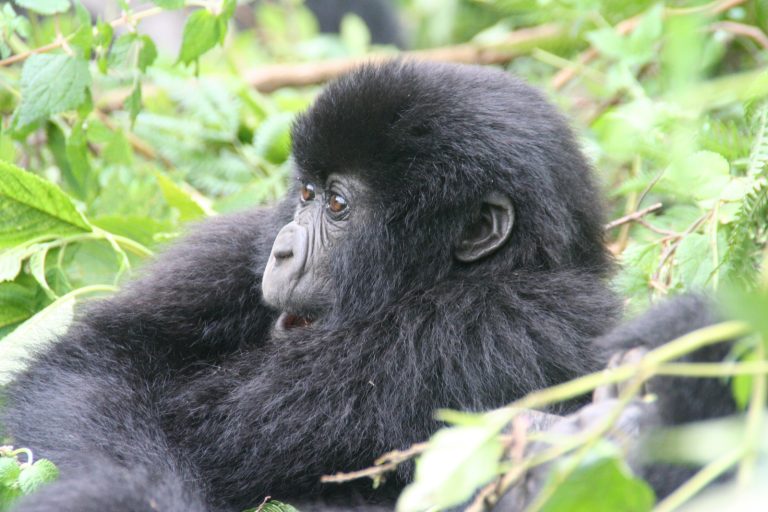
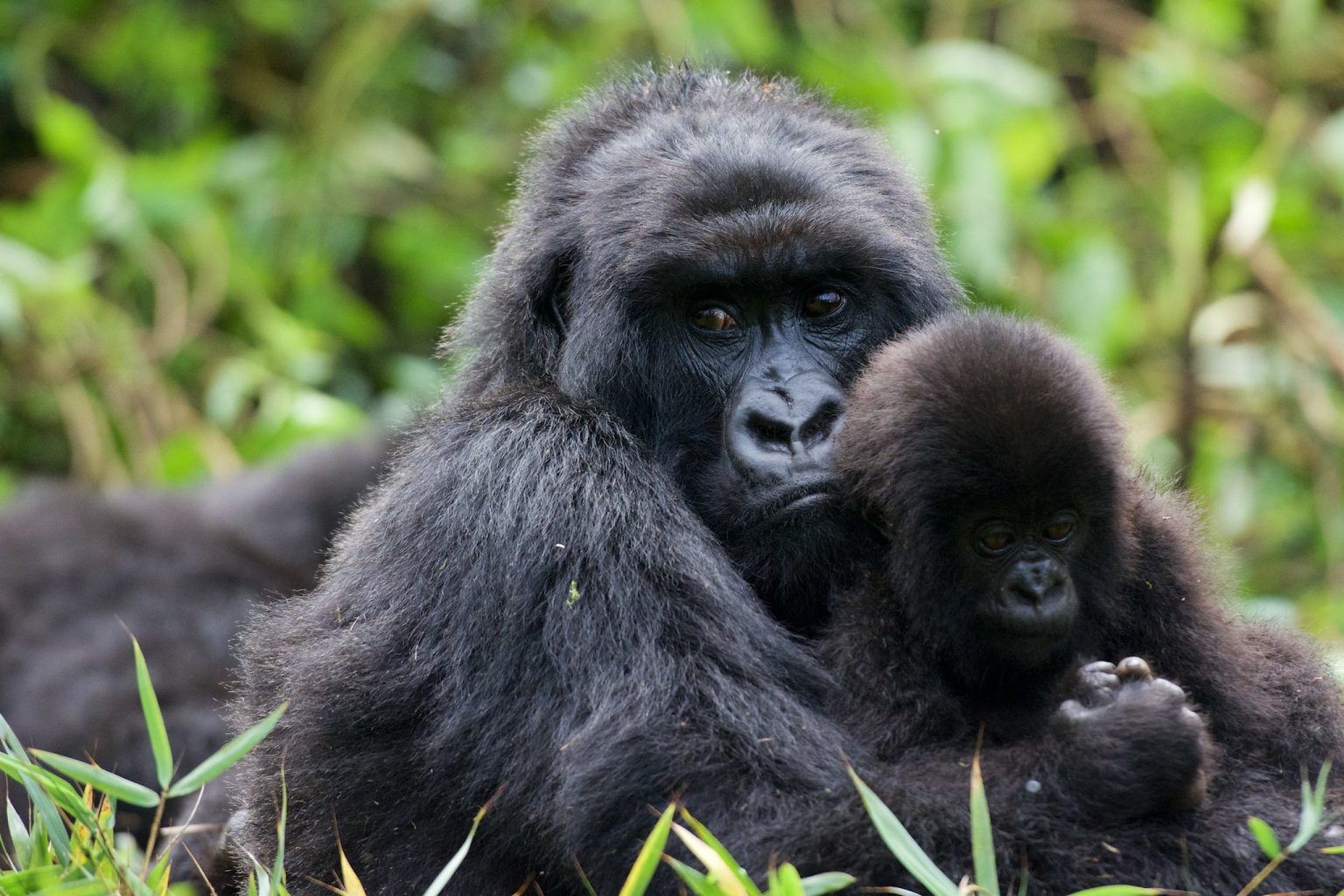
The Nkuringo gorilla family is a habituated mountain gorilla group of about 14, led by the young silverback Rwamutwe, that lives below Nteko Ridge in the Nkuringo sector of southern Bwindi Impenetrable National Park. It was the first family opened for trekking in the south of the park, and it is visited on a Nkuringo permit from the Uganda Wildlife Authority, with rangers naming families at the morning briefing. Expect a steep descent, a hard climb back and a family with a long, eventful history.
Older versions of this page carried a member list and a few notes on the drive across the park. The family has changed a great deal since then. Its founding silverback died, its next leader was speared by a poacher, and a young male now holds the group together. Below is the story, the current picture and what a gorilla trekking safari to see the Nkuringo group actually asks of your legs.
Nkuringo Gorilla Family History: From Crop Raiders to a Trekking Family
This family was not chosen for gorilla trekking because it was easy to reach. It was chosen because it would not stay in the forest. Through the 1990s the group kept walking out of Bwindi into the gardens below Nteko Ridge, eating bananas, beans and sweet potatoes, and rangers spent much of their time chasing it back across the boundary. Relations with the farmers were tense.
Habituation started in 1997. Part of the thinking was practical: a group that earns permit revenue gives the people who share its land a reason to tolerate it. The International Gorilla Conservation Programme (IGCP) and partners later bought a strip of land along the park edge as a buffer zone, so the gorillas could feed outside the forest without raiding crops, and residents of the frontline villages moved off that strip.
Health came into it too. In December 2000 the group caught scabies, a skin disease almost certainly picked up from people or their belongings, and vets had to treat it. That outbreak made the case for a gap between gorillas and homes.
Trekking opened in April 2004. Nkuringo was the first habituated family in the south of Bwindi, five years before the first Rushaga family was ready, and for a while it was the only reason anyone drove up to the ridge. It started with 17 members, a number it has never quite returned to.
The name causes small arguments. Most guides translate the Rukiga word as round hill, after the hill where trackers first found the group; a few operators render it as rolling hills. Either way, the founding silverback took the same name, and the family kept it after him.
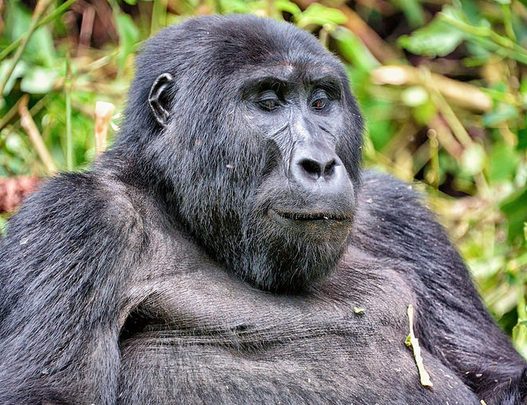
Silverbacks of the Nkuringo Gorilla Group: From Nkuringo to Rwamutwe
Four males have led this family, and each change came with a story.
Nkuringo, the founding silverback, led the group through habituation and was already old when tourists first arrived. He died in April 2008. One widely repeated account puts his age near 49, which would be very old for a wild gorilla, so treat that figure with caution.
His son Safari took charge next, with a second silverback, Rafiki, beside him. Several operators describe the two as brothers. For a while they shared the group, and it was during Safari’s early months in charge that the family’s twins arrived. Then Safari left after a clash with another group and was not seen again by the trackers, leaving Rafiki in charge.
Rafiki’s origins are told two ways. Conservation charities describe him as a lone young male who turned up around 2003 and was accepted into the group, which almost never happens. The Uganda Tourism Board describes him as born into the group in August 1995 to the female Kasotora. Guides tend to tell whichever version they learned. Both agree on the name: Rafiki means friend in Swahili, chosen for his calm manner with people.
A further silverback, Bahati, left around 2011 and went on to lead the Bushaho family, which formed when part of Nkuringo split away. Today the group is led by Rwamutwe, listed in the old roster as an infant and described in several accounts as Rafiki’s younger brother. He was a blackback, not yet a silverback, when he stepped up in 2020, which is why some operator pages from that period said the family had no silverback at all. One operator names Tabu, another male from the old roster, as Rwamutwe’s brother and right hand. IGCP’s latest profile now counts two silverbacks in the group.
Rafiki’s Killing and Its Lasting Effect on the Nkuringo Gorilla Family
Rafiki was reported missing on 1 June 2020. His body was found inside the park the next day, speared in the abdomen. The park was closed to visitors at the time because of the pandemic lockdown, and a group of men had gone in to hunt small antelope.
One of them, Felix Byamukama, pleaded guilty in the Kabale Chief Magistrate’s Court to illegal entry into a protected area, killing a gorilla and killing a duiker. He was jailed for 11 years in July 2020. He had first claimed he acted in self defence when the silverback charged. Wildlife groups said the sentence was lighter than the law allowed, since the case was not heard in Uganda’s specialised wildlife court.
The case drew attention around the world, and it still colours what you hear on a Nkuringo trek. Rangers talk about it openly at the briefing. Community work around Bwindi, from revenue sharing out of permit fees to health programmes in villages on the park edge, is often explained through Rafiki’s story. A statue of him stands in the arrivals hall at Entebbe International Airport, so many visitors meet Rafiki before they ever reach the forest.
For the family, the loss was serious but not fatal. Groups that lose their only silverback sometimes break apart. This one stayed together under Rwamutwe and has since recorded new births.
Nkuringo Gorilla Family Members, Twins and Group Size Today
IGCP’s latest profile records 14 gorillas: two silverbacks, two blackbacks, six adult females, one juvenile and three infants. Operator pages give anything from about 9 to 15. One lists a single silverback with two adult females, two subadults, three juveniles and two babies; another still says nine gorillas under a blackback, which dates from the months after Rafiki died. Births, deaths and young males leaving all move the count, and some members are hard to see on any single visit, so a spread like this is normal.
Twins are the detail people remember. Gorilla twins are rare, and Nkuringo has a recorded set, though accounts of the date disagree. IGCP’s profile says the group was the first in Bwindi to record twins, in December 2004. The African Wildlife Foundation reported twins born to the female Kwitonda in November 2008, usually named Katungi and Muhozi (also spelled Muhoozi). Katungi died before his second birthday. Muhozi survived and appears in later rosters as a blackback.
The roster this page carried for years is below. It reflects the family before Rafiki’s death and is kept as a record, not a current list. Several names, such as Kwitonda, Kuhirwa, Furaha, Kiiza and Tabu, still turn up in recent operator lists, while others have died or moved on.
Three names in that list now matter well beyond it. Christmas, the blackback said to be born on Christmas Day, heads the small Christmas family. Posho gave his name to the Posho family. And Rwamutwe, an infant on the old roster, leads Nkuringo itself. Every gorilla family in Bwindi grows and splits this way; our Bwindi gorilla families hub explains the roles of silverbacks, blackbacks and females in more detail.
Nkuringo Family Behaviour and Gorilla Photography on the Trek
Guides describe the Nkuringo family as calm and close knit, a character that has held through three changes of leader. Mothers keep the infants close, the young males wrestle at the edges, and Rwamutwe tends to rest where he can watch the whole group. Some days the family sits in a clearing near the forest edge; on others it moves steadily through thick growth and your hour is spent following.
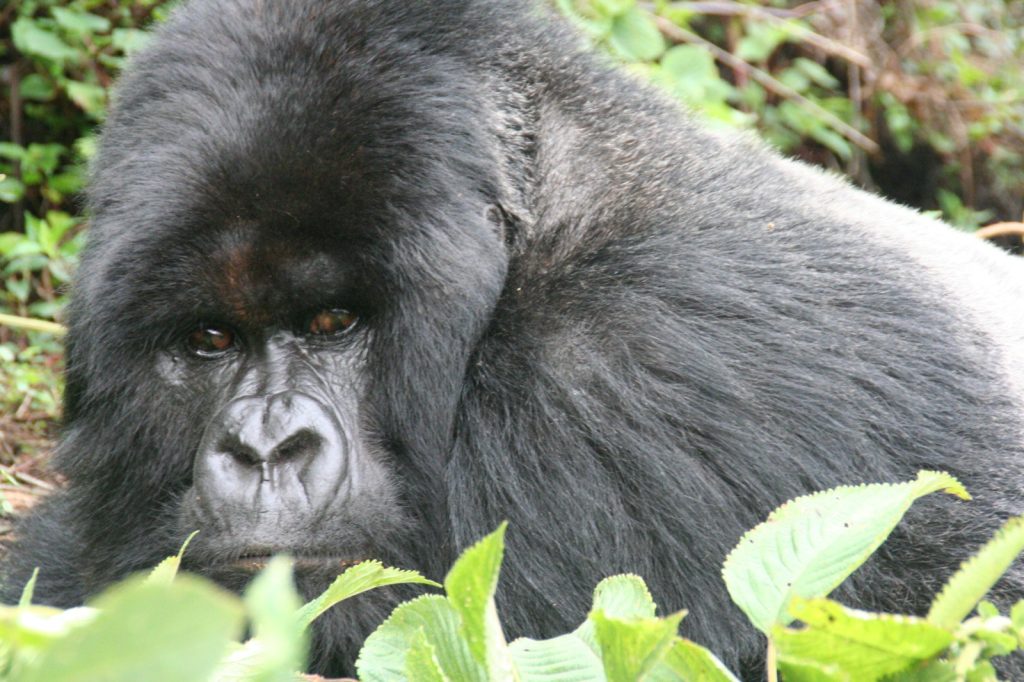
Its crop raiding past still shows. The family uses the buffer zone and the forest margin more than many Bwindi groups, which is one reason treks here sometimes end in open vegetation with better light than the deep forest gives. The newer Posho family, by contrast, is said to keep further inside the trees.
For a gorilla photography trip, Nkuringo has two things going for it: the backdrop of the ridge and, on clear mornings, the Virunga volcanoes before you set off. Use a fast lens or a phone with a good night mode, switch the flash off, and keep one wide frame for the setting. Mud and steep ground make heavy kit a burden, so pack light. Our gorilla trekking and photography guide covers settings and gear.
How Hard Is the Nkuringo Gorilla Family Trek Below Nteko Ridge?
Hard. Of Bwindi’s four sectors, Nkuringo gorilla trekking has the strongest reputation for punishing walks, and the Nkuringo family is a big reason why. The trailhead sits on Nteko Ridge at roughly 2,100 to 2,200 metres, with Bwindi’s forest falling away to the north and the Virunga volcanoes on the horizon to the south. The family spends most of its time far below, in the Kashasha River valley and the buffer zone, roughly 600 metres lower than the road.
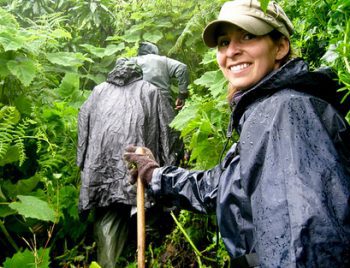
So the trek starts by going down. Steeply, often on zigzag paths through farmland and then forest, which sounds easier than it is; trip reports mention thighs turning to jelly on the descent long before anyone sees a gorilla. After the hour with the family, every metre has to be climbed back up, usually in the warmest part of the day.
Total times vary a lot. On a good day the group feeds close to the forest edge and the round trip takes three or four hours. On others the trackers find it deeper in the valley, and people return after seven hours or more. Our page on trekking difficulty and fitness covers how to prepare, but the short version for Nkuringo is regular hill walking in the weeks before you fly, and a porter for the climb out.
Rain makes it harder still. The wetter months, March to May and October to November, turn the red earth on the farmland sections into something close to grease. June to August and December to February are drier, though rain can fall on any day of the year in Bwindi. Our guide to the best time for gorilla trekking in Uganda goes month by month.
If your knees, heart or breathing are a worry, say so early. Rangers can sometimes allocate a slower walker to a family feeding closer to the ridge, but there are no promises in Nkuringo, and the honest advice for anyone with real mobility limits is to book a different sector.
A Nkuringo Gorilla Tracking Day: Briefing, Trek and the Hour With the Family
The day follows the same shape across Bwindi, with a Nkuringo twist in the middle.
Inside the hour, what you see depends on the morning. Rwamutwe may be resting while infants climb over the females, or the whole family may be on the move. Sightings of every member are not guaranteed, though the trackers’ daily checks mean finding the family at all is very likely. Keep your voice low, no flash, and step back if a gorilla comes towards you; the ranger will guide you.
The rules exist for the gorillas’ health. A cold or stomach bug can pass to them, so anyone visibly ill can be turned away, and the minimum age is 15.
Nkuringo Sector Gorilla Families: Bushaho, Christmas and Posho Treks
For years the Nkuringo family was the only group on the ridge. The sector now has three more, each tied to it by blood or history, and any of them could be the family you are given on a Nkuringo permit. Counts below match our families hub and will drift with births and splits.
Bushaho is the family whose status changes most. Some guides list it for regular trekking, while others name it as one of the families used for the four hour habituation experience, so ask your operator which way it is running when you book. Christmas is a small group, and operators who have tracked it often describe it as calm and easy to watch. A few call Christmas a brother of Rafiki; that is not something the published profiles confirm.
Posho is the one to watch. At around 17 it is the largest family in the sector, and reports say it ranges deeper inside the forest around the Kashasha and Nteko side than the old crop raiding Nkuringo group, which keeps it away from village gardens. Older pages called Posho the biggest family in Bwindi; it is big for Nkuringo, but some Ruhija and Rushaga families are as large or larger.
Each family takes eight visitors a day, so the sector’s daily permits follow the family count: about 24 with three families on the list and 32 once Posho is bookable. That is still fewer than Rushaga, which is why Nkuringo dates fill early in the busy months. The sector page on Nkuringo gorilla trekking covers the area as a whole.
Getting the Nkuringo Family on Your Gorilla Trekking Permit
You cannot book a gorilla family by name. UWA sells gorilla permits by sector, and a Nkuringo permit puts you with one of the sector’s families: Nkuringo, Bushaho, Christmas or Posho. The warden allocates visitors on the morning.
A request helps. Ask your operator to pass it on when they buy the permit, then mention it again at the briefing. Wardens do try to match fitness to distance, so if the Nkuringo family is known to be deep in the valley that week, a fit group is more likely to get it, and a slower walker may be steered to Christmas or Bushaho instead.
Permits are paid in full at the time of booking, and the sector has fewer of them than Rushaga, so popular months fill early. A licensed operator running Uganda safaris through the south can secure the permit, transport and lodge together, and our gorilla safari companies page lists firms to compare. If Nkuringo is sold out, a Rushaga permit is the closest alternative, an hour to an hour and a half away by road, and Rushaga is also where Uganda’s gorilla habituation experience runs.
Nkuringo Lodges and Packing for a Steep Gorilla Trek
Sleeping on the ridge saves an early drive, which matters on a day this long. Clouds Mountain Gorilla Lodge is the upmarket choice, a short walk from the briefing point. Nkuringo Bwindi Gorilla Lodge, which grew from the old Nkuringo gorilla camp, covers mid range and budget travellers, and Gorilla Heights Lodge is another option close by. Some visitors base themselves at Lake Mutanda or in Rushaga instead and drive up before dawn, which adds an hour or more on rough road. Our Bwindi lodges page has the options by tier.
One practical detail: water on the ridge is scarce, and lodges truck it in from Kisoro. Showers can be short. Take the hint and fill your bottles the night before.
For the trek itself, grip matters more than anything. Waterproof boots with deep lugs, gaiters to keep mud and ants out, and a rain jacket that still breathes on the climb back. Gloves save your hands on nettles and thorny vines when you grab vegetation to steady yourself on the descent, and gaiters earn their place here. Pack two litres of water, snacks and a warm layer for the cold start on the ridge. The full kit list is on our gorilla trekking packing list.
Getting to Nkuringo and Other Trips Around the Family’s Ridge
Most people reach Nkuringo by flying to Kisoro and driving up, an hour to an hour and a half over the hills and up to two after heavy rain, or by road from Kigali through the Cyanika border in four to six hours, which makes a two country trip with Rwanda gorilla trekking easy to plan. From Kampala or Entebbe it is a long day of nine hours or more by road through Mbarara and Kabale. Our getting to Bwindi page has the routes, and travellers starting in Rwanda can read about a Bwindi gorilla trek from Kigali.
Every habituated group in the park is listed on our Bwindi gorilla families hub, with profiles of families such as Bitukura in Ruhija and Nshongi in Rushaga.
Off the gorilla trail, villagers near Nkuringo run a community walk that visits a traditional healer, a blacksmith, a homestead and banana beer brewers, and some operators add a visit to a local school. The Ivy River trail links Nkuringo with Buhoma on foot through the forest. The two are only about 10 kilometres apart in a straight line, but the walk runs roughly 14 to 17 kilometres and most of a day, while porters carry bags round by road. Drivers going the other way can cross the middle of the park through Ruhija in a four wheel drive, a ridge route with long views over Bwindi National Park; at Ruhija, birders take the three hour hike down to Mubwindi Swamp. Lake Mutanda and the Batwa cultural trails are close, and Mgahinga Gorilla National Park is about an hour away past Kisoro. Plenty of travellers then fly on for a Masai Mara safari or a Serengeti safari, pairing the forest with the plains.
Nkuringo Gorilla Family FAQ
How much is a permit to trek the Nkuringo gorilla family?
The Nkuringo family is trekked on a standard Uganda gorilla permit: US$800 for foreign nonresidents, US$700 for foreign residents and UGX 300,000 for East African citizens. A low season rate of US$600 for nonresidents and US$500 for foreign residents has been announced for April, May and November; those permits cannot be rescheduled. UWA has suspended its reservation hold, so permits are paid in full when booked. Porters are hired at the trailhead for a fixed daily fee set locally; ask at the briefing.
Who leads the Nkuringo gorilla family now?
Rwamutwe, who stepped up as a young male after the silverback Rafiki was killed by a poacher in June 2020. Your ranger will confirm the current leader on the day.
How many members does the Nkuringo gorilla family have?
About 14 in IGCP’s latest profile, including two silverbacks and six adult females. Operators quote anything from about 9 to 15, mostly because their counts were taken at different times.
How difficult is the Nkuringo gorilla family trek?
Usually harder than treks elsewhere in Bwindi. The family lives in a valley well below the Nteko Ridge trailhead, so you descend steeply and then climb back up. Fit walkers manage it; anyone with knee or heart problems should consider Buhoma or Rushaga instead.
How many gorilla families are in the Nkuringo sector?
Four: Nkuringo, Bushaho, Christmas and Posho, the newest. Bushaho has at times been used for the habituation experience rather than standard trekking, so check how it is listed when you book.
Can I choose the Nkuringo family when I book?
Not directly. Permits are sold for the Nkuringo sector, and rangers allocate families at the morning briefing. You can request the family through your operator and again at the briefing.
Does the Nkuringo family really have twins?
Yes. Twins born to the female Kwitonda were reported in November 2008, and IGCP records the group as the first in Bwindi to register a twin birth, giving December 2004. One twin died young; the other survived to adulthood.
How close do you get to the Nkuringo gorillas?
UWA asks visitors to stay at least 10 metres away and to wear a mask. In Rwanda the rule is 7 metres. Gorillas sometimes move closer on their own; if that happens, step back quietly and follow the ranger.
What is the minimum age for gorilla trekking in Nkuringo?
Fifteen, the same as everywhere in Uganda. Given the steep climb, teenagers should be comfortable on long hill walks before the trip.