A Uganda plug adapter needs to take your plug and fit the British style Type G socket, with three flat rectangular pins, on a 240 volt, 50 hertz supply. The same adapter covers Kenya and most of Tanzania, so one compact Type G unit with USB ports handles a classic East Africa safari. Rwanda is the exception on a gorilla trekking route, with round pin Type C and Type J sockets, which is why many travellers pack a universal adapter instead.
This page covers plugs, voltage and charging in detail. For the rest of the kit list, the Uganda gorilla trekking packing list and the wider African safari packing list take it from here.
Plug Types and Voltage by Country for an East Africa Safari
The table below follows the plug and voltage reference that the International Electrotechnical Commission long published as its World Plugs guide. The IEC has since retired that online tool, so the figures here were cross checked against current country listings. Every country on a typical East Africa safari runs at 230 or 240 volts and 50 hertz. What changes from border to border is the shape of the hole in the wall.
| Country | Plug type | Voltage | Frequency |
|---|---|---|---|
| Uganda | G | 240 V | 50 Hz |
| Kenya | G | 240 V | 50 Hz |
| Tanzania | G and D | 230 V | 50 Hz |
| Rwanda | C and J | 230 V | 50 Hz |
| USA, Canada | A and B | 120 V | 60 Hz |
| UK | G | 230 V | 50 Hz |
Read across the table and the shopping list writes itself. Travellers from the UK need nothing for Uganda, Kenya or Tanzania, because the socket is the same one they have at home. Visitors from North America, continental Europe, Australia, South Africa or Asia need a plug adapter for all three. Anyone continuing to Rwanda needs a second shape as well.
Small differences between 230 and 240 volts do not matter to travel electronics. The gap that matters is between roughly 120 volts in North America and 240 volts here, covered in the voltage section below.
The Type G Socket on a Uganda Safari Trip
Type G is the British standard: three thick rectangular pins set in a triangle, with the earth pin at the top. So yes, the Uganda plug is the same as the UK plug. You will find it in Kampala hotels, Entebbe guesthouses and the lodges around Bwindi, from simple bandas in Buhoma to the top end properties on a Bwindi gorilla trekking safari. Trip reports from Kenya and Tanzania say the same thing about safari camps there, high end lodges included.
A few details trip up first time visitors.
The socket has shutters over the live and neutral holes, and the longer earth pin pushes them open. An adapter needs a real or dummy earth pin to work, which every proper Type G adapter has. Cheap two pin converters from a market stall sometimes do not, and travellers end up jamming a pen into the earth hole. Do not do that.
Many sockets also have their own switch. If your phone is not charging, check that the little rocker next to the socket is on before blaming the adapter. Older wall sockets can be loose, too, so a heavy universal adapter with a charger hanging off it may sag or drop out. A compact adapter, or a short extension lead plugged into the wall, sits far better.
Type G plugs carry a fuse, usually 3 or 13 amps. That matters if you buy a local extension lead or multi socket in Kampala or Nairobi: a blown fuse is the commonest reason one suddenly stops working, and supermarkets sell replacements.
Plug Adapters by Home Country for a Uganda Safari
What you pack for a Uganda safari depends on the plug you start with. The socket here does not change; your side of it does.
Adapter or Voltage Converter for Your Safari Electronics
An adapter changes the shape of your plug. It does nothing to the electricity. A voltage converter changes 240 volts down to 120, and most safari travellers do not need one.
Turn your charger over and read the small print. If it says Input: 100 to 240V, 50/60Hz, the device is dual voltage and works anywhere in Africa with only a plug adapter. Phones, tablets, laptops, camera battery chargers, e readers, headlamp chargers and electric toothbrush bases almost all fall into this group. Most modern beard trimmers do too.
The trouble sits with anything that heats. A single voltage American hair dryer, curling iron or straightener rated at 110 or 120 volts will overheat or burn out within seconds on a Ugandan socket. A converter big enough to run one is heavy, and most bush camps cannot supply that load anyway. Buy a small dual voltage travel hair dryer, ask the lodge whether it supplies one, or go without for a week. Plenty of travellers say the third option was easier than expected.
If you truly need to run a 120 volt appliance, match the converter to the load. Travel step down converters usually carry two ratings: a low setting of around 50 to 200 watts for electronics and a high setting of up to about 2,000 watts for heating appliances that only run for a few minutes. A 220 to 110 volt step down travel converter of that kind weighs far more than an adapter, and some are sold as combined adapter and converter units. Heavier transformer types suit electronics left running for hours. Check the converter’s watt rating against the label on the appliance, never the other way round.
Frequency is the other number. East Africa runs at 50 hertz against 60 in North America. Phone and camera chargers do not care. Most travel converters change only the voltage, not the frequency, so motorised devices, older clocks and some shavers can run slow or warm even on a converter. That is another reason to leave mains gadgets at home.
Medical devices need their own check. Many modern CPAP machines and their chargers are dual voltage, but not all, and a camp generator that switches off at night will not run one. Read the label, ask each lodge or camp about overnight electricity before you book, and talk to the maker about a battery option for remote camps.
Choosing the Best Travel Adapter for a Uganda, Kenya or Tanzania Trip
The right adapter depends on where your safari trip goes and how many devices you carry. Four types cover nearly every itinerary.
A dedicated Type G adapter. If your route stays within Uganda, Kenya and mainland Tanzania, a small single country plug is the lightest choice and the least likely to fall out of a loose socket. Search for a US to UK Type G plug adapter with USB from North America, or a EU to UK Type G travel adapter from Europe. Buy a grounded version if any of your chargers has a third pin; ungrounded two pin models only accept two pin plugs. Brands that keep coming up include TESSAN, HANYCONY and Ceptics, whose ultra compact Type G adapters sit flush in the wall. A Type G adapter with a USB C fast charging port lets you leave the separate phone brick at home.
If you want outlets next to the USB ports, a US to UK adapter with three outlets and three USB ports turns one socket into a small charging station, which helps in tents with a single point.
A universal travel adapter. This is the usual pick when Rwanda, Zanzibar or a stopover in Europe is also on the route. Slide out the British pins for Uganda and Kenya, the European pins for Kigali and Musanze. Makers such as Epicka, Ceptics and Skross sell versions with several USB ports built in. Look for a universal travel adapter with USB C fast charging, a built in fuse and a compact body. Newer GaN models such as the MOMAX 70W GaN universal adapter, or a 100W GaN universal adapter with an AC outlet, can charge a laptop and two phones at once. The cheapest universal units are bulky and loose in Type G sockets, which is the complaint that comes up most in reviews. Note too that none of them is a voltage converter, whatever the box suggests.
An Africa adapter kit. Multi country itineraries that add Victoria Falls, Botswana or South Africa need the large round pin Type M, which most universal adapters do not include. An Africa travel adapter kit with Type M and Type G clips the right head onto one body. Specialist travel shops also sell Uganda kits with two grounded adapters and a surge protected strip, which suits a family.
A wall charger with swappable pins. Phone and camera users who carry little else can skip the adapter and buy a multi port charger with interchangeable plug heads. A GaN USB C travel charger with interchangeable plugs from brands such as Anker or Ugreen charges a phone, a camera battery and a laptop from one socket, and weighs less than an adapter plus three separate bricks.
For laptops and camera chargers that draw more, look at the USB C wattage. A port rated at 20 watts or more charges a phone quickly; laptops usually want 45 to 65 watts. Cameras that charge in body over USB C, as many recent Sony, Canon, Nikon and Fujifilm models do, can then share the same cable.
Whatever you choose, pack two. Adapters get left behind in lodge rooms, and a replacement is easy to find in Kampala, Nairobi or Arusha but not in Buhoma or the Serengeti. One goes in the duffel, one in your hand luggage.
Grounded, Polarised and Fused: Safe Adapters for Safari Lodges
Three words on the packaging decide whether a safari adapter is safe to leave charging overnight in a tent.
Grounded. A grounded adapter carries the earth connection through from a three pin plug, which laptops and some camera chargers use. A non grounded adapter only accepts two pin plugs, and forcing a three pin plug into one is a bad idea. If in doubt, buy grounded: it takes both.
Polarised. Many North American plugs have one blade wider than the other. A polarised adapter accepts that wide blade and keeps live and neutral the right way round. Cheap adapters sometimes only take two narrow blades, so a polarised plug will not go in.
Fused and marked. A proper Type G adapter has a fuse inside, as British plugs do, and a recognised safety mark such as CE or UKCA. Unmarked adapters with no fuse are the ones travellers report scorching. Spend a little more and check the marking before you leave home.
Plugs for Rwanda Gorilla Trekking and Cross Border Trips
Plenty of gorilla safaris cross between Uganda and Rwanda, often flying into Kigali and driving to Bwindi through the Katuna or Cyanika border. That is where a single Type G adapter stops working.

The IEC plug reference listed Rwanda as using Type C, the slim round two pin European plug, and Type J, the Swiss three pin, at 230 volts and 50 hertz. In practice the socket most visitors meet in Kigali hotels and Volcanoes National Park lodges takes a round two pin plug, while some newer buildings fit British style sockets as East African standards converge. A traveller with a universal adapter, or a Type G adapter plus a small Type C European plug adapter, is covered either way. The Rwanda gorilla trekking packing list covers the country’s other quirks, and Rwanda gorilla trekking explains the park itself.
Are Type C and Type F the same? No, and the difference matters in Rwanda. Type C is the thin, unearthed two pin Europlug. Type F, the German Schuko plug, has thicker round pins and earthing clips on its sides. A Type C plug fits a Type F socket, but a Type F plug will not go into a plain Type C or a Swiss Type J socket. So a German or French traveller whose charger has a bulky earthed plug may still need a slim Type C adapter in Kigali, while a flat Europlug phone charger fits straight in.
Continental European travellers with slim two pin chargers have it easiest here: their own plugs fit Rwanda, and they need a Type G adapter only for the Uganda half. Visitors heading to the Congo side of the Virungas should expect the same round pin pattern as Rwanda.
Plugs on Multi Country Safari Tours in Tanzania, Zambia and Southern Africa
Tanzania is officially Type G and D. Type D is the old British round three pin, and it turns up in some older hotels and the odd camp. Most travellers on a Serengeti safari never see one, and a universal adapter with Type G covers the rest. Zanzibar follows the mainland, so the same adapter works on a beach extension after the parks, as on a Tanzania safari and Zanzibar holiday.
Kenya is simpler still: Type G throughout, including the camps on a Masai Mara safari, which makes gorillas plus the Mara one of the easiest combinations to pack for.
Further south the picture changes. Zambia and Zimbabwe, the two sides of a Victoria Falls safari, mostly use Type G with some round pin Type D. South Africa, Namibia and much of Botswana use the large round three pin Type M, and South Africa is moving to the newer compact Type N. A Botswana leg such as an Okavango Delta safari calls for the Africa kit above, not a standard universal adapter, unless your camp confirms it has universal sockets.
Charging Cameras and Phones at Safari Lodges, Camps and in Vehicles
Having the right plug is half of it. The other half is knowing when and where the electricity runs on a safari tour, because a bush camp is not a city hotel.
Lodges in Bwindi and other forest parks. Most rooms have at least one socket, and many lodges run on mains with a generator or solar backup. Outages happen across the region, sometimes daily, and a fridge or a charger that stops for an hour is normal. Trekkers who need a full camera battery at dawn charge the night before and carry spares. The safari lodges page describes the main properties near the park.
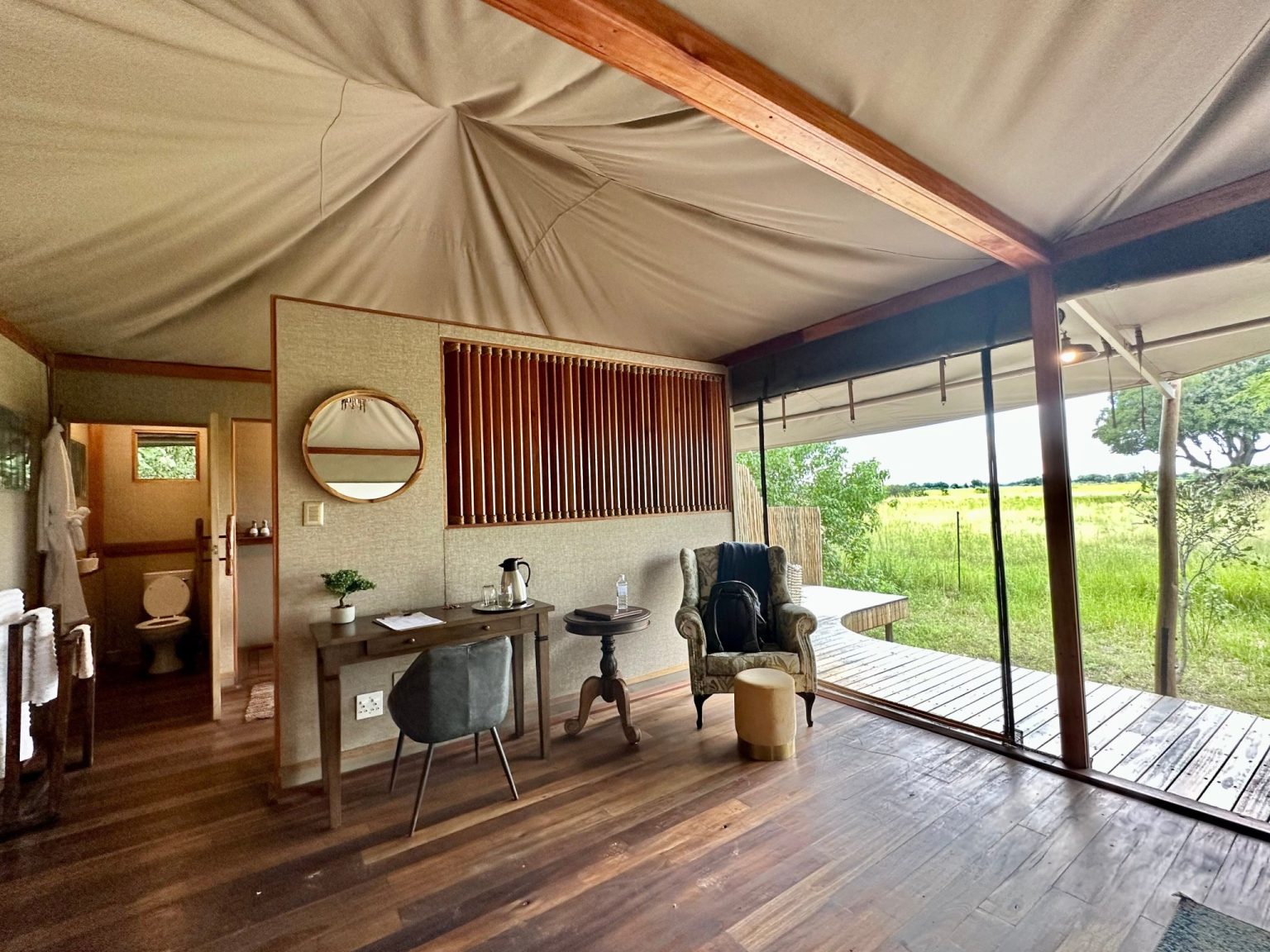
Tented camps. Many run on solar or a generator that switches off late in the evening and comes back before dawn. Some tents have sockets; others have none, and guests charge at a shared bank of sockets in the main mess tent, often next to the bar. A few remote camps provide only a rechargeable lantern in the tent. Ask each camp before you go, and plan to charge everything during the midday break between drives.
This is where a compact multi socket travel extension with USB earns its space. One adapter in the wall, then three or four devices off the strip, so you are not queueing with other guests at the one free socket. Pick one with surge protection: several travellers report flickering supplies at camps on generator, and a protected strip is cheap insurance for a laptop. UK travellers, or anyone happy to plug a strip straight into a Type G socket, can use a 13A UK extension strip with USB and a short cord, which also solves the problem of a socket hidden behind the bed.
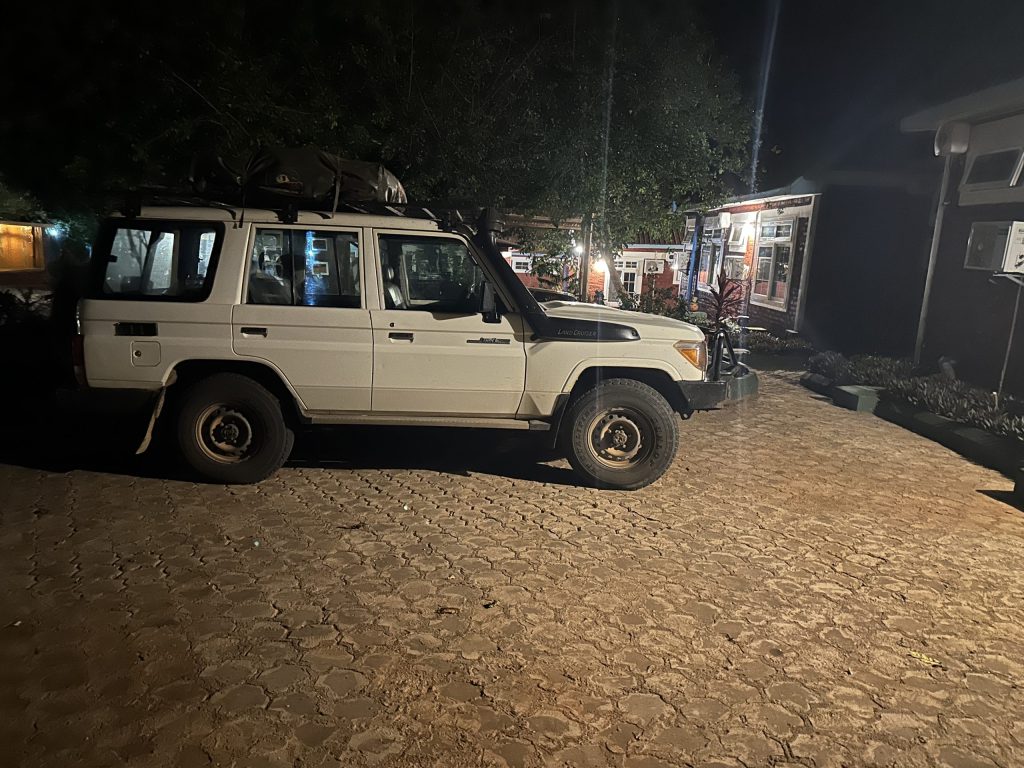
Safari vehicles. Many Land Cruisers used in Uganda, Kenya and Tanzania have a 12 volt socket or USB ports near the seats, and some carry an inverter with a household style socket. It is not universal. A 12V car charger with USB C plugs into the cigarette lighter socket and charges phones and in body camera batteries on long transfers, such as the road between Kampala and Bwindi. Check with your operator what the vehicle has.
Battery packs. A 20,000mAh portable charger with USB C covers a full day of phone photography or several in body camera charges. Under IATA’s current passenger guidance, battery packs travel in hand luggage only, you may carry two of 100 watt hours or less without approval, and they may not be recharged from the aircraft’s sockets; almost every phone sized pack fits. Light aircraft operators in East Africa follow the same rule, so keep it out of the duffel that goes in the pod.
For remote camping trips, a small foldable solar charger panel strapped to a daypack or a vehicle roof tops up a battery pack. It is a backup, not a replacement, and it does little under Bwindi’s forest canopy.
What Not to Pack for Charging on a Gorilla Trekking Safari
A few items cause most of the problems, and most of them are bought in a hurry the week before departure.
Heavy voltage converters. Unless you are carrying a single voltage medical device, you do not need one, and they weigh as much as a pair of boots. Bush flights limit you to about 15 kg, hand luggage included, as the safari duffel bag guide explains.
Unfused multi plug cubes. The cheap cube that turns one socket into three with no fuse and no surge protection is the item that melts. Spend a little more on a fused, certified strip.
Chunky all in one universal adapters. The biggest ones hang off a loose Type G socket and fall out overnight. Lighter designs, or one short extension lead, avoid it.
Single voltage hair tools. Covered above, and still the most common casualty.
Plastic bags for cables. Rwanda, Kenya and Tanzania ban plastic carrier bags and Uganda restricts the thin ones, so keep chargers and adapters in a fabric pouch or a small waterproof travel electronics organiser.
Packing and Looking After Your Adapter on Safari
Dust gets into everything on a game drive, adapters included. Keep the adapter, cables and battery pack in one pouch inside your gorilla trekking daypack, and blow the dust out of the pins if it starts to feel gritty. A cable that frays at the plug end will not be replaceable in a park, so bring one spare USB C cable and one spare lightning or camera cable.
Label everything with tape or a coloured cable tie. On group trips, five identical black chargers on one strip in a mess tent is how things go missing. At checkout, look behind the bedside table and in the bathroom socket, the two places adapters are left most often.
Charge in a routine: camera batteries and the battery pack first, phone second, everything else last. If the generator goes off at night, the items that matter for the morning trek or game drive are already full. Camera owners will find more on spare batteries and memory cards in the best camera for safari guide, the gorilla trekking packing list shows where the adapter pouch fits in the full kit, and what to wear gorilla trekking covers the clothing side of the bag. For the rest of the kit, our gear and clothing guide sorts every buying guide by need.
Uganda Plug Adapter FAQs
What plug adapter do I need for Uganda?
A Type G adapter, the British three pin design. Uganda runs on 240 volts at 50 hertz. Travellers from the UK need no adapter; visitors from the US, Canada, Europe, Australia, South Africa and most of Asia do.
What type of electrical plug is used in Uganda?
Only Type G: three flat rectangular pins in a triangle, with a fuse in the plug and shutters on the socket. You will not find round pin sockets in normal use in Uganda’s hotels and lodges.
Is the Uganda plug the same as the UK plug?
Yes. Both use Type G, and the voltage is close enough that British devices work without any adapter or converter in Uganda, Kenya and Tanzania.
Is the same adapter fine for Uganda, Kenya and Tanzania?
Yes. All three use Type G, so one adapter covers a Uganda gorilla trek followed by a Kenya or Tanzania safari. Tanzania also has some older round pin Type D sockets, but they are uncommon in the hotels and camps safari travellers use.
Do I need a voltage converter for a safari in East Africa?
Usually not. If your charger says 100 to 240V, it works with a plug adapter alone. Only single voltage 110 to 120V appliances, mostly hair dryers and straighteners, need a converter, and it is simpler to leave them at home or buy dual voltage versions.
Should I buy a Uganda plug adapter with USB C?
It is worth it. A Type G adapter with a USB C fast charging port of 20 watts or more charges a modern phone quickly and frees the wall plug for a camera charger, which helps in camps with one socket per tent.
What plugs does Rwanda use for gorilla trekking?
Type C and Type J at 230 volts. Most hotel and lodge sockets take the round two pin European plug, and some newer buildings have British style sockets. A universal adapter covers both Uganda and Rwanda on a combined gorilla trip.
Can I charge my camera at lodges near Bwindi?
Yes. Lodges near the trekking sectors have sockets, usually in the room and always in the main building, though outages happen and some properties run on solar or generator. Charge the night before your trek and carry at least one spare battery.
Can I buy a travel adapter in Uganda?
In Kampala and Entebbe, yes: supermarkets and electronics shops sell Type G adapters and extension leads. Near the parks the choice is thin. Some hotels lend adapters at reception, but do not count on it.
How much does a good travel adapter for Africa cost?
As a rough guide on Amazon, a single country Type G adapter runs about US$10 to US$20, a universal adapter with USB about US$20 to US$35, an Africa kit with Type M about US$20 to US$40, and a GaN multi port charger with swappable plugs about US$40 to US$70. Prices change often, so check current listings.