The best safari hat is a crushable nylon hat with a brim of at least 7.5 cm (3 inches) all round, a UPF 50+ rating, a chin cord and a vented crown, in khaki, olive or stone. Sunday Afternoons’ Ultra Adventure and Tilley’s Airflo are the models most often recommended, and a Columbia booney covers a tight budget. On open game drives in the Serengeti, Masai Mara and Okavango, and on gorilla treks in Bwindi, it is the piece of kit you wear most.
Equatorial sun at altitude burns faster than most visitors expect, even on a cool morning, and an open roof hatch turns a loose hat into a lost one within minutes. Below you will find what to look for, the models worth shortlisting, which style suits which trip, how to get the size right and what to skip. For the rest of your outfit, see our guide to what to wear on safari; for the forest version, read the gorilla trekking clothing guide. Men can build the rest of the outfit with our guide to safari clothes for men.
What Makes a Good Safari Hat: Brim, UPF, Chin Cord and Airflow
A safari hat has four jobs on a game drive. It shades your face, ears and the back of your neck. It stays put in a moving vehicle. It lets heat escape from your head, and it survives being crushed into a soft duffel. Anything beyond that is a bonus, pleasant but optional.
Outdoor testers who score sun hats tend to weigh the same things in roughly the same order: protection first, then comfort, breathability, packability and durability, with style a distant last. That order suits a safari well, with one addition the testers rarely stress. Wind.
A practical fit test comes up again and again in traveller forums: with the hat on, you should be able to slide two fingers flat between the band and your forehead. Tighter than that gives you a headache by lunch. Looser, and even a good chin cord struggles.
Best Safari Hat Picks by Brand and Budget
Pick the style first, then the model. With that said, the same handful of names keeps coming up in independent sun hat tests, safari outfitter advice and traveller threads, and these are the safari hats worth shortlisting. Each link opens an Amazon search for that model so you can compare current colours, sizes and sellers.
What do these have in common? Almost every one carries a chin cord, a brim near 7.5 cm and a fabric that dries quickly. Brand matters far less than those three things.
Safari Hat Materials for Game Drives: Nylon, Cotton Canvas, Felt, Leather and Straw
Material decides how a safari hat handles heat, rain, dust and packing on a typical East or Southern African safari. Here is how the common options compare.
| Material | Heat | Rain | Packs well |
|---|---|---|---|
| Nylon | Cool | Dries fast | Yes |
| Cotton canvas | Warm | Slow to dry | Fairly |
| Polyester mesh | Coolest | Dries fast | Yes |
| Wool felt | Hot | Sheds rain | Poorly |
| Leather | Hot | Sheds rain | Poorly |
| Straw | Cool | Poor | Only rollable |
Nylon is the default for most safari travellers: light, quick to take a UPF finish, dry within minutes after a shower or a sink wash, and happy to be squashed. Cotton canvas has the classic bush hat look and a softer feel. It blocks sun well when the weave is dense, yet holds sweat and stays damp for hours in the green season. Lightweight polyester with mesh panels runs coolest of all, at the cost of a more technical look.
Felt and leather outback hats look the part and shed rain. They are also hot on a midday drive, heavy against a 15 kg bag limit and awkward to pack, although crushable wool felt versions exist. If you love the look, a crushable wool felt outback hat survives a duffel better than a stiff one. Straw hats breathe well and suit lodge afternoons, though most cannot be crushed and a loose weave lets light through.
Best Safari Hat Types and Which Traveller Each Suits
Most good safari hats fall into a handful of types. Pick the type first, then the brand. Each link below opens an Amazon search for that style.
So what are safari style hats called? The names overlap. A bush hat is the broad, soft brimmed canvas or cotton hat most people picture. A boonie or booney is the floppier military derived version with a stitched brim. An outback hat is the Australian shape in leather or felt, often with one side able to pin up, and a safari fedora or Panama is the dressier pinched crown version in straw or canvas. Caps with a fabric flap at the back are sometimes sold as legionnaire or flap caps.
Then there is the old pith helmet, also called a sola topi. It belongs to the colonial era of the safari, when cork and pith helmets were standard issue, and it has no practical place on a modern trip. A wide nylon brim does the same job at a fraction of the weight.
Choosing a Safari Hat by Trip: Game Drives, Walking Safaris, Boat Safaris and Gorilla Trekking
The right hat depends on what your safari actually involves. One good wide brim nylon hat covers most itineraries, but a few trips change the priorities.
Vehicle game drives in the Serengeti or Masai Mara put wind first. With the roof up, you stand for long stretches and the breeze grabs any brim. Wear the cord, and expect to tip the hat back when you lift binoculars or a long lens, since a very wide brim can bump the eyecup. Several travellers simply push the hat onto their back, held by the cord, for the minutes they spend shooting.
Walking safaris in Zambia, Zimbabwe or the Kruger wilderness trails add hours of direct sun with no roof at all. Coverage matters most here, so a wider brim or a neck cape earns its place, and guides expect muted colours.
Boat trips are different again. On a mokoro in the Okavango Delta or a launch on the Chobe, sun reflects off the water from below, so a dark underbrim helps, and a hat that floats can be fished out if it goes over the side. Look for floating UPF sun hats if your trip includes water days.
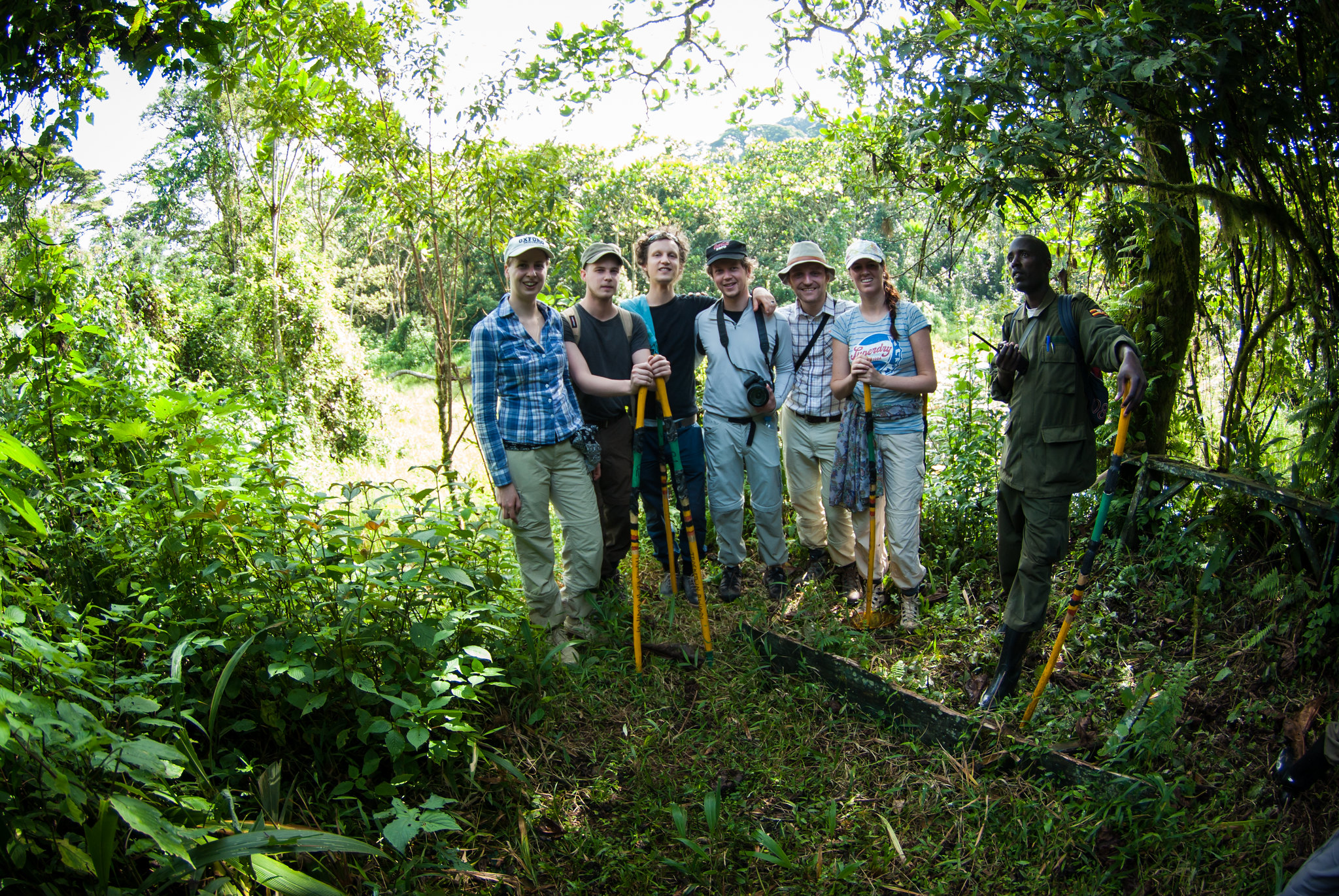
On a gorilla trekking safari in Bwindi or Volcanoes National Park, the hat stops water dripping from wet leaves down your collar and takes the first knock from low branches. A crushable brim works better than a stiff one under the canopy, and the cord saves it on steep slopes. The same hat then shades you on open stretches through tea and farmland. Our gorilla trekking packing list covers the rest of the forest kit, and the African safari packing list handles the savannah half of a combined trip.
Safari Hats for Women, Men and Children: Fit, Sizing and Ponytails
Most safari hat styles are unisex, and the choice comes down to fit rather than gender. A few details make a real difference on the trip.
Women with long hair often find a hat sits badly over a ponytail. Some designs have a rear opening or an adjustable drawcord at the back, which lets the hat sit level. Search women’s wide brim safari hats with a ponytail opening. Plenty of women prefer a slightly narrower, curved brim for style in camp and switch to a wider one for long drives, which is fine as long as the drive hat has a cord. Hat makers’ women’s ranges lean towards straw sun hats, Panamas and crushable felt outback shapes, which look good at the lodge and less good in a 40 km/h breeze. Our guide to safari clothes for women covers the rest of the outfit.
Large heads are a common complaint. Many hats come in a single adjustable size that stops at around 59 to 60 cm, and men with bigger heads end up with a hat perched on top that blows away. Measure around your forehead and check the size chart, or look for extra large wide brim sun hats. Hats sold in fitted sizes, as Tilley’s are, suit people between standard sizes.
To measure, run a soft tape around your head about a finger’s width above the eyebrows and over the bumps at the back, where the band will sit. Round up if you fall between two sizes; a thin foam strip inside the band can take up slack, while nothing fixes a hat that is too small. The chart below shows a typical conversion. Letter sizes vary by maker, so check each brand’s own chart.
| Letter size | Head (cm) | Head (in) | US fitted |
|---|---|---|---|
| S | 55 to 56 | 21.7 to 22 | 6 7/8 to 7 |
| M | 57 to 58 | 22.4 to 22.8 | 7 1/8 to 7 1/4 |
| L | 59 to 60 | 23.2 to 23.6 | 7 3/8 to 7 1/2 |
| XL | 61 to 62 | 24 to 24.4 | 7 5/8 to 7 3/4 |
| XXL | 63 to 64 | 24.8 to 25.2 | 7 7/8 to 8 |
Children burn quickly and lose hats constantly. A kids’ UPF safari hat with a chin strap in a bright enough colour to spot in the vehicle footwell, but still neutral outdoors, is worth buying before you go. Our family safari guide covers the rest of travelling with children, and the safari gear for kids page goes item by item.
Already own a hat that fits but has no cord? An adjustable hat chin cord clips onto most brims and fixes the problem cheaply.
Warm Hats for Cold Morning Game Drives
Here is the part people forget. A sun hat does nothing on a 6am game drive on the Ngorongoro crater rim, in the Okavango in July, or in the Kruger during the southern winter, when the air in an open vehicle can feel close to freezing. Your ears take the worst of it.
Pack a thin beanie as a second hat. A lightweight merino wool beanie weighs very little, does not itch, and fits under a hood or in a jacket pocket. By mid morning it goes into the daypack and the brimmed hat comes out. Gorilla trekkers starting in Ruhija, Nkuringo or the higher sectors of Volcanoes often want one at the briefing as well.
That answers the common question of how many hats to take. Two: one brimmed safari hat that does everything in daylight, and one beanie for dawn. A third, dressier hat for the lodge or the beach is a luxury, not a need, and on a 15 kg bag it is usually the first thing to go.
Safari Hat Colours, Insects and Camouflage Rules
Colour matters more for a safari hat than people assume, because it sits at the top of your silhouette. Khaki, olive, stone, tan and sand blend with dry grass and hide red dust, which makes them the best colours for a safari hat. White shows every mark within a day. Dark blue and black attract tsetse flies, which bite hard in parts of the Serengeti, Tarangire, the Okavango and much of Zambia and Zimbabwe, so leave a navy cap at home.
Camouflage is the firm rule. Military pattern clothing, including caps and hats, is banned for civilians in Uganda and Zimbabwe and widely reported as restricted or discouraged in Tanzania and Zambia. A camo hat can lead to an awkward conversation at a checkpoint, so choose plain khaki instead.
Insects are the other consideration. Some hats come treated with permethrin, a repellent bonded into the fabric that deters mosquitoes, tsetse flies and ticks for a set number of washes; several big hat brands sell mesh bucket hats treated this way. A permethrin treated sun hat is worth a look in tsetse country and malaria areas, alongside repellent on your skin. For dusk walks near swamps or a night in a riverside camp, a fine mesh head net that fits over the brim weighs almost nothing. The guide to the best insect repellent for Africa covers treated clothing in more detail.
Safari Hats That Let You Down on the Trip
A few hats cause trouble on safari time after time. A baseball cap is the most common: comfortable and familiar, it leaves your ears and neck in full sun all day, and its peak catches the wind like a sail. It is fine for a forest trek under the canopy, much less so for a week of open game drives. If you cannot give up a cap, testers suggest two workarounds: a cap with a clip on neck cape, or a buff pulled up over the neck and ears under an ordinary cap, worn with a long sleeved sun shirt.
Stiff hats with no cord blow off. Heavy felt and leather hats run hot and use precious kilos on a bush flight. Loose straw hats let sunlight through the weave and fall apart after one crushing in a duffel. Very wide fashion brims flop over your eyes in the wind and bump into binoculars. Anything in camouflage, black or bright white works against you for the reasons above.
Skip novelty pith helmets as well. They are bulky, hot and impossible to pack.
Hats are not the only thing travellers regret taking. The usual list of what not to bring on an African safari runs to hard shell suitcases that will not fit a bush plane pod, camouflage of any kind, bright white or dark blue clothing, single use plastic bags (banned outright in Kenya, Tanzania and Rwanda), and more outfits than a lodge laundry service makes necessary.
Packing and Caring for Your Safari Hat on Bush Flights
Small planes between safari airstrips in Kenya and Tanzania usually allow about 15 kg per person in a soft bag, and a rigid hat box will not fit the cargo pod. The simplest answer is to wear your hat on every flight. If it must go in the bag, crush it flat, fill the crown with socks and pack it between soft clothes, or slip it inside a packing cube on top of your duffel. The safari duffel bag guide explains the soft bag rule.
Dust is the main cleaning job. Brush or shake it out after each drive. Most nylon and cotton hats hand wash in cool water with a little soap and dry overnight in camp; leather and felt need only a brush and a damp cloth, plus an occasional coat of leather hat waterproofing spray to keep them shedding rain. Keep wet straw out of direct heat or it can warp. If you leave your hat behind, craft markets in Arusha, Nairobi, Kampala, Kisoro and Musanze sell basic brimmed hats, though UPF ratings and chin cords are rare there.
Weight is covered in full in our African safari packing list, and the safari gear and clothing section has guides to rain jackets, boots and daypacks.
Sun Protection on Safari Beyond the Hat
Even the best hat only shades your head. Reflected light off pale grass, sand and water still reaches your chin, nose and forearms, so pair it with a high factor sunscreen and SPF lip balm. A sweat resistant SPF 50 sunscreen that does not run into your eyes is worth the search. Polarised wrap around sunglasses and a buff over the neck finish the job; both appear in our safari clothing guide. Long sleeves in a UPF fabric cover the forearms on long drives, and our safari pants guide deals with the lower half. The safari camera and binoculars guide covers the optics you will be lifting under that brim, with more detail in the best binoculars for safari. Pair the hat with one of the best safari shirts for full sun cover.
What is the best safari hat for a game drive?
A quick drying nylon hat with a brim of about 7.5 cm all round, a UPF 50+ rating, a vented crown and a chin cord. It handles sun, wind and dust in an open vehicle and crushes into a soft bag. Sunday Afternoons’ Ultra Adventure is the current favourite of independent testers, with Tilley’s Airflo LTM6 the premium choice and Columbia’s Bora Bora booney the budget one.
What are some popular brands of safari hats?
Tilley, Sunday Afternoons, Outdoor Research and Columbia lead for technical nylon hats. Stetson, Scala and Dorfman make classic outdoor and Panama styles, Barmah is known for squashable leather and canvas hats, and specialist safari outfitters sell their own canvas and leather ranges.
What color is best for a safari hat?
Khaki, olive, tan, stone or sand. Avoid dark blue and black in tsetse fly areas, bright white because it shows dust, and any camouflage print, which is banned for civilians in Uganda and Zimbabwe.
What are safari style hats called?
Bush hat is the general name. The family also includes the boonie, the Australian outback hat, the safari fedora or Panama, the legionnaire style flap cap and the historic pith helmet, or sola topi, which is now a costume piece rather than practical kit.
How much does a good safari hat cost?
Prices change often, but as a rough guide budget boonie and bucket hats sit around US$15 to US$35, mid range nylon safari hats from outdoor brands around US$35 to US$70, and premium hats with lifetime guarantees, leather outback hats and felt hats around US$80 to US$130 or more. A mid range nylon hat is enough for most safaris.
Do I really need a chin strap on safari?
Yes for open vehicle game drives and boat trips. Wind through a pop up roof or across a river lifts most hats, and you cannot get out of the vehicle to fetch one. Wear the cord loose behind your head or under the jaw, and tighten it only when the vehicle speeds up.
Is a baseball cap good enough for an African safari?
Not on its own. A cap shades your eyes but leaves your ears, cheeks and neck exposed for hours, and equatorial sun at altitude burns fast. It works under a forest canopy on a gorilla trek, but bring a wide brim hat for game drives and walking safaris, or add a neck cape.
Is a Tilley hat worth it for a safari?
For frequent travellers, often yes. Tilley hats come in fitted sizes, the Airflo LTM6 is light and well ventilated, and the brand labels its hats guaranteed for life. For a single trip, a cheaper nylon hat with the same brim and cord does the job just as well.
Is a cotton or nylon safari hat better?
Nylon for most trips, because it is lighter, cooler and dries in minutes after rain or a wash. Cotton canvas feels softer and looks classic, but it holds sweat and dries slowly in the green season.
Can I use the same hat for gorilla trekking and a savannah safari?
Yes. A crushable nylon hat with a cord and a moderate brim works in the forest, where it keeps drips off your neck, and on the plains, where it shades you. Very wide or stiff brims are awkward under the canopy, so a moderate brim of around 7.5 cm is the best compromise.
How many hats should I pack for a safari?
Two for most trips: a brimmed safari hat for daylight and a thin beanie for cold dawn drives and early gorilla briefings. A dressier straw hat for the lodge or the beach is optional and the first thing to drop on a 15 kg bush flight allowance.
What not to bring on an African safari?
Camouflage clothing, hard shell suitcases on fly in trips, single use plastic bags, bright white and dark blue clothes in tsetse areas, and a stiff hat with no chin cord. Leave valuables you do not need at home and pack for the lodge laundry rather than a fresh outfit every day.
Should I pack a beanie for a safari in Africa?
Yes for dawn game drives in the Serengeti, the Mara, Ngorongoro, Botswana and the Kruger between June and August, and for gorilla treks that start in the higher sectors. A thin merino beanie fits in a pocket and keeps your ears warm until the sun takes over.
Can I buy a safari hat in Africa instead?
Yes, craft markets and lodge shops in Arusha, Nairobi, Kampala, Kisoro and Musanze sell brimmed hats. Choice is limited and few have a UPF rating or a chin cord, so buying before you travel gives you more options and time to check the fit.