A luxury Kenya safari costs about US$625 to US$1,100 per person a night at premium conservancy camps, plus a conservancy fee of around US$130, and US$1,850 to US$2,750 at flagship lodges such as Angama Mara, with meals, drinks and game drives in the rate. Most travellers book it as a fly in safari through a specialist operator. Kenya’s top camps sit in the Masai Mara, Laikipia and Samburu.
Every figure here comes from the camps’ own rate sheets, the Mara fee schedule and airline fare sheets, in US dollars per person sharing unless stated. For prices at every level, start with our Kenya safari cost guide; for the reserve on its own, our Masai Mara safari cost page goes camp by camp. If you are weighing Kenya against Botswana or Tanzania at the top end, our guide to the best luxury African safari tours compares them.

Luxury Kenya Safari Cost per Night by Camp Tier
On a luxury Kenya safari the camp is the trip, and usually well over half the bill. Kenya’s top camps publish rack rates per person per night, and those rates fall into clear bands once you line them up.
| Camp tier | Per night | Example |
|---|---|---|
| Classic river camp | US$453 to 998 | Governors’ Camp |
| Top river camp | US$667 to 1,592 | Il Moran |
| Mara conservancy | US$625 to 1,095 | Kicheche |
| Laikipia rhino camp | US$570 to 860 | Kicheche Laikipia |
| Family run classic | From US$1,000 | Cottar’s |
| Flagship lodge | US$1,850 to 2,750 | Angama Mara |
Those numbers are not like for like, which is the first thing to grasp when comparing quotes. Governors’ Camp on the Mara River is full board plus: meals, soft drinks, beer, house wine and non premium spirits, laundry and shared drives, but not the reserve ticket or a nightly community fee, listed on its sheet at about US$50 per adult. Kicheche includes meals, drinks, drives, walks and airstrip transfers, then adds a conservancy fee of US$130 per adult a night in the Mara and US$187 at Ol Pejeta in Laikipia. Angama Mara folds in everything a guest normally pays on the spot: drives into the Mara Triangle, walks on the escarpment, drinks except French Champagne and reserve wines, laundry, Wi Fi, airstrip transfers, emergency evacuation cover and all levies, leaving out the reserve ticket, tips, a private vehicle and a US$20 nightly contribution to its foundation. Cottar’s says its all inclusive rates start at about US$1,000 per person a night, with house drinks, laundry, private airstrip transfers, drives and walks included.
Mixing tiers is normal. Plenty of experienced travellers spend two nights at a classic camp and save flagship nights for the area they care most about. Paying flagship money for a night where you arrive at dusk and leave after breakfast is the most common waste on a luxury Kenya safari. Several camps rent a whole private house with its own vehicle, guide and chef: Kicheche’s family suites for up to five guests run US$2,280 to US$4,380 a night before conservancy fees, which for a family can match the cost of separate tents. Our Kenya family safari guide covers age limits.
Luxury Kenya Safari Packages: What Specialist Operators Charge for a Whole Trip
Most people buy a luxury Kenya safari package as one price from a specialist, so the per night rates above end up inside a trip figure. The operators ranking for this search publish theirs.
What the package price leaves out matters as much as the number. The Lion World trip excludes drinks, tips, laundry, visas and travel insurance, which it makes mandatory. A bespoke trip quoted land only usually leaves out the international flight and sometimes the light aircraft legs, and a quote per person per day can hide reserve tickets and the single supplement. At least one top tier company, Micato, advertises no tipping ever on its safaris, which moves that cost into the price. Ask every operator for one total per person for the whole trip, with each flight, fee and supplement listed.
Length drives the total more than people expect. On the camp rates above, a seven night fly in safari in premium and flagship camps lands between about US$9,100 and US$16,100 per person sharing in August once flights and fees are added, as the worked total further down shows. Our best safari in Kenya guide has routes at every budget.
Luxury Masai Mara Safari Camp Prices by Area
The Masai Mara holds more luxury safari camps than anywhere else in Kenya, and where a camp sits shapes the bill as much as its thread count, because it decides whether you pay a reserve ticket each day.
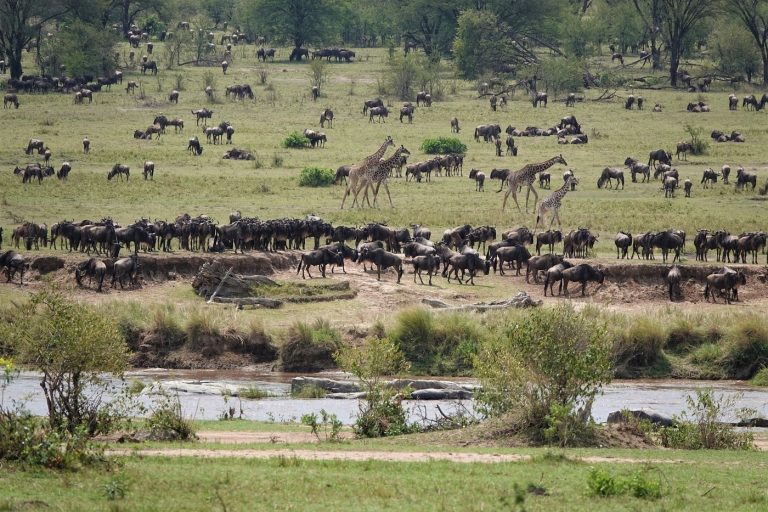
In migration months a good plan mixes two or three river or Triangle nights for crossings with three conservancy nights for quieter cat viewing. For the herds themselves, see our great wildebeest migration page and our Masai Mara safari guide.
Park and Conservancy Fees on a Luxury Mara Safari
Fees are the line most luxury quotes bury, and on a long Mara stay in August they come to over a thousand dollars per person. The Maasai Mara National Reserve is run by Narok County, and its western Triangle by the Mara Conservancy on the same visitor rates. Neither is a Kenya Wildlife Service park. Angama’s own rate sheet repeats the same schedule, per person per day:
| Visitor | Jan to Jun | Jul to Dec |
|---|---|---|
| Non resident adult | US$100 | US$200 |
| Child 9 to 17 | US$50 | US$50 |
| Child 8 and under | Free | Free |
The ticket is valid for 12 hours, from 6am to 6pm, whatever time you enter, and it does not carry overnight. That is the 12 hour rule, and it is why a camp’s arrival afternoon and a reserve day are worth separating on a quote. The higher band runs from 1 July to 31 December, well past the end of the crossing season.
On a conservancy safari the reserve ticket is replaced by a nightly conservancy fee that goes to the Maasai landowners. Kicheche lists US$130 per adult and US$65 per child in its Mara camps; Gamewatchers lists US$130 in the Selenkay Conservancy and US$150 in its other conservancies. Conservancy guests pay the reserve ticket only on days they drive into the reserve itself, often for the river crossings. What the fee buys is practical: capped beds and vehicles, off road driving to sightings, night drives and guided walks, none of which are allowed in the main reserve.
Laikipia and Amboseli carry their own charges. Kicheche Laikipia adds US$187 a night in Ol Pejeta Conservancy fees. Angama Amboseli adds a Kimana conservation levy of US$80 per adult a night. Inside Amboseli National Park, the Kenya Wildlife Service currently lists US$90 per non resident adult for 24 hours; that schedule was challenged in court after it launched, so confirm the rate on the KWS website for your dates. The Mara Triangle admits private four wheel drive vehicles, while Narok County’s side of the reserve does not, though almost no luxury guest drives themselves.
Laikipia, Samburu, Amboseli and Nairobi Luxury Lodge Costs
North of Mount Kenya a luxury safari changes character and price structure. The country is drier and higher, the game is different, and many lodges run walks, rides and conservation visits alongside drives.
A Mara plus Laikipia or Samburu route gives two different sets of wildlife joined by one light aircraft leg, which is why it is the most common shape at this level.
Fly In Safari Costs: Light Aircraft Fares, Charters and the 15 kg Limit
Almost every luxury Kenya safari is a fly in safari, and the flights are a real line on the bill. Scheduled light aircraft leave Nairobi’s Wilson Airport each morning for airstrips across the Mara, Laikipia, Samburu, Amboseli and Meru.
The usual light aircraft limit is 15 kg per person in a soft sided bag, including hand luggage and camera gear, and rigid suitcases are often refused. Trip reports repeat the same tip: leave a suitcase at your Nairobi hotel and fly with one soft duffel. Our guide to the best safari duffel bags covers sizes that fit the hold, and camera gear is often the hardest part to fit, so see our notes on cameras and binoculars for safari.
Scheduled flights hop between airstrips and can stop two or three times, so a 45 minute flight may take longer. Charters suit families or groups flying to a strip with no scheduled service, and helicopters mostly fly scenic trips from Laikipia to Lake Turkana or Mount Kenya; both are quoted on request and priced on top of everything else.
Private Vehicles, Single Supplements and Children on a Luxury Safari
The supplements are where two similar luxury safari quotes split apart, so check each one.
A private vehicle is the upgrade most photographers and families take, since shared camp drives carry other guests, and families with children under seven must book one at both Angama and Kicheche when they take fewer than three suites. Some camps, Serian among them, give every booking a private vehicle as standard.
Luxury Kenya Safari Prices by Season
Season moves a luxury Kenya safari price more than anything except the camp itself, and the camps do not all switch on the same dates. Here are three published rate cards side by side, per person sharing per night.
| Months | Angama Mara | Governors’ | Kicheche Mara North |
|---|---|---|---|
| Jan to Feb | US$1,850 | US$623 | US$730 |
| March | US$1,850 | US$623 | US$625 |
| Apr to May | US$1,850 | US$453 | Closed |
| June | US$1,850 | US$623 | US$625 |
| Jul to Sep | US$2,750 | US$998 | US$995 |
| October | US$1,850 | US$998 | US$995 |
| Nov to mid Dec | US$1,850 | US$623 | US$625 |
| Festive | US$2,750 | US$998 | US$995 |
The Mara ticket adds its own step: US$100 per adult per day to the end of June, US$200 from 1 July to 31 December. So October at Angama is a quiet win, with the standard camp rate but late migration herds often still in the Triangle, while November pairs lower camp rates with the higher ticket.
The best value luxury months are January to March and June: rates below peak, the lower ticket, mostly dry weather and resident lions and cheetahs easy to find. In April and May several camps close, Kicheche’s Mara camps from early April to late May or early June and Porini’s from mid April. Those that stay open run offers: Angama’s stay four, pay three applies across its standard season, Cottar’s calls April, May and November to mid December its private season with much lower rates, and Kicheche takes 10 percent off stays of six nights or more. Honeymooners should ask: Kicheche Valley takes 50 percent off the bride’s stay, 25 percent from July to September.
Rates rise from one year to the next. Angama’s published rates for next season split into three bands of US$1,950, US$2,450 and US$2,950, and Kicheche raised its Mara peak rates by 10 percent this year. Booking far ahead and paying the deposit usually locks the current rate; flagship and river camps for July to October commonly fill twelve to eighteen months out.
Worked Total: Seven Night Mara and Laikipia Luxury Fly In Safari per Person
Here is a whole luxury Kenya safari priced from published rates: two people sharing in August, four nights at Angama Mara over the Triangle for the migration, then three at Kicheche Laikipia in Ol Pejeta for rhinos, flying throughout.
Swap the flagship for a premium conservancy camp and the same week falls by more than a third. Four nights at Kicheche Bush Olare in August cost US$1,095 a night plus US$130 in conservancy fees, or US$4,900, and the reserve tickets drop away unless you drive into the reserve for a crossing day at US$200. With the flights, Laikipia and extras unchanged, the trip comes to about US$9,135 per person. Move the Angama version to June and the camp rate falls to US$1,850 with the stay four, pay three offer, the ticket to US$100 and Kicheche Laikipia to its regular US$570: about US$9,395, almost the same as the Bush Olare week in August.
Travelling alone in August adds 50 percent at Angama, or US$5,500 over four nights, and US$245 a night at Kicheche Laikipia. A dawn balloon flight adds US$450 to US$500, and a private vehicle at Angama US$800 a day in peak. Families should run the numbers both ways, since a private house or a family suite can beat two tents.
Hidden Costs on a Luxury Kenya Safari: Tips, Visas, Balloons and Extras
Even at the all inclusive end, a few costs sit outside the rate on a luxury safari trip.
Health costs such as malaria tablets and any vaccinations your doctor recommends are paid before you leave, along with a yellow fever certificate if you arrive from a risk country. Carry clean, recent US dollar notes for tips, since old or torn notes are often refused.
Booking a Luxury Kenya Safari and Reading the Quote
A luxury Kenya safari is booked through a Kenyan ground operator, an overseas specialist that uses one, or sometimes direct with a camp group such as Angama, Cottar’s or Kicheche. Booking direct with a camp is often cheapest for a single property; an operator earns its margin by joining the flights, transfers and camps into one trip and handling problems on the ground. Either way, choose a company licensed by Kenya’s Tourism Regulatory Authority and ideally a member of KATO, the Kenya Association of Tour Operators.
Which company is best depends on what you want, not on a ranking. Look for licensing, named camps on every night, a clear cancellation policy and an operator that answers detailed questions quickly. Our list of the best Kenya safari companies is a good place to start.
Adding Gorilla Trekking or the Coast to a Luxury Kenya Safari: The Cost
The most popular extension to a luxury Kenya safari is a gorilla trek. Kenya has no gorillas, but a flight to Kigali or Entebbe puts you near Volcanoes National Park in Rwanda or Bwindi Impenetrable National Park in Uganda. A Uganda permit costs US$800 for foreign non residents, US$700 for foreign residents and UGX 300,000 for East Africans, with US$600 and US$500 rates in April, May and November that are paid in full at booking and cannot be rescheduled; the gorilla habituation experience sells at US$1,500, with US$1,800 announced. Rwanda charges US$1,500, or US$1,050 from November to May on the RDB offer with two nights in Nyungwe or Akagera.
Our luxury Rwanda gorilla safari and luxury gorilla safari in Uganda pages lay out routes and lodges, luxury gorilla trekking in Rwanda and Uganda compares the two, and our gorilla permits guide explains booking. Timing lines up well: July to October is migration season in the Mara and the long dry season for trekking. Secure the permit first, since it is the item most likely to sell out, then build the Kenya leg around it.
The coast is the other common finish. Diani and Watamu have beach villas and boutique hotels, and Lamu’s old town is a UNESCO World Heritage Site with small luxury houses; some operators finish in the Seychelles or Zanzibar instead. Couples often combine bush and beach; see our honeymoon in Africa guide, or our Serengeti safari page for the Tanzanian side of the migration. Our guide to the best African safari countries compares the top options across the region.
Luxury Kenya Safari Cost FAQ
How much does a luxury safari cost in Kenya?
On published rates, about US$625 to US$1,100 per person a night at premium conservancy camps such as Kicheche, plus a conservancy fee of about US$130, and US$1,850 to US$2,750 at flagship lodges such as Angama Mara. A seven night fly in trip with flights, fees and tips comes to about US$9,100 to US$16,100 per person sharing in August, before international flights.
What is the most luxurious African safari?
At the very top, a private conservancy or flagship lodge with a private vehicle and guide, flown between camps. In Kenya that means camps such as Angama Mara, Mahali Mzuri, Cottar’s and the Laikipia private houses. Botswana and Rwanda sit higher still on average; our Botswana luxury safari cost and Tanzania luxury safari cost pages compare them.
What is the 12 hour rule for Masai Mara?
A reserve ticket runs from 6am to 6pm on the day you enter, whatever time you arrive, and does not carry overnight. Each day inside costs US$100 per adult from January to June and US$200 from July to December, so a late afternoon entry pays a full day.
What is the best safari company in Kenya?
There is no single best. Choose a company licensed by the Tourism Regulatory Authority, ideally a KATO member, that names every camp, itemises fees and flights and answers detailed questions fast. Compare three on the same trip; our Kenya safari companies list helps.
How much is a Masai Mara luxury safari package?
Porini Lion Camp’s two night fly in package costs US$1,930 per person sharing in June and November and US$2,800 from July to September with flights and fees. Four nights at Angama Mara in August with reserve tickets, the foundation contribution and return flights from Wilson cost about US$12,300 per person.
Are park fees included in luxury camp rates?
Conservancy fees often are not: Kicheche and the Porini offers list them separately, and Angama and Governors’ exclude the Mara reserve ticket. Ask for every fee as its own line.
Should I stay in a conservancy or inside the Mara reserve?
Stay on the river or above the Triangle if crossings are the priority. Choose a conservancy for quieter sightings, walking and night drives. In migration months many luxury itineraries split the stay between the two.
When is the best time for a luxury safari in Kenya?
July to October for the migration, if you book twelve to eighteen months ahead. For value, January to March and June bring dry weather, lower camp rates and the US$100 Mara ticket.
Do I need a private vehicle on a luxury safari?
Not always. Shared conservancy drives rarely feel crowded, but photographers and families with young children usually find the US$350 to US$800 a day worth it, and some camps require one for families with under sevens.
Is a luxury Kenya safari worth it over a mid range trip?
For most people the big gain is the conservancy, not the thread count: fewer vehicles, walks, night drives and a better guide. If the budget is tight, spend it on conservancy nights in the Mara and keep the rest mid range.
What luggage and clothing should I bring?
One soft duffel within the 15 kg light aircraft limit, neutral layers, a warm fleece for dawn drives, a wide brimmed hat and good binoculars. Most luxury camps include laundry, so pack less than you think. Our what to wear on safari guide has the details.
Is Kenya safe for a luxury safari?
The safari areas are well run and camps are guarded at night. Take normal city precautions in Nairobi, follow camp rules after dark, take malaria advice from your doctor and carry insurance with evacuation cover.
Will I see the Big Five on a luxury Kenya safari?
Lions, elephants and buffalo are very likely in the Mara. Leopards are seen on many trips, though never guaranteed. Rhinos are hard in the Mara; Lewa, Ol Pejeta and Solio give far better odds, which is one reason the Mara plus Laikipia route works.
What a Luxury Kenya Safari Is Like Day to Day
The day follows the light. Early tea in the tent, a dawn drive in a cold open vehicle, then a long breakfast or a picnic on the plains. Midday is for the pool, a sleep or a walk with a Maasai guide where the conservancy allows it. The afternoon drive runs to a sundowner, a gin and tonic on the tailgate in the traditional version, and in a conservancy the evening can continue with a night drive by spotlight for aardvark, genet and hunting lions.
Kenya was where the modern safari started, and its guiding is strong. On the best trips the guide reads the country rather than following radio calls, and at a luxury camp you will usually keep the same guide for your stay. Activities widen the further north you go: horse and camel rides in Laikipia, mountain biking, fishing, scenic flights, visits to rhino and community projects, and a private morning at the Sheldrick elephant orphanage in Nairobi on some operators’ trips.
Getting to Kenya for a Luxury Safari and How Long to Stay
Almost every safari starts at Jomo Kenyatta International Airport in Nairobi, with nonstop flights from New York on Kenya Airways and many connections through Europe and the Gulf. Light aircraft to the camps leave from Wilson Airport across the city, so allow a night in Nairobi if your international flight lands late. Three nights in one camp is the minimum most luxury camps suggest; Cottar’s recommends at least three. A first luxury safari usually runs seven to ten nights across two or three areas, and Kenya pairs easily with Tanzania by air for a longer trip.