The right great migration safari package depends on your travel month: calving packages at Ndutu from about December to March, green season and Grumeti packages from April to June, river crossing packages in the northern Serengeti or the Masai Mara from July to October, and return migration trips in November. Most travellers book through a licensed Arusha or Nairobi operator, six to twelve months ahead for peak weeks. The herds circle one ecosystem shared by Tanzania and Kenya, so the package changes with the calendar.
This page is for travellers who know roughly when they can go and want to know which package to ask for: where it should base you, how many nights, whether to drive or fly, group or private, what it costs and what the quote must show. The herd movements get one line each here, because our great wildebeest migration guide covers them in depth. We are an independent guide and do not sell trips.

Great Migration Safari Packages Month by Month
Match your month to a migration safari package with this table. Herd positions show the usual pattern, and rain can move everything two to four weeks either way.
| Month | Herds usually | Package base | Nights |
|---|---|---|---|
| January | Ndutu plains | Ndutu camps | 3 to 4 |
| February | Calving peak | Ndutu camps | 3 to 4 |
| March | South plains | Ndutu, Seronera | 3 |
| April | Moru, Seronera | Seronera lodge | 3 |
| May | Central, west | Seronera, west | 3 |
| June | Western Corridor | Grumeti area | 3 |
| July | Grumeti, north | Kogatende, Mara | 3 to 4 |
| August | Mara River | Kogatende, Mara | 4 |
| September | Mara River | Kogatende, Mara | 4 |
| October | North, Lobo | Kogatende, Lobo | 3 to 4 |
| November | East, Lobo | Lobo, Seronera | 3 |
| December | Heading south | Ndutu, Seronera | 3 |
“Nights” means nights in the right part of the park, not the length of the trip. A package that drives in from Arusha spends a day each way plus a stop at the crater or Tarangire, so three nights near the herds usually sits inside a six to eight day itinerary.
Quiet months help the budget. April, May and November carry the lowest lodge rates of the year, while January, July and October give most of the peak season action with fewer vehicles than February or August.
Calving Season Safari Packages: December to March
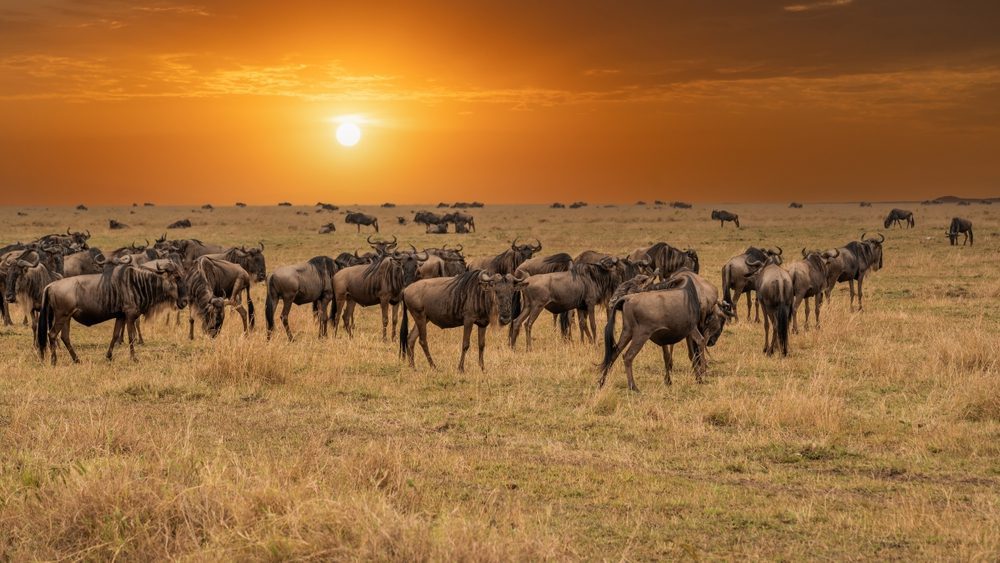
A calving season safari package bases you at Ndutu and the southern Serengeti plains. After the short rains the herds graze the short grass there and drop most of their calves within a few weeks, usually peaking in February. Predators follow, and because lions and hyenas hold territories rather than trailing the herds, the resident prides around Lake Ndutu and Lake Masek feast while the herds are in. Cheetah hunt on the open plains.
The classic version runs six to eight days by road: Arusha, Tarangire or Lake Manyara, a night on the Ngorongoro rim or in Karatu, three or four nights at Ndutu, then the crater floor on the way out. Ndutu lies inside the Ngorongoro Conservation Area rather than the national park, so a calving package pays Ngorongoro fees for those nights. A shorter fly in version lands at the Ndutu airstrip and spends every day on the plains.
Where you sleep is the big decision. Permanent lodges such as Ndutu Safari Lodge and Lake Masek Tented Camp sit in the calving area. Seasonal mobile camps set up nearby from about December to March and move away with the herds. Off road driving has traditionally been allowed on the Ndutu plains, which lets a guide reach a birth or a hunt; ask your operator to confirm the current rule.
Two things catch people out. Afternoon storms are common and tracks turn to black cotton mud, so a day can lose an hour or two. And if the plains dry early, the herds can drift toward Kusini or the Gol area for a few weeks, so a guide based within reach of both is worth requesting. February camps near Ndutu book out early, often nine to twelve months ahead.
Green Season and Grumeti Migration Safari Packages: April to June
A green season migration safari in April and May follows the herds north past the Moru Kopjes toward Seronera and the Western Corridor. Columns of wildebeest walking nose to tail for kilometres are common in May, and the rut fills the nights with grunting bulls.
These are the cheapest migration months, and the packages change shape. Many mobile camps close for the long rains, so trips lean on permanent lodges around Seronera, whose resident lions and leopards hold up whatever the herds do. A five or six day road trip with three Seronera nights is the usual plan. Expect rain most afternoons and some slow, muddy tracks. People who go in May tend to come back pleased; people who expected August scenes in April do not.
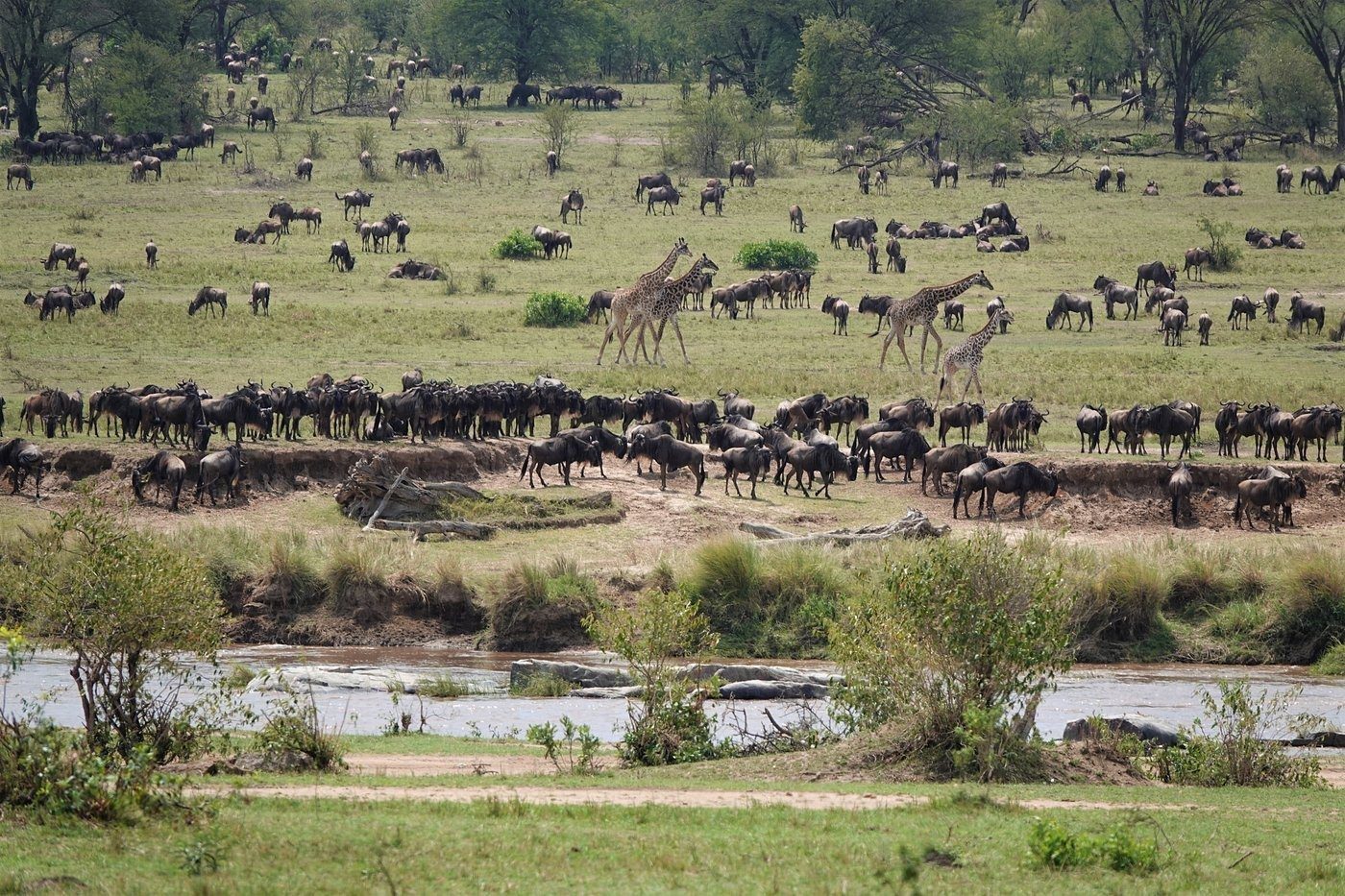
June brings the Grumeti river crossing safari. The herds bunch in the Western Corridor and cross the Grumeti, a chain of channels and pools rather than one fast river, so crossings come in pulses and look less dramatic than at the Mara, with far fewer vehicles watching. Packages base you near the river at camps such as Kirawira or in the private Grumeti concession to the north, where walks and night drives are allowed. Several camps that spent the calving season at Ndutu reopen here from about May. Pack neutral clothes: tsetse flies in the corridor go for dark blue and black.
River Crossing Safari Packages: July to October, Serengeti and Masai Mara
A river crossing safari package is what most people mean by a migration trip. From July to October the herds work through the northern Serengeti and into Kenya’s Masai Mara, crossing the Mara River again and again, sometimes the same herd twice in a week. Fees on the Kenyan side are broken down in our Kenya safari cost guide.
On the Tanzania side, packages base you at Kogatende or in the Lamai Wedge, where crossing points sit a short drive from camp and traffic is far lighter than in Kenya. It is a long way from Arusha, so most northern Serengeti packages fly at least one way. A common shape drives in through Tarangire and the crater, spends two nights at Seronera, then three or four in the north before a flight back to Arusha. Our Tanzania safari guide covers Tarangire, the crater and the southern parks.
On the Kenya side, a Masai Mara migration safari is shorter and simpler. The reserve is a 45 minute flight or a five to six hour drive from Nairobi, and three day fly in packages from Wilson Airport are common. Lion density is high all year. The catch is crowding: at the busiest crossing points near Lookout Hill, many vehicles line up as a herd starts down the bank. The Mara Triangle on the west bank tends to be calmer, and private conservancies cap vehicles, though the crossings happen inside the reserve. Rangers enforce rules at the river: vehicles hold back from the bank until a crossing is under way, and drivers who block a herd face fines.
Nobody can promise a crossing. Herds gather, look ready, then walk away, and some days bring none. Trip reports include people who arrived just after a crossing because their guide was slow to move, and others who found the herds still short of the river in early August. Plan four nights near the river, take packed lunches and expect to wait for hours. Even without a crossing, the plains in these months are full of game.
Book early. Camps near the crossings fill nine to twelve months ahead for August, and the best mobile camps go first.
Return Migration Safari Packages: November
When the short rains break, the herds leave the north and walk south along the eastern Serengeti, through Lobo and the Loliondo area. A November migration safari is the least predictable month, because the herds split and move fast, but it is quiet and lodge rates drop.
Packages base you at Lobo or in the eastern Serengeti around Namiri Plains, known for cheetah, with Seronera as a backup. A six or seven day road package with a loose route lets your guide follow the herds. By December the leading groups are usually back near Ndutu, and the first calves arrive with the new year. Christmas and New Year carry festive supplements and minimum stays, so the first half of December is better value.
Migration Safari Camps by Season: Mobile Camps, Lodges and Luxury Tented Camps
The camp decides more of a migration safari than any other line in the package, because a camp two hours from the herds spends the best light on the road. Three kinds of base turn up in quotes.
Mixing the kinds is normal. A river crossing package might spend two nights in a Seronera lodge on the way north and three in a mobile camp near Kogatende. Small luxury camps with only six to twelve tents fill fastest, and for July to September some travellers book them twelve months or more ahead. Our safari lodges section covers properties across the region, and the Serengeti safari guide sets out the park’s sectors.
Drive, Fly or Both: How Migration Safari Packages Are Built
Migration packages differ most in how they move you between the herds and the airport. Four shapes cover nearly every quote.
Scheduled fly in packages hop between airstrips on shared light aircraft. Private flying safaris charter a plane for your group, which fixes your own timings and suits families or photographers with heavy kit, at a much higher cost. Either way, bush flights hold you to about 15 kg per person in a soft bag; some airlines sell an extra seat to raise the allowance, and a few group tour companies negotiate a larger limit for their guests. Our safari duffel bag guide covers what fits.
Package length follows. A 5 day Tanzania safari can catch calving or the central Serengeti in season. An 8 day safari or a 9 day safari leaves room for the north, and the 9 day itinerary sets out calving and river crossing versions. A 10 day safari gives four Serengeti nights split across two areas, the surest way to stay near the herds if they arrive late.
Departure city matters too. Most Tanzania packages start from Arusha or Kilimanjaro airport; a few start in Mwanza on Lake Victoria, closer to the Western Corridor, or fly straight from Zanzibar, and some end in Mwanza to save the long drive back. Kenya packages start in Nairobi.
Group Tour, Private or Tailor Made Migration Safari Packages
Beyond the route, a migration safari tour comes in three formats, and the choice changes the trip as much as the camp does.
Shared budget safaris. Arusha and Nairobi operators run camping or simple lodge trips that fill seats in a pop roof van or Land Cruiser with strangers, often up to six or seven guests. They are the cheapest way to see the herds. The trade off sits at the river: the group decides how long to wait, and someone always wants to leave.
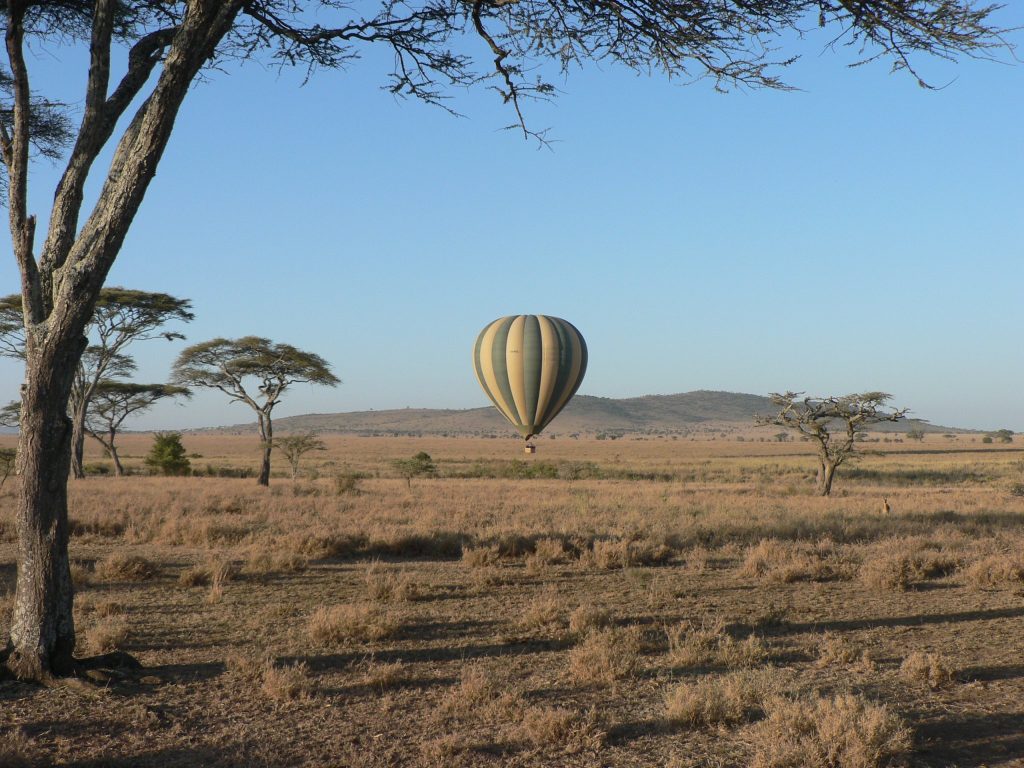
Set departure group tours. Large tour companies, many based in the United States and Europe, sell fixed dates with a tour leader, flights between parks and a group of around twelve to eighteen guests split across several vehicles. Expect window seats guaranteed for everyone, open top or pop roof vehicles with six seats or fewer, a balloon flight and a Maasai village visit built in, and booking terms with a deposit, a final payment due a few months before departure and cancellation fees that rise as the date nears. Some will sell a whole departure privately to a family or group of friends.
Private and tailor made safaris. Your own vehicle and guide, with camps and route chosen around your dates and interests. This is the format that lets you stay at the river all day, move camps if the herds are late and add conservancy walks or night drives. It costs more per person for couples, and the gap narrows as the group grows, because the vehicle and guide are shared across more people.
For photographers, a private vehicle or a photographic package with fewer guests and charging points on board makes the biggest difference. Families gain from a private vehicle too, since children set the pace. Many conservancy stays also return money to the Maasai landowners through lease fees, which is worth asking about whichever format you pick.
Migration Safari Package Prices by Season and Tier
Migration safari package prices follow three things: the camp’s distance from the herds, the month, and whether you drive or fly. Published rates on the site’s cost guides, which come from park authorities, airlines, lodges and operators, give these ranges per person sharing.
| Tanzania tier | Per person | Basis |
|---|---|---|
| Camping | US$220 to 460 | Per day, fees in |
| Mid range lodge | US$340 to 515 | Per day, fees in |
| Luxury camp | US$520 to 3,500+ | Per night |
A 7 day northern circuit comes to about US$2,401 to US$3,585 per person as a private mid range trip and US$2,680 to US$4,460 on the camping trips priced on our Tanzania safari cost guide, before visas, tips and international flights. At the top end, Singita Sasakwa in the Grumeti concession publishes US$2,550 to US$3,525 per adult per night, with park and concession fees on top.
On the Kenya side, a three day shared road safari to the Mara costs about US$370 to US$600 per person from January to June and US$570 to US$970 from July, park fees included. A two night fly in conservancy package with Wilson flights runs about US$2,800 from July to September. River camp nights at Governors’ Camp are listed at US$998 from July to October against US$453 in April and May, which shows how hard season moves the price. Our Masai Mara safari cost guide breaks those down.
Fees shift with the months as well. The Mara reserve ticket doubles from US$100 to US$200 per adult per day on 1 July. In the Serengeti, a night inside from July to September carries about US$130 in park fees before VAT. Ndutu nights pay the Ngorongoro authority’s US$70.80 per adult per 24 hours, and each crater descent costs US$295 per vehicle. Flights add up too: about US$343 plus US$32 in taxes from Arusha to Ndutu for calving, and US$355 plus US$33 to the northern airstrip for the crossings.
To pay less, move the dates rather than the camp: the same package in May or November costs far less, and January or October keeps most of the action. The Serengeti safari cost page has the full park fee tables.
What a Migration Safari Package Quote Should Include
Migration quotes hide more variation than ordinary safari package quotes, because the price depends on where each camp sits relative to the herds in your dates. Ask every operator the same questions.
Packages advertised for every month on an identical route deserve a second look. A good migration package moves its Serengeti nights with the calendar.
Paperwork belongs in the plan too. Your passport should be valid for at least six months beyond travel with two blank pages. Tanzania requires its government inbound travel insurance on top of your own medical and evacuation cover, Kenya requires an eTA before you board, and a yellow fever certificate is needed if you arrive from a risk country. Balloon operators set minimum ages and passenger weight limits, so check them before a family booking. Buy cancellation cover when you pay the deposit, since peak season deposits are rarely refundable.
Kenya, Tanzania or a Cross Border Migration Safari
The herds spend roughly nine months of the year in Tanzania and about three to four, from July to October, partly in Kenya. So a Tanzania migration safari works in any month, while a Kenya package is a July to October product.
Kenya wins on speed and price for short trips: Nairobi to the Mara is quick, three or four day packages are easy, and the reserve’s big cats are reliable. Tanzania’s northern Serengeti gives quieter crossings, and its packages can add calving, the crater and Tarangire. Our Masai Mara safari guide and Serengeti safari guide cover each side, and the best time to visit Tanzania guide sets out the weather month by month.
A cross border migration safari of ten to fourteen days combines both. There is no tourist crossing inside the ecosystem: the Bologonja and Sand River route between the Serengeti and the Mara has been closed for decades. Vehicles cannot cross either, so packages either fly via Nairobi and Kilimanjaro, fly between Serengeti airstrips and a western Kenya airport such as Kisumu to clear immigration, or drive to the Isebania and Sirari border post with a change of vehicle and guide. Flying is far quicker. You need a Tanzania visa and a Kenya eTA, plus a yellow fever certificate if you have been in a risk country.
The Serengeti and Mara are not the only option. Zambia’s Liuwa Plain has a smaller wildebeest migration, best from about late November into December, for travellers who want the spectacle without the vehicles.
Adding Gorilla Trekking or the Beach to a Migration Safari
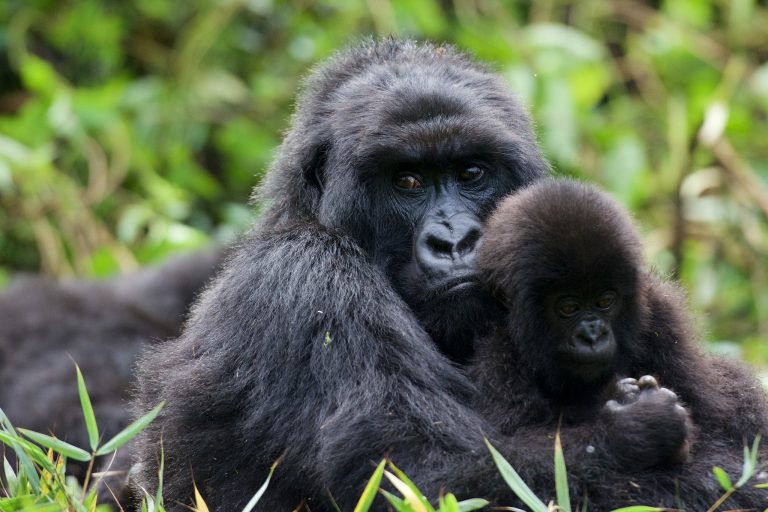
Many travellers pair a migration safari package with gorilla trekking in Bwindi. Flights via Entebbe or Kigali link the Serengeti or the Mara with Uganda and Rwanda in a day, and three or four days covers one trek. June to September suits both, since it is dry season for gorillas and river crossing season in the north. Our Tanzania safari and gorilla trekking guide sets out routes, the gorilla and Masai Mara safari plan covers the Kenya version, and the gorilla permits page explains booking; Rwanda options sit in the Rwanda gorilla trekking guide. Zanzibar is a short flight from the Serengeti airstrips, which is how the 15 day safari and Zanzibar holiday ends. For broader package choices, see our guide to Tanzania safari packages, and for kit, the binoculars for safari and safari duffel bag guides. For other regions, our guide to Africa’s top safari countries covers the alternatives.
Great Migration Safari Packages FAQ
How much does a great migration safari package cost?
On published rates, Tanzania trips run about US$220 to US$460 per person per day camping and US$340 to US$515 at mid range lodges, park fees included, with luxury camp nights from about US$520 to past US$3,500. A 7 day northern circuit comes to about US$2,400 to US$4,460 per person before visas, tips and flights, and an eight day river crossing package that flies out of the north to roughly US$3,320 to US$4,760 at mid range. Three day Masai Mara road safaris cost about US$570 to US$970 from July. Fixed date luxury group tours sold by large US operators are priced from about US$12,000 to US$16,500 per person. These are market prices, not fixed ones.
Which park fees change with the migration months?
In the Masai Mara, adult non residents pay US$100 per day from January to June and US$200 from July to December. Serengeti entry for non resident adults is US$70 before VAT, or US$82.60 in the high season and US$70.80 from mid March to mid May with VAT, and the overnight concession is highest from July to September. Ndutu stays pay the Ngorongoro authority’s US$70.80 per adult per 24 hours, and a crater descent costs US$295 per vehicle. Our Serengeti safari cost and Masai Mara safari cost pages carry the full tables.
What do flights and a balloon add to a migration package?
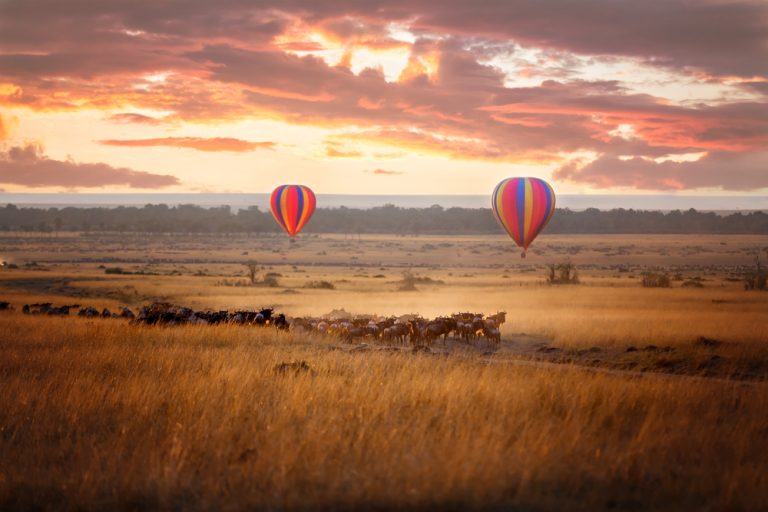
Light aircraft from Arusha to Serengeti airstrips cost about US$343 to US$355 one way plus about US$33 in taxes, and Wilson Airport to the Mara about US$224 to US$320 a leg. A shared Serengeti balloon flight is published at US$599 per person, plus a TANAPA balloon fee of about US$50 if not included, and a Mara balloon at about US$450 to US$500. The Tanzania visa is US$50 for most nationalities and US$100 for US citizens, the government inbound travel insurance is US$44, and the Kenya eTA is US$30.
What is the best month for a migration safari package?
For river crossings, August and September, with July and October quieter. For calving and predators, February. For the lowest rates and fewest vehicles, May or November. There is no bad month, only the wrong area for the month.
How many days does a migration safari need?
Plan at least three nights near the herds, four for river crossings. By road from Arusha that means six to eight days in total; a fly in package can do it in four or five, and a Masai Mara trip from Nairobi in three or four.
Is a river crossing guaranteed on a migration safari?
No. Crossings depend on rain and on the herds. Four nights near the Mara River and long mornings at the crossing points give the best odds, and the north is full of game even on days without one.
How far ahead should I book a migration safari package?
Nine to twelve months for August, September and February, when the best camps near the herds fill first, and longer for small luxury camps. Three to six months is usually enough for April, May and November.
Mobile camp or permanent lodge for the migration?
Mobile camps move two or three times a year to stay near the herds, which saves driving. Lodges have pools, more space and lower rates, but in some weeks the herds are two hours away. Many packages mix the two.
Is a group tour or a private migration safari better?
A shared or set departure group tour costs less and suits solo travellers. A private safari lets you wait at the river as long as you like and change plans if the herds are late, which matters most in the crossing months.
Can children join a migration safari?
Yes, though long drives are hard on young children and some camps and balloon operators set minimum ages. A fly in package or a lodge base with a pool helps. Our family safari in Africa guide has more.
What should I pack for a migration safari?
Neutral layers, a warm fleece for dawn drives, a hat, sunscreen, binoculars and a camera with a zoom lens, all in a soft bag of about 15 kg if any leg flies. Add a light rain jacket from November to May and a dust cover for your camera in the dry months. See what to wear on safari.