A luxury safari in Tanzania costs about US$480 to US$800 per person per day on a local Arusha operator’s luxury package, roughly US$1,400 to US$1,500 a day when the trip is built from top camps’ own rack rates, and US$2,210 to US$3,525 a night at Singita’s private reserve lodges before fees. Most travellers book through a licensed operator who holds the camp rooms and bush flights. The Serengeti, the Ngorongoro Crater and the reserves beside them set the price.
Spending this much and still not knowing whether a quote is fair is an uncomfortable place to be. This page takes the luxury safari Tanzania cost apart line by line: operator package prices, camp and lodge rack rates, park and crater fees, bush flights, the private guide, the season and the extras. Every figure comes from a park authority, an airline, a lodge’s own rate sheet or an operator’s own price page. For budget and mid range tiers, the Tanzania safari cost guide sets them side by side, and the Serengeti safari cost page goes deeper on that one park. We are an independent guide and do not sell safaris.

Luxury Tanzania Safari Cost per Person per Day and per Trip
Start with what operators actually charge for a finished luxury Tanzania safari package, because that is the number you will compare. The table uses each company’s own published price per person, two sharing, divided by the number of days.
| Trip | Days | Per person | Per day |
|---|---|---|---|
| ZK luxury loop | 3 | US$1,950 | US$650 |
| ZK fly back | 5 | US$3,950 | US$790 |
| ZK river crossing | 8 | US$4,850 | US$606 |
| Blessing Silver | 8 | US$3,830 | US$479 |
| Blessing Platinum | 8 | US$5,121 | US$640 |
| Blessing sky safari | 10 | US$7,730 | US$773 |
| Micato, June to Oct | 10 | US$22,850 | US$2,285 |
The Arusha operators sit in one band. ZK Tanzania lists its private luxury routes per person sharing, from US$1,950 for three days through Tarangire Treetops, Lake Manyara and the Melia lodge on the crater rim, to US$4,850 for eight days reaching the Mara River in the north. Blessing Safaris prices its eight day migration safari in three lodge grades, and its Platinum grade includes park fees, taxes and transfers but leaves out tips, drinks and laundry. Its ten day sky safari, which uses the Serena lodges at the crater and in the Serengeti, comes to US$7,730 each for two. ZK’s page lists prices per person sharing without a full inclusion list, so ask it to confirm fees and VAT in writing.
Micato is a different product. Its 10 day Tanzania Spectacular costs US$20,950 per person in November and January to May, US$22,850 from June to October and US$23,850 in December, with internal flights of US$950 to US$1,150 on top. That price includes every tip, house wine and beer, daily laundry, a safari director, park fees and transfers, which the local packages leave out. Even so, the gap is wide, and some of the same lodges appear on both price lists.
Short trips cost more per day because the fixed costs of airport transfers, the Arusha night and the flight out are spread over fewer days. Ask for every quote as a per day figure and a total, so a five day and an eight day trip can be compared fairly.
Luxury Safari Lodge and Tented Camp Rates in Tanzania by Area
The camp rate is the largest line on any luxury safari bill. Lemala, which runs camps and lodges across the northern circuit, publishes a full rate card, so it shows how the price changes with area and season better than any brochure.
| Lemala property | Low | Mid | High |
|---|---|---|---|
| Hamerkop, Arusha | US$250 | US$352 | US$484 |
| Mpingo Ridge | US$585 | US$869 | US$1,458 |
| Osonjoi, crater | US$691 | US$1,051 | US$1,886 |
| Nanyukie, east | US$585 | US$853 | US$1,480 |
| Kuria Hills, north | US$520 | US$902 | US$1,496 |
| Ewanjan, central | US$305 | US$427 | US$595 |
| Mara camp, north | US$330 | US$560 | US$825 |
Rates are per person sharing per night, full board with house drinks, WiFi and laundry. They exclude government levies, airstrip transfers and, the line people miss, a professional safari guide and vehicle. High season at most of these runs from June or July to the end of September plus 20 December to 5 January, and for most of them the low rate applies from March to May. Ndutu Tented Camp, placed for the calving herds, charges US$825 from 20 December to the end of March.
Read across the rows and two tiers appear. The tented camps, Ewanjan and the Mara camp, cost about US$300 to US$825. The lodges with suites and pools, Mpingo Ridge in Tarangire, Nanyukie and Kuria Hills, cost two to three times as much at the same moment of the year.
Gibbs Farm in the Ngorongoro highlands publishes its own rack sheet: US$518 per person full board in the green season, US$624 in the shoulder months and US$683 from June to August and over Christmas. Its rates include 18 percent VAT and a 5 percent service charge but exclude a 1 percent government tourism levy. Families can take a whole farmhouse at US$2,213 to US$3,060 a night for up to four people.
Three kinds of luxury safari accommodation turn up in quotes. Large lodges such as the Four Seasons Safari Lodge in the central Serengeti and the big crater rim hotels have stone buildings, spas and fifty rooms or more; neither publishes a rate we could check, so ask for them by name. Permanent tented camps, with canvas walls on raised decks, flush toilets and ten to twenty tents, are the backbone of the luxury tier. Mobile camps move two or three times a year to stay near the wildebeest, and TANAPA charges guests at these seasonal camps TZS 153,300 per adult per night in the 1 July to 30 September high season, the same as a lodge concession. They are plainer than permanent camps, often with bucket showers and solar lighting, yet trip reports rarely mention missing the pool.
Solo travellers pay more everywhere. Gibbs Farm’s single supplement is 50 percent of the nightly rate; Micato adds a fixed US$3,150 to US$3,550 to its 10 day price. The best luxury African safari tours guide compares Tanzania’s top camps with Kenya, Botswana and South Africa if the country is still open. For every budget, our African safari cost guide compares the countries side by side.

Private Reserve Safari Prices: Singita Grumeti and the Serengeti Edges
The steepest jump in a Tanzania luxury safari price comes when you leave the national park for a private reserve. The Grumeti concession on the western corridor shares the Serengeti’s wildlife and runs under its own rules, and Singita publishes the rates for its three lodges there.
| Singita lodge | Off peak | Shoulder | Peak |
|---|---|---|---|
| Sasakwa | US$2,550 | US$3,160 | US$3,525 |
| Faru Faru | US$2,210 | US$2,795 | US$3,220 |
| Sabora tented | US$2,210 | US$2,795 | US$3,220 |
These are per adult per night sharing, tax included. Peak runs from 16 May to 30 September and 15 December to 5 January, shoulder is October, and off peak covers 6 January to 15 May and 1 November to 14 December. Children pay US$1,105 to US$1,763 a night depending on the lodge and season. Sasakwa’s Hillside Suite costs US$6,925 to US$9,720 per suite, and its four bedroom cottage US$14,025 to US$19,388 a night for up to eight people.
The rate covers all meals, premium wines and spirits, laundry, WiFi, twice daily game drives in open vehicles and road transfers from the Sasakwa airstrip. It excludes the wildlife fee, park fee, concession fee, tourism development levy and a carbon offset levy, none of which Singita prints on its rate page, so ask the operator to show them as separate lines. South of the Serengeti, Mwiba Lodge sits in a large private wildlife area of its own; we could not find a published rate, so get it in writing.
What a reserve sells is control. Guest numbers are capped, a sighting may be yours alone, and night drives, guided walks and driving off the track to a sighting are routine. In the national parks those activities are limited and charged separately: TANAPA lists night game drives at TZS 127,750 per adult, about US$50, in Tarangire, Lake Manyara, Nyerere and Ruaha, with no Serengeti rate on its tariff. The trade is mobility. A reserve covers one slice of the ecosystem and the herds pass through for only part of the year, so many trips split the stay: a reserve for privacy and walking, then a park camp for the migration month.
Park, Concession and Crater Fees on a Luxury Tanzania Safari
Government fees are the one line nobody can discount, and on a luxury trip they are a small share of the bill. Tanzania National Parks (TANAPA) charges a conservation fee per person for every 24 hours in a park and a concession fee for each night at a lodge or camp inside it. Its current tariff, running 1 July to 30 June, lists non resident fees in Tanzanian shillings.
| Park | Adult entry | Concession | About US$ |
|---|---|---|---|
| Serengeti | TZS 178,850 | TZS 153,300 | US$70 / US$60 |
| Nyerere | TZS 178,850 | TZS 153,300 | US$70 / US$60 |
| Tarangire | TZS 127,750 | TZS 102,200 | US$50 / US$40 |
| Lake Manyara | TZS 127,750 | TZS 102,200 | US$50 / US$40 |
| Ruaha | TZS 76,650 | TZS 76,650 | US$30 / US$30 |
The shilling figures equal the old dollar tariff at 2,555 shillings to the dollar. That old tariff was quoted before 18 percent VAT, which is why many quotes still show US$82.60 a day for the Serengeti, so ask whether VAT sits on top for your dates. The Serengeti and Nyerere concession shown is the 1 July to 30 September rate, and the adult entry rates apply from 16 May to 14 March. From 15 March to 15 May, Serengeti and Nyerere entry drops to US$70.80 with VAT. Children aged 5 to 15 pay TZS 51,100 in the Serengeti.
The Ngorongoro Conservation Area Authority prices in dollars: US$70.80 per adult per 24 hours, US$59 concession per night at rim lodges and permanent camps, and a US$295 crater service fee per vehicle for each descent. A couple in a private vehicle pays US$147.50 each for that descent. Sleeping on the rim adds a concession and usually a second entry, which is why many luxury routes sleep at Gibbs Farm in Karatu, outside the conservation area, and drive up at dawn.
On the seven night week worked through further down, government fees come to about US$710 to US$890 per person, around 7 percent of the total. On a budget camping trip the same kind of fees come close to half the price. That is why a luxury quote barely moves when park fees change and moves a great deal when you swap one camp for another.
Fly In Luxury Safari Costs: Bush Flights, Charters and Bag Limits
Most luxury safaris in Tanzania fly at least one leg. Coastal Aviation’s own schedule and price list gives fares per adult before taxes.
Flying looks expensive until you set it against a night. The US$277 flight from Seronera back to Arusha replaces a seven or eight hour drive, and the day it saves is worth more than the fare when a Serengeti lodge costs US$1,480 a night. On Micato’s 10 day trip the internal flights add a flat US$950 to US$1,150 per person.
Bush flights allow 15 kg per person in soft bags, which rules out hard suitcases; Coastal sells an XL seat with 30 kg when the aircraft has room. Our safari duffel bag guide covers bags that meet the limit. A private charter removes the timetable and the stops at other strips, and it is priced per aircraft on request, so it gets cheaper per head as the party grows. We found no published charter or helicopter fare to quote, so treat any figure in a quote as the operator’s own and compare two. Each camp on a fly in trip uses its own guides, so you start over every two or three nights, and some travellers find the early flights every few days tiring.
Private Guide and Vehicle Costs on a Luxury Tanzania Safari
A private guided safari keeps one guide and one Land Cruiser with you from Arusha to the last camp, and it is the line many camp rates leave out. Lemala’s rates exclude the guide and vehicle; Singita’s include game drives in shared open vehicles, with a private vehicle only in its Hillside Suite and four bedroom cottage.
Gibbs Farm’s rate sheet gives a rare published price for a private vehicle with driver guide, per vehicle of up to seven, park fees extra: US$447 for a full day crater safari with picnic lunch, US$424 for a Kilimanjaro airport transfer, US$395 from Arusha airport and US$930 for the run to the central Serengeti. Use the US$447 day as a fair marker when an operator itemises the vehicle.
Group size moves the per person price because the vehicle is priced per day. Blessing Safaris’ eight day Platinum migration trip costs US$7,290 for one traveller, US$5,121 each for two, US$4,972 for three and US$4,480 for four or more. Its Silver grade drops from US$5,690 solo to US$3,160 for four. A solo traveller pays roughly 40 to 80 percent more than each member of a full vehicle.
Travellers who have done both often say the guide mattered more than the tent. Spending on a private vehicle and a senior guide before upgrading to the largest suite is the usual advice from repeat visitors. The two models mix well: drive with a private guide through Tarangire and the crater, then fly to a camp in the north whose own guides take over. Photographers can ask for a vehicle with fewer seats and camera mounts, and families often book one so young children can set the pace; the family safari in Africa guide covers minimum ages at camps.
Luxury Safari Season Pricing in Tanzania: Peak, Shoulder and Green Season
Season moves a luxury safari price far more than it moves a budget trip, because camp rates swing harder than fees.
| Rate per person | Lowest | Middle | Peak |
|---|---|---|---|
| Kuria Hills night | US$520 | US$902 | US$1,496 |
| Mpingo Ridge night | US$585 | US$869 | US$1,458 |
| Sasakwa night | US$2,550 | US$3,160 | US$3,525 |
| Gibbs Farm night | US$518 | US$624 | US$683 |
| Micato 10 days | US$20,950 | US$22,850 | US$23,850 |
Lemala’s peak rates are two and a half to three times its low rates. Singita’s is about 1.4 times, Gibbs Farm’s 1.3 and Micato’s 1.14, so the camps placed for the herds are where the season bites hardest. The herd calendar below explains why.
| Months | Herds | Camps open | Rate level |
|---|---|---|---|
| Jan to Feb | South, calving | Most | High |
| March | South | Most | Shoulder |
| Apr to May | Moving west | Some close | Lowest |
| Jun to Jul | West to north | All | Peak |
| Aug to Oct | North, rivers | All | Peak |
| Nov to Dec | Heading south | Most | Shoulder |
April and May are where luxury becomes good value. Lemala’s low rates apply from March to May, Gibbs Farm’s green season covers April, May and November to mid December, and some camps close for maintenance. Afternoon storms are common, yet resident lions and cheetahs stay in the central and eastern Serengeti and the crater floor still shows rhino on most days.
July to October costs the most because of the northern river crossings, which are never guaranteed, and the camps near Kogatende fill a year ahead. Christmas and New Year carry their own peak: Lemala’s high rate runs 20 December to 5 January, Singita’s peak 15 December to 5 January, and Micato’s December departures are its most expensive. The great migration safari packages by month page matches each month to the right camp area, and the best time to visit Tanzania covers the weather.
What a Luxury Safari Price Includes and the Extras It Leaves Out
Board basis decides how many extras follow you home. Singita is all inclusive, premium drinks and laundry included. Lemala is full board with house drinks and laundry. Gibbs Farm is full board with a local drinks package at US$60 per person and laundry excluded. Micato goes furthest and includes every tip. The local packages above include park fees and meals but leave out drinks, laundry and tips.
Medical evacuation cover matters on a trip this remote, and the government inbound policy is not proper travel insurance; our African safari insurance guide explains what to look for. Carry clean, recent US dollar notes in small denominations for tips, since older or torn notes are often refused.
Worked Example: A 7 Night Luxury Northern Circuit Safari Costed per Person
Here is a luxury Tanzania safari budget for one named trip shape: 7 nights, two people sharing, July, a private guide and Land Cruiser, built from published rack rates. Night 1 is Arusha, nights 2 and 3 Tarangire, night 4 Gibbs Farm with a crater descent the next morning, nights 5 to 7 in the eastern Serengeti, and day 8 a flight from Seronera to Arusha.
Two things stand out. Lodging is three quarters of the bill, so the camp list is where to negotiate. And moving the same week from July to April saves close to US$5,000 per person. An operator buys these rooms at trade rates, so a quote for this route can land at or below the rack total once its margin is added; a quote far above it deserves a line by line explanation. The 8 day Tanzania safari page shows a similar route day by day.
Three Luxury Tanzania Safari Shapes and What Each Costs
Most luxury Tanzania safari tours follow one of three shapes. Compare your quote with the one it most resembles.
Variant 1: Seven night drive and fly northern circuit
Variant 2: Eight night fly in migration safari
Variant 3: Ten nights, safari then beach
A good luxury quote names every camp and its area, states the board basis for each night, lists every park, concession and crater fee with VAT shown, names each flight and its bag limit, says whether the vehicle is private, and lists exclusions such as tips, premium drinks, balloon flights and insurance. The site’s day by day pages show how longer routes fit: the 10 day safari and the 15 day safari and Zanzibar holiday.
Planning this trip? Send your dates, group size and the camps you are weighing through our contact page for free, independent advice on routing and on any quote you hold. To compare licensed operators who book luxury camps, see the Tanzania safari companies list and the best safari companies in Tanzania.
Luxury Safari Extras: Balloon, Walking, Zanzibar and Gorilla Trekking Costs
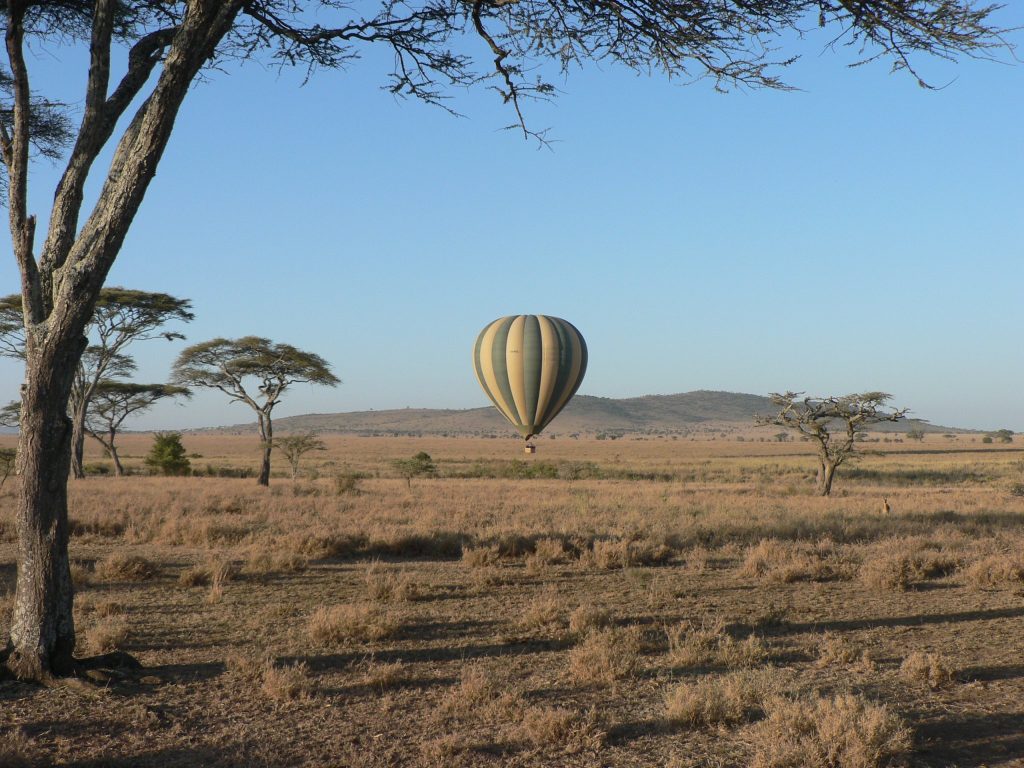
A few extras sit outside even all inclusive rates. The Serengeti balloon safari is the big one: Serengeti Balloon Safaris publishes US$599 per person for about an hour over the plains at dawn and a bush breakfast. TANAPA’s tariff also lists a balloon safari fee of TZS 127,750, about US$50, so ask whether your quote carries it. Book it with the safari in peak months, since the baskets fill.
Walking safaris carry park fees of their own. TANAPA charges TZS 51,100 per adult for a short walk and TZS 63,875 for a long one, plus a ranger fee of TZS 51,100; in the Ngorongoro highlands the NCAA charges US$23.60 for one to four hours or US$29.50 for longer. Visits to the Hadzabe near Lake Eyasi are priced per group, so get the figure in writing. In the south, Nyerere safari tours add boat trips on the Rufiji at TZS 51,100 per adult on the park tariff, and many second time visitors find the southern camps quieter than the north at a similar rate.
Zanzibar is the usual finish, and honeymooners often plan the whole trip around the pairing; the Africa honeymoon safari guide covers bush and beach routes.
Gorilla trekking adds the one thing Tanzania cannot offer. A Uganda gorilla permit costs US$800 for foreign non residents and US$700 for foreign residents, with a low season rate of US$600 and US$500 in April, May and November that cannot be rescheduled and is paid in full at booking. Rwanda’s permit costs US$1,500, or US$1,050 under the RDB 30 percent offer from November to May when booked with nights in Nyungwe or Akagera. Coastal’s code share fare from Kigali to Arusha is US$944 plus US$139 in taxes, so most combinations route through Kilimanjaro on scheduled airlines. Our luxury gorilla safari in Uganda, the luxury Rwanda gorilla safari and the Tanzania safari and gorilla trekking guide show how the two fit. Book the permit first, then build the Serengeti around it.
Booking a Luxury Tanzania Safari: Deposits, Agents and Ways to Pay Less
Luxury money is easy to waste. Squeezing five camps into eight nights is the commonest mistake: every move costs a morning, a flight and a new guide. Two or three nights per camp usually buys a better trip for the same total.
Booking channel matters too. An international agent usually buys from a Tanzanian ground handler and adds its own margin, which can pay for financial protection, a single contact at home and inclusions such as tips and flights. A licensed Arusha operator sells direct, and the price lists above show how far apart the two can sit for similar lodges. Either works. Ask for the camp names before comparing totals.
Deposits are large at this level. Blessing Safaris asks for 40 percent to confirm and the balance 30 days before departure, and trips booked inside that window are paid in full within seven working days. Book nine to twelve months ahead for the crossing months and for February at Ndutu. Pay deposits by card or bank transfer to the company itself, check the cancellation scale, and buy insurance that covers both cancellation and air evacuation.
The plainest savings: travel from March to May, when Lemala’s rates fall by more than half; sleep at Gibbs Farm in Karatu rather than on the rim to avoid the US$59 NCAA concession and a second entry; fill a vehicle, since Blessing’s Platinum price falls from US$5,121 to US$4,480 each at four; and fly one leg rather than drive back.
Luxury Tanzania Safari Cost FAQ
What is the average cost of a luxury safari per night in Tanzania?
At published rack rates, top tented camps and lodges cost about US$520 to US$1,500 per person per night, Lemala’s Kuria Hills runs US$520 to US$1,496, and private reserve lodges cost more: Singita’s Grumeti lodges run US$2,210 to US$3,525. Add park fees, a guide and flights, and a luxury week built from these camps averages roughly US$1,450 a day in July.
How much does it cost for a safari in Tanzania at other levels?
Camping safaris run about US$220 a day and up, and mid range lodge safaris roughly US$340 to US$515 a day with park fees included. The Tanzania safari cost guide compares every tier.
What is included in a 5 day luxury safari in Tanzania?
Typically accommodation, all meals, park and crater fees, a private vehicle and driver guide, airport transfers and drinking water. ZK Tanzania’s 5 day luxury route, from US$3,950 per person sharing, adds a flight back from the Serengeti. Blessing Safaris’ 5 day luxury camping safari costs US$2,980 each for two and excludes tips, laundry, drinks and the US$500 balloon. Confirm whether the bush flight and VAT are inside the price.
What is the best luxury safari in Tanzania?
For a first trip, a seven or eight night route through Tarangire, the crater and a Serengeti camp placed for that month’s herds, with a private guide and one flight. For privacy and walking, add two nights in the Grumeti reserve. For the river crossings, choose a camp near Kogatende from July to October.
Is a luxury Tanzania safari worth it over a mid range trip?
The animals are the same. Luxury buys fewer vehicles at sightings, camps placed where the herds are, better rest and often a better guide. If your budget allows one upgrade, a private vehicle with a strong guide usually beats a bigger room.
Should we choose a private reserve or a national park camp?
A reserve suits travellers who want walks, night drives and very few other vehicles. A park camp suits those chasing the migration in a given month. Many luxury trips use both, two or three nights each.
How far ahead should a luxury safari be booked?
Nine to twelve months for July to October in the northern Serengeti and for February calving at Ndutu, since the small camps have few tents. Green season trips can often be arranged a few months out.
Can children go on a luxury safari in Tanzania?
Yes. Singita charges US$1,105 to US$1,763 per child a night, Gibbs Farm charges US$94 for children aged 6 to 15 sharing and nothing under six, and park entry for children aged 5 to 15 is TZS 51,100 in the Serengeti. Some camps set minimum ages for walks, and balloon flights have age limits.
Is it better to fly in or drive on a luxury safari?
Fly for the northern Serengeti and for short trips; a flight costs US$277 to US$388, less than a night at a top camp. Drive with a private guide if you want one guide throughout and Tarangire and the crater on the way. Many itineraries do both.
Can a luxury Tanzania safari include gorilla trekking?
Yes. Fly from Kilimanjaro to Entebbe or Kigali and spend three or four nights near Bwindi or Volcanoes National Park. The Bwindi gorilla trekking guide and the Uganda gorilla permits page explain the permit side.
Is a Luxury Tanzania Safari Worth the Money?
For most people who choose it, yes, though not for the reasons the brochures give. The lions are the same lions. What changes is how the day runs. A small camp inside the park means the first game drive starts close to your tent rather than an hour away at a lodge outside the gate. A private guide waits at a leopard tree for as long as you like and skips lunch for a crossing when the herds bunch at the bank.
The tiredness is real at any price. Dust, early starts and hours in the vehicle are what trip reports mention most, and luxury softens them without removing them. Some travellers who paid for glamping say a lodge felt too far from the bush around it; others found big lodges every bit as wild. Neither is wrong. The money is well spent when it buys time and quiet, and less well spent when it buys a fourth camp.
Packing and Pace on a Luxury Safari in Tanzania
Packing is lighter than people expect. Camps do laundry daily, so a few neutral layers, a warm fleece for crater mornings and good binoculars for safari do more than a full suitcase, and everything has to fit the 15 kg soft bag. Rim nights from June to August are genuinely cold, and a room with a fire is worth more there than anywhere on the route. The what to wear on safari guide has the rest.
Pace matters as much as the kit. Plan at least one afternoon with nothing in it, keep two or three nights per camp, and let the guide choose the morning start. On the Ngorongoro rim, the Crater Lodge looks straight into the caldera, while The Highlands sits on the slopes of Olmoti with wood stoves for the cold nights; both are reminders that where a camp sits shapes the trip as much as what it costs.