
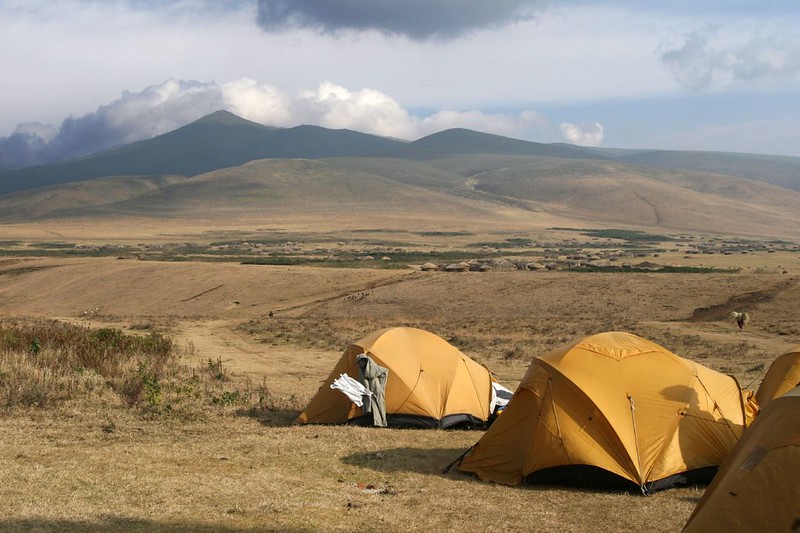
A budget camping safari in Tanzania costs about US$220 to US$250 per person per day on a group departure from Arusha, park and campsite fees included, and about US$320 to US$460 a day each for two travellers on a private camping trip. Most people book a group departure or a private trip with a licensed Arusha operator. You sleep in dome tents at public campsites on the same northern circuit as the lodges: Tarangire, the Serengeti and the Ngorongoro Crater.
Plenty of people pick camping because the lodge quotes made them wince, then worry about what they have signed up for. This guide covers both halves: what a Tanzania camping safari really costs, line by line, and what the nights at Seronera or on the crater rim are like. Every figure comes from the park authorities’ own tariffs or from operators’ own price pages. For every tier side by side, see the Tanzania safari cost guide; for park fees in more depth, the Serengeti safari cost page. We are an independent guide and do not sell safaris.
Tanzania Budget Camping Safari Prices per Person and per Day
A budget camping safari is sold as one price per person covering the vehicle, fuel, driver guide, cook, food, tents, park fees and campsite fees. What moves that price most is how many people share the vehicle. The table uses two licensed Arusha operators’ own published prices.
| Trip | Days | Per person | Per day |
|---|---|---|---|
| ZK group | 4 | US$990 | US$248 |
| ZK group | 5 | US$1,100 | US$220 |
| Blessing, 4 or more | 6 | US$1,480 | US$247 |
| Blessing, 2 people | 5 | US$1,900 | US$380 |
| Blessing, 2 people | 6 | US$1,920 | US$320 |
| Blessing, 2 people | 7 | US$3,200 | US$457 |
| Blessing, solo | 7 | US$4,460 | US$637 |
ZK Tanzania runs group joining camping safaris with a cap of six guests per Land Cruiser: four days through Tarangire, the Serengeti and the crater from US$990, and five days adding Lake Manyara from US$1,100. Both include airport transfers, all park and conservation fees, the crater descent, full board, drinking water and flying doctors cover. ZK’s group lodge trips on similar routes cost US$1,520 for four days and US$1,890 for five, so camping saves roughly US$530 to US$790 per person on the same parks. Our Tanzania safari guide covers those parks in more depth.
Blessing Safaris prices its private camping routes by group size. Its 7 day trip costs US$4,460 for one person, US$3,200 each for two, US$2,700 for three and US$2,680 for four or more, including a night at a hotel in Arusha, airport transfers, all entrance fees and government taxes, camping gear and flying doctors cover. Its 5 day trip runs US$2,900, US$1,900, US$1,680 and US$1,600; its 6 day trip US$2,800, US$1,920, US$1,680 and US$1,480.
Read the table from the bottom up and the pattern is plain. A solo traveller on a private trip pays well over double what each member of a full vehicle pays, which is why group departures exist at all.
Park and Campsite Fees on a Tanzania Camping Safari
Park fees are the floor under every camping safari price, and on a budget trip they are close to half of it. TANAPA, the national parks authority, lists non resident fees in Tanzanian shillings on its current tariff, running 1 July to 30 June; the Ngorongoro Conservation Area Authority (NCAA) prices in US dollars. Park fees elsewhere in Africa are compared in our African safari cost guide.
| Fee | Adult | Child 5 to 15 | About US$ |
|---|---|---|---|
| Serengeti entry | TZS 178,850 | TZS 51,100 | US$70 |
| Tarangire entry | TZS 127,750 | TZS 38,325 | US$50 |
| Park public campsite | TZS 76,650 | TZS 12,775 | US$30 |
| Park special campsite | TZS 153,300 | TZS 12,775 | US$60 |
| Ngorongoro entry | US$70.80 | US$23.60 | US$70.80 |
| Simba public campsite | US$35.40 | US$11.80 | US$35.40 |
| NCAA special campsite | US$70.80 | US$35.40 | US$70.80 |
Entry is charged per 24 hours, and Lake Manyara costs the same as Tarangire. The shilling amounts equal the old dollar tariff at 2,555 shillings to the dollar; that old tariff was quoted before 18 percent VAT, which is why many quotes still show US$35.40 for a park campsite and US$82.60 for a Serengeti day in the high season, or US$70.80 from mid March to mid May, so ask whether VAT sits on top for your dates. The special campsite figure shown is TANAPA’s 1 July to 30 September rate. Under fives enter free.
On top of those comes the crater service fee of US$295 per vehicle for each descent to the Ngorongoro Crater floor, shared by everyone aboard. Six campers pay about US$49 each; a couple on a private trip pays US$147.50 each.
The crew costs almost nothing in fees. TANAPA charges a camping crew entry fee of TZS 1,500 and a crew camping fee of TZS 2,000 for driver guides and cooks, and no concession fee for crew. That is one reason a cook adds so little to the price.
Here is the catch most people miss. A public campsite in the Serengeti costs TZS 76,650 per adult per night, and a lodge concession in Tarangire costs TZS 102,200, so camping inside a park saves less on fees than expected. The real saving is the room rate.
Public, Special and Outside Park Campsites: What Each Costs
Three kinds of site turn up on a budget safari itinerary, and the difference shows in both the price and the night.
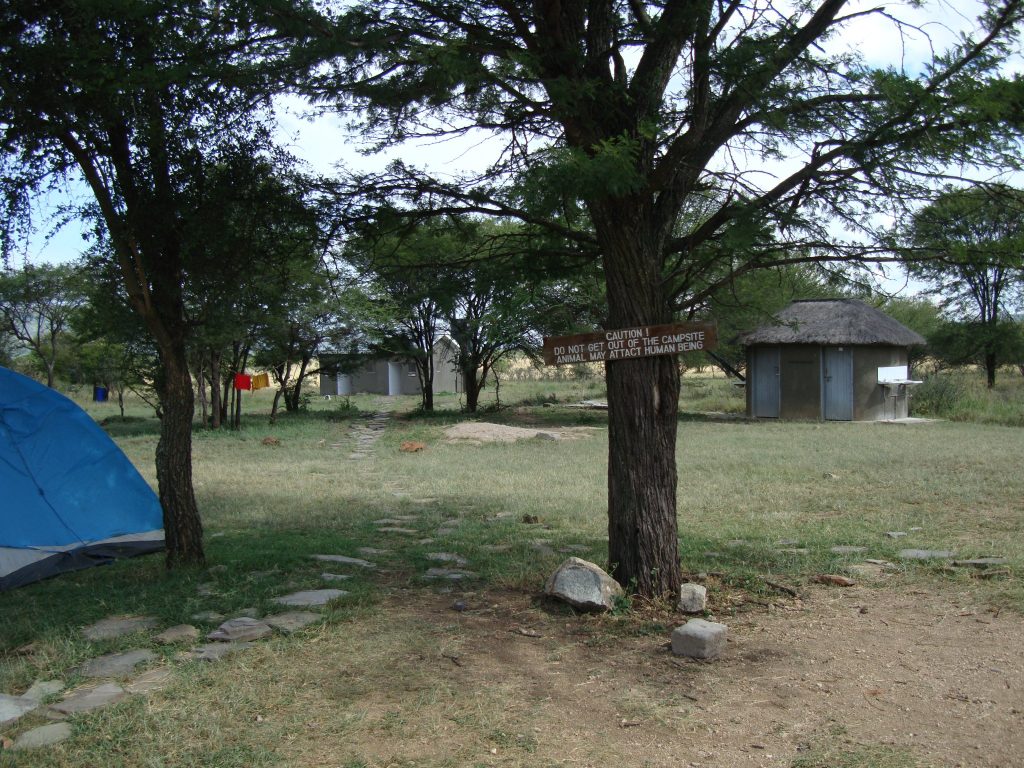
Public campsites inside the parks are what most budget safaris use, at TZS 76,650 per adult per night. In the central Serengeti a cluster of small public sites spreads along the Seronera valley, with names such as Nyani and Pimbi, plus sites near Lobo in the north. Each has a cooking shelter, a dining area and a washblock with toilets and showers. They are unfenced and shared, and in peak weeks reviewers describe well over a hundred campers sharing one washblock.
Simba campsite on the Ngorongoro rim is the famous one, at US$35.40 per adult. It sits at roughly 2,300 metres above the crater, and almost every budget trip that descends to the floor sleeps here the night before. It is crowded in peak months, the washblock queues are long, and buffalo, zebra and the odd elephant wander between the tents after dark. The enclosed dining room is the warmest place on the site.
Special campsites are remote pitches with no facilities, booked in advance through the park authority: TZS 153,300 per adult in the Serengeti, Tarangire and Manyara from July to September, US$70.80 in the Ngorongoro area. They need a full crew with portable toilets and bush showers, and they are the closest a budget traveller gets to a mobile camp. TANAPA also lists fly camping at TZS 127,750 per adult for a night out on a walking route.
Campsites outside the parks in Mto wa Mbu near Lake Manyara, in Karatu below the crater and around Arusha pay no park camping fee and often have hot showers, a bar and sometimes a pool. Twiga campsite in Mto wa Mbu is a common first or last night. The catch is distance: sleeping outside the Serengeti to save fees means hours of driving, and a fresh 24 hour entry fee, to reach the animals.
Group Joining or Private Camping Safari: How Sharing Moves the Price
A group joining safari puts you in a shared Land Cruiser with other travellers on a fixed departure. The vehicle, guide, fuel and crater fee are split, which is what makes it the cheapest option. ZK Tanzania guarantees its departures with no minimum group size and caps each vehicle at six, so every guest has a window and a roof hatch.
The trade is control. The group sets the pace, the route is fixed, and the middle seats on a seven seat vehicle are the ones people complain about after an eight hour day. Ask how many seats are sold per vehicle. Six is fair, seven is tight.
A private camping safari uses the same campsites with your own vehicle, guide and cook. On Blessing’s 7 day route it costs a couple US$3,200 each, falling to US$2,680 each for four or more, which makes it little more for a family of four than a shared trip and often the best value of all for five or six friends. Photographers and families with children tend to prefer it, since you choose when to stop and how long to stay.
Solo travellers save most by joining a group. On Blessing’s 7 day private trip a solo traveller pays US$4,460; on ZK’s shared 5 day departure the same person pays US$1,100.
Budget Camping Safari Routes and Prices: 3 to 7 Days on the Northern Circuit
Most budget camping safari packages are built from the same pieces. These three shapes cover nearly every quote, with the park fees each one carries.
Variant 1: Three days, Tarangire and the crater
Variant 2: Five days with the Serengeti
Variant 3: Seven days, slower and with Lake Manyara
Three days without the Serengeti is a taster, and it is the cheapest honest trip because it skips the highest entry fee and the longest drives. Five days is the shortest trip with real Serengeti time, and seven gives three nights there, which is where a budget trip pays off. Some operators also sell two day camping trips to Tarangire and Lake Manyara or the crater for travellers short on time. The site’s day by day pages cover each length: the 3 day Tanzania safari, the 5 day safari, the 6 day northern circuit and the 7 day safari.
Camping is possible in the south too. Ruaha’s public campsite costs the same TZS 76,650 and its entry is only TZS 76,650 a day, but reaching it means a long road trip or a Coastal flight from Dar es Salaam at US$433 plus US$39, which wipes out the saving for most budget travellers.
Planning this trip? Send your dates, group size and budget through our contact page for free, independent advice on which camping route fits and whether a quote looks fair. To compare licensed Arusha operators, start with our Tanzania safari companies list and the best safari companies in Tanzania.
Worked Example: A 5 Day Group Camping Safari Costed per Person
Here is a realistic Tanzania camping safari budget for one named trip shape: 5 days, a solo traveller on a shared group departure of six, July, Tarangire, two nights camping at Seronera, a night at Simba on the rim, the crater and Lake Manyara. It uses ZK Tanzania’s published group camping price.
The government fees line explains the whole budget market. Fees alone take about US$105 to US$115 a day per person on this route, before fuel, food, crew wages and the vehicle. That leaves an operator very little room, which is why the cheapest quotes deserve the hardest questions.
Camping Safari Season Prices in Tanzania: Dry Months, Calving and Green Season
Season changes how a camping safari feels far more than what it costs. TANAPA charges the same TZS 76,650 public campsite fee all year, and the group camping prices above are published as single year round figures, so camping is the least seasonal way to see Tanzania. The higher special campsite and concession rates apply from 1 July to 30 September.
| Months | Weather | Herds | Camping |
|---|---|---|---|
| Jan to Feb | Short dry | South, calving | Good |
| March | Rains begin | South | Fair |
| Apr to May | Long rains | Moving west | Wet, muddy |
| Jun to Aug | Dry, cold nights | West to north | Busy, cold |
| Sep to Oct | Dry, dusty | North | Good |
| Nov to Dec | Short rains | Heading south | Fair |
June to October is dry and easiest for driving, but it is also when Seronera and Simba are most crowded and the rim is coldest. January and February bring calving on the southern plains, which budget trips reach on long day drives from Seronera since there are few public sites near Ndutu.
April and May are the hardest months to camp. Afternoon storms can soak a tent, black cotton soil turns tracks to glue, and some operators stop running camping departures. TANAPA lists its adult entry rates from 16 May to 14 March, so ask which park rate applies between those dates. If you go then, ask for a lodge night or two in the mix. The best time to visit Tanzania page covers the weather month by month, and the great migration safari packages page shows where the herds sit.
Extra Costs on a Budget Camping Safari: Tips, Visa, Drinks and Balloon
The package covers the safari. A handful of costs sit outside it, and on a budget trip they add up faster than people expect.
Carry clean, recent US dollar notes in small denominations for tips, since older or torn notes are often refused. The government inbound policy is not proper travel cover, and evacuation cover matters this far from a hospital; our guide to African safari insurance explains what to look for.
What a Cheap Camping Safari Quote Should Include and the Price Floor
Cheap quotes save money somewhere. With fees at about US$105 to US$115 a day on a typical route, a shared camping trip priced far below the US$220 to US$250 a day that licensed operators publish has to be cutting the vehicle, the crew or the fees themselves. Line up quotes and check these items in every camping safari quote.
The cheapest budget safari operator is sometimes cheap for a reason. Trip reports return to the same failures: old vehicles that break down on the Serengeti road, a driver who is not a trained guide, a cook missing from the trip, or seven people squeezed into a car for six. Ask for the operator’s Tanzanian tour operator licence and a copy, check whether it belongs to the Tanzania Association of Tour Operators, read recent reviews that name guides and vehicles, and make sure the company on the invoice matches the bank account.
Deposits are normal. Blessing asks for 40 percent to confirm and the balance 30 days before departure. Pay to the company, never to a personal account or by a money transfer app, and avoid touts in Arusha selling a seat on a safari leaving tomorrow at a price far below the rest. Low prices can also mean low wages, so ask how the crew are paid. Self drive camping is possible for experienced overlanders, but a foreign registered vehicle of 2,001 to 3,000 kg pays TZS 383,250 a day in the Serengeti; our self drive safaris in Africa page explains the trade offs. The Tanzania safari packages guide goes further into comparing quotes, and the Ngorongoro Crater safari page explains how the crater descent works.
Adding Zanzibar, Kilimanjaro or Gorilla Trekking to a Budget Safari: Costs
Zanzibar is a short flight from Arusha at US$348 plus US$32 on Coastal’s fare sheet, or US$89 plus US$21 from Dar es Salaam for travellers taking the bus to the coast. The 15 day safari and Zanzibar itinerary shows how the two halves fit.
Many budget travellers come off Kilimanjaro straight onto a camping safari, and the same sleeping bag works for both; see the Kilimanjaro gear list and the Kilimanjaro trekking guide.
Gorilla trekking is the other big add on, and Uganda keeps the cost down. A Uganda gorilla permit costs US$800 for foreign non residents, or US$600 in the April, May and November low season, though low season permits cannot be rescheduled and are paid in full at booking. Rwanda’s permit costs US$1,500. Flights from Kilimanjaro reach Entebbe and Kigali. Our budget gorilla trekking in Uganda guide and the Tanzania safari and gorilla trekking page explain how to combine them.
Budget Camping Safari Tanzania FAQ
How much does a budget camping safari in Tanzania cost?
On operators’ own published prices, about US$990 for 4 days and US$1,100 for 5 days on a shared group departure, and US$1,900 to US$3,200 each for two travellers on a private 5 to 7 day trip, park fees included. Add US$95 to US$145 for visa and insurance and US$15 to US$20 a day in tips.
What are the campsite and park fees on a camping safari?
TANAPA charges TZS 76,650 per adult per night at a public campsite, about US$30, and TZS 178,850 per 24 hours for Serengeti entry. With VAT, Serengeti entry comes to US$82.60 in the high season and US$70.80 from mid March to mid May. The Ngorongoro Conservation Area charges US$70.80 per adult per 24 hours, US$35.40 at Simba campsite and US$295 per vehicle for each crater descent. Ask whether VAT is added on top.
Is camping cheaper than a lodge safari in Tanzania?
Yes. ZK Tanzania’s 4 day group camping trip costs US$990 against US$1,520 for its 4 day group lodge trip, a saving of about US$530 per person on similar parks.
Is a camping safari in Tanzania safe with wild animals around?
Yes, when you follow the guide’s rules: stay in a closed tent after dark, keep food out of it and never wander off alone at night. Public campsites are unfenced and animals do pass through.
How cold is it camping on the Ngorongoro Crater rim?
Cold. Simba campsite is around 2,300 metres, and nights from June to August can fall close to freezing. Bring a warm sleeping bag and layers, even if the days on the plains are hot.
Do I need my own sleeping bag?
Check the quote. Some operators include one, others hire them out, and many travellers prefer their own for hygiene and warmth. A bag rated to around freezing covers every site on the route.
Can a solo traveller join a budget camping safari?
Yes, and it is the cheapest way to travel alone. ZK’s group departures go with no minimum number, so a solo traveller pays the same US$1,100 for 5 days as everyone else, against US$2,900 for Blessing’s private 5 day trip for one.
Can I see the wildebeest migration on a camping safari?
Yes, though public campsites are fixed. From July to October, trips that camp near Lobo reach the northern herds; in calving season, long day drives from Seronera reach the southern plains. River crossings are never guaranteed on any budget.
Life in Camp on a Tanzania Camping Safari: Tents, Food, Showers and Cold Nights
Here is the honest version of a camping safari night. The tent is a standard dome, big enough for two and their bags, on a thin foam mat. Showers at public sites are cold or lukewarm unless the solar or firewood heater has had a good day, and at peak times the hot water runs out by evening, so campers at Simba shower as soon as they arrive. Toilets range from flush to squat, cleanliness depends on the day, and a roll of your own toilet paper saves grief.
Days start early. Breakfast is at first light, the morning drive runs until a packed lunch at a picnic site, and you are back at camp before dark because park rules end game drives around sunset. Dinner is cooked on a gas stove or a fire, usually soup, a stew with rice or potatoes and fruit, and cooks work small wonders on two gas rings. Tell the operator about dietary needs before booking, not on arrival.
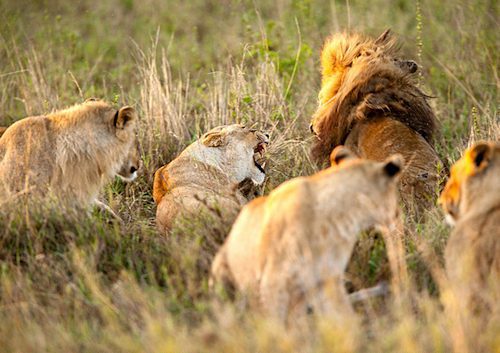
Cold surprises nearly everyone. The crater rim drops close to freezing on clear nights from June to August, and Seronera can be chilly before dawn. Animals come through camp too: hyenas patrol the Seronera sites at night, lions are heard and sometimes seen, and buffalo graze at Simba. Stay in the tent after dark, zip it fully, and call a crew member before walking to the toilet.
Packing for a Tanzania Camping Safari
Pack for cold nights and dust. A three season sleeping bag, a fleece and a warm hat, a head torch for the walk to the washblock, wet wipes, a quick drying towel, flip flops for the showers, a buff for the dust and a soft bag rather than a hard case. Our African safari packing list, the what to wear on safari guide and the insect repellent guide cover the rest. Leave dark blue and black at home, since tsetse flies like them.
For travellers who can live with basic washblocks, early starts and cold nights, camping is the best value way to see the northern parks: the same parks, the same animals, for a fraction of the lodge price. If comfort matters more, a mix of camping in the Serengeti and a lodge night in Karatu is a good middle path.